




























Views
Downloads

Printable Bean Plant Life Cycle Worksheet | Grade 3

Paste this activity's link or code into your existing LMS (Google Classroom, Canvas, Teams, Schoology, Moodle, etc.).
Students can open and work on the activity right away, with no student login required.
You'll still be able to track student progress and results from your teacher account.
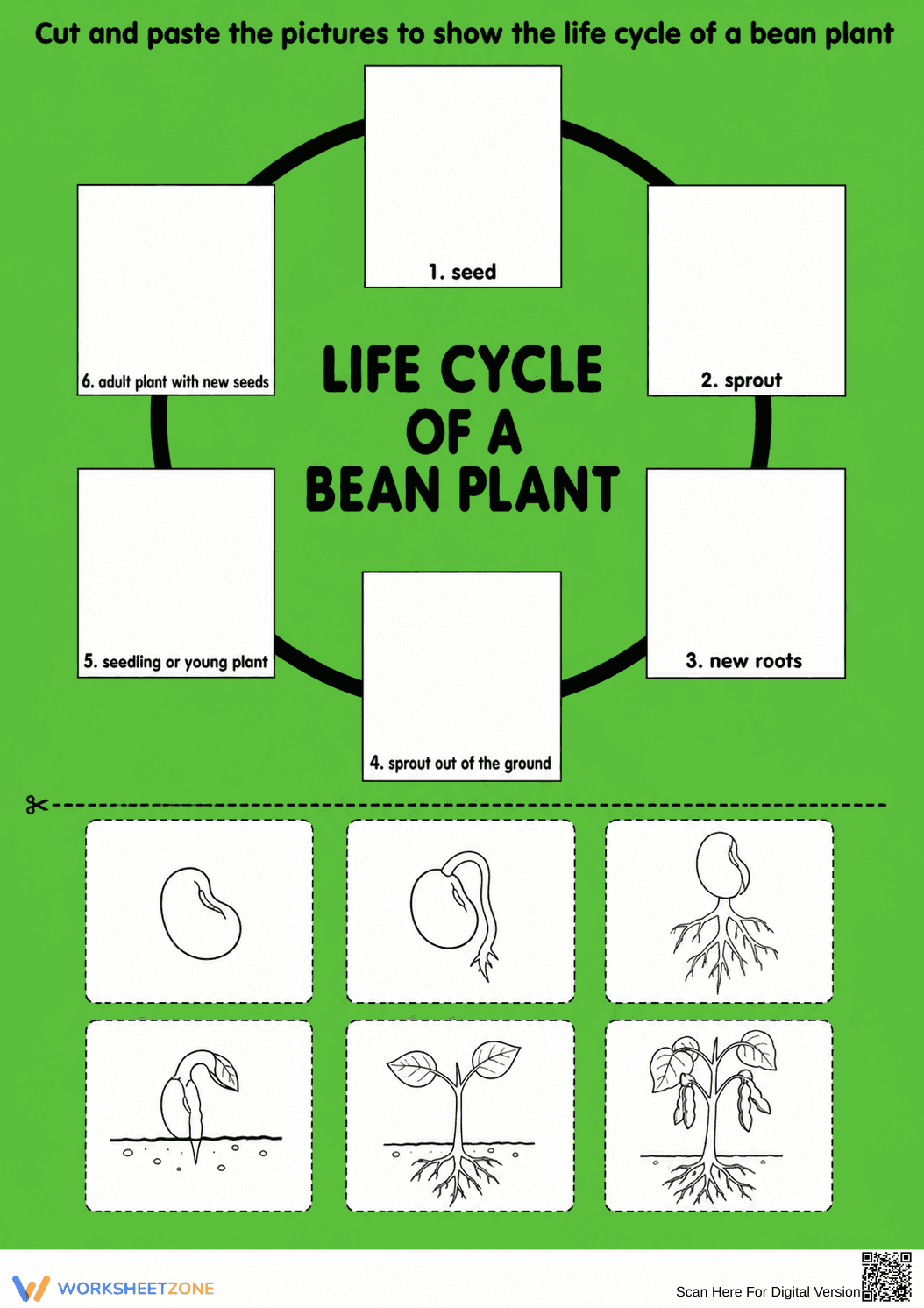
This Grade 3 science worksheet helps students visualize and sequence the life cycle of a bean plant. By cutting and pasting six distinct growth stages into a continuous cycle diagram, learners actively build their understanding of how organisms grow, reproduce, and change over time.
At a Glance
- Grade: 3 · Subject: Science
- Standard:
3-LS1-1— Sequence the stages of an organism's life cycle- Skill Focus: Plant Life Cycles
- Format: 1 page · 6 problems · Answer key included · PDF
- Best For: Independent practice or science centers
- Time: 15–20 minutes
What's Inside
This single-page resource features a clear, circular diagram with six labeled stages: seed, sprout, new roots, sprout out of the ground, seedling, and adult plant. The bottom half of the page provides six corresponding illustrations separated by a dashed cut-line. Students snip out the images and match them to the correct descriptive text in the cycle. A complete answer key is included for quick grading.
Zero-Prep Workflow
- Print (1 minute): Simply print the PDF. No special materials are required beyond standard classroom scissors and glue sticks.
- Distribute (1 minute): Hand out the sheets during your science block or place them in a designated center folder.
- Review (3 minutes): Quickly check student sequences against the provided answer key or have students peer-review their diagrams.
Total teacher prep time is under two minutes, making this an excellent emergency sub plan or quick formative assessment.
Standards Alignment
Aligned to 3-LS1-1, this activity requires students to develop models to describe that organisms have unique and diverse life cycles but all have in common birth, growth, reproduction, and death. By ordering the bean plant's stages, students create a functional model of this biological process. Both standard codes can be copied directly into lesson plans, IEP goals, or district curriculum mapping tools.
How to Use It
Use this worksheet as an independent practice activity after a direct instruction lesson on plant biology. It also works perfectly as a hands-on science center station where students can discuss the sequence with peers before gluing the pieces down. As a formative assessment tip, observe whether students correctly place the "new roots" stage before the "sprout out of the ground" stage to gauge their understanding of subterranean growth. Expected completion time is 15 to 20 minutes.
Who It's For
This resource is designed for third-grade general education students, but its highly visual nature makes it excellent for English Language Learners and students needing modified assignments. The clear illustrations provide strong scaffolding for the vocabulary terms. Pair this activity with a read-aloud about seeds or a live classroom bean-sprouting experiment for maximum impact.
Integrating hands-on sequencing tasks into elementary science instruction significantly reinforces foundational biological concepts for early learners. When students interact with the 3-LS1-1 standard to sequence the stages of an organism's life cycle, they move beyond rote vocabulary memorization into active, functional model creation. According to a recent ScienceDirect TpT Analysis, interactive diagrams that require physical manipulation—such as cutting, sorting, and pasting—measurably improve long-term retention of sequential scientific processes in elementary classrooms. By physically moving the bean plant illustrations from the initial seed stage through to the adult plant, students solidify their internal mental models of growth, development, and reproduction. This tactile engagement directly supports deeper cognitive processing and helps bridge the critical gap between abstract biological terminology and concrete, observable phenomena found in the natural world. Providing these structured, hands-on opportunities ensures that core science standards translate into meaningful, lasting student comprehension.


