


























Views
Downloads

Printable Bean Plant Life Cycle Worksheet | Grade 3
Paste this activity's link or code into your existing LMS (Google Classroom, Canvas, Teams, Schoology, Moodle, etc.).
Students can open and work on the activity right away, with no student login required.
You'll still be able to track student progress and results from your teacher account.
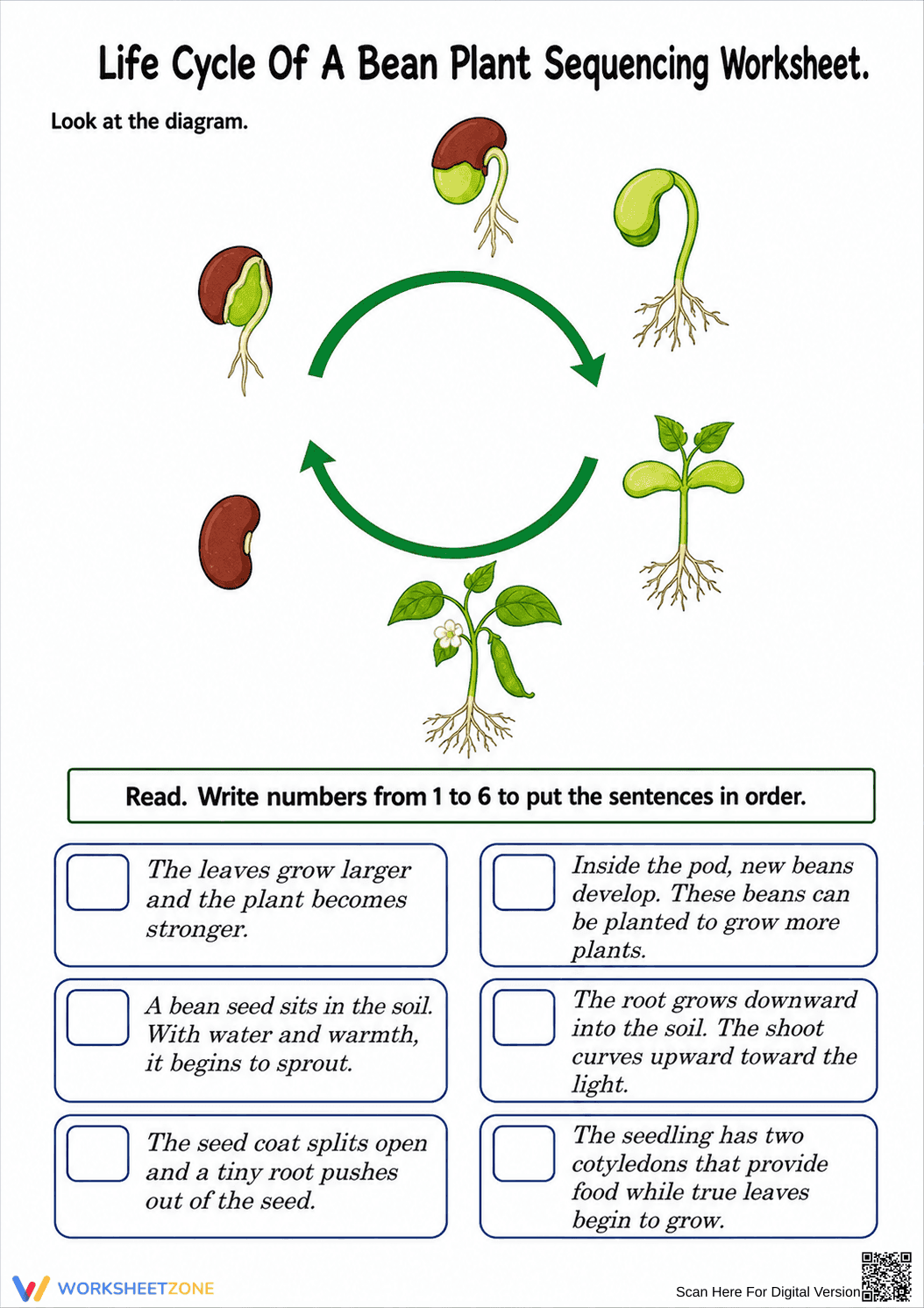
This Grade 3 science worksheet helps students sequence the stages of a bean plant's growth by matching descriptive text to a visual diagram. By analyzing the progression from seed to mature plant, learners build critical reading comprehension and scientific vocabulary while mastering fundamental biological concepts.
At a Glance
- Grade: 3 · Subject: Science
- Standard:
3-LS1-1— Sequence the stages of a plant's life cycle- Skill Focus: Life Cycle Sequencing
- Format: 1 page · 6 problems · Answer key included · PDF
- Best For: Independent practice and review
- Time: 15–20 minutes
This single-page resource features a circular diagram illustrating six stages of a bean plant's development. Below the model, students find six text boxes detailing biological changes, from seed sprouting to pod formation. The activity requires students to read each description and assign it a number from one to six, establishing the correct chronological order. An answer key is provided.
This worksheet offers a streamlined workflow:
- Print (1 minute): Print the single-page PDF for your class.
- Distribute (1 minute): Distribute the activity; no scissors required.
- Review (3 minutes): Go over the correct sequence using the included answer key.
With a total teacher preparation time of under two minutes, this resource is highly effective for unexpected schedule changes or as a reliable component of a substitute teacher plan.
This activity is directly aligned with 3-LS1-1: Develop models to describe that organisms have unique and diverse life cycles but all have in common birth, growth, reproduction, and death. By ordering the text descriptions to match the visual model, students demonstrate their understanding of these continuous biological phases. Both standard codes can be copied directly into lesson plans, IEP goals, or district curriculum mapping tools.
Deploy this worksheet during independent practice after direct instruction on plant biology. It also serves as excellent morning work before a seed germination experiment. As students work through the six problems, observe their ability to connect vocabulary terms like "cotyledons" to visual cues in the diagram. This formative assessment helps identify students needing vocabulary support. Expect completion within 15 to 20 minutes.
This resource is optimized for third-grade general education students, though it functions well for second graders needing visual science activities or fourth graders requiring a fundamental review. To support emerging readers, teachers can pre-highlight key vocabulary words within the text boxes. Pair this sequencing activity with a hands-on bean planting lab or a non-fiction text about plant growth to reinforce the concepts through multiple modalities.
Understanding biological progressions through visual models is a foundational component of early science education. Aligning with 3-LS1-1, this activity requires students to sequence the stages of a plant's life cycle by integrating written descriptions with a circular diagram. According to a ScienceDirect TpT Analysis, instructional materials that combine visual representations with targeted reading tasks significantly improve retention of domain-specific vocabulary in elementary science classrooms. By requiring learners to actively match text detailing germination and growth to specific illustrations, this worksheet reinforces cognitive connections between abstract terms and concrete biological processes. This dual-coding approach ensures that students not only memorize the chronological order of events but also comprehend the functional purpose of each developmental stage, from the initial seed coat splitting to the final pod formation.


