




























Views
Downloads

Grade 3 Bean Life Cycle — Printable No-Prep Worksheet

Paste this activity's link or code into your existing LMS (Google Classroom, Canvas, Teams, Schoology, Moodle, etc.).
Students can open and work on the activity right away, with no student login required.
You'll still be able to track student progress and results from your teacher account.
This printable science worksheet helps students master the stages of a bean plant's growth by combining visual modeling with descriptive writing. Students illustrate and describe each phase of the cycle, reinforcing key botanical vocabulary while demonstrating their understanding of how living organisms grow and change over time.
At a Glance
- Grade: 3 · Subject: Science
- Standard:
3-LS1-1— Develop models describing diverse organism life cycles- Skill Focus: Bean plant life cycle
- Format: 2 pages · 4 problems · No answer key · PDF
- Best For: Independent practice or science centers
- Time: 15–20 minutes
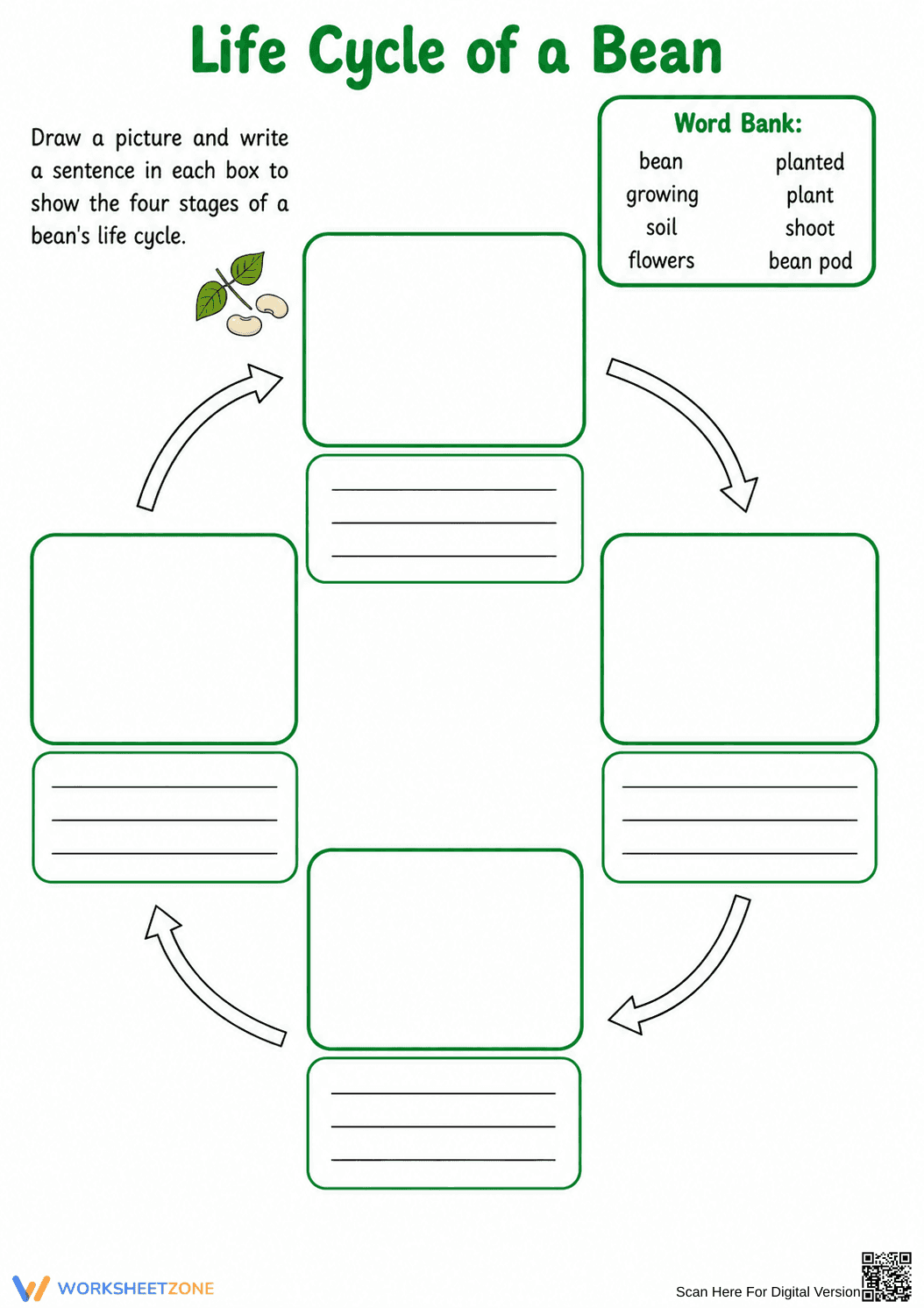
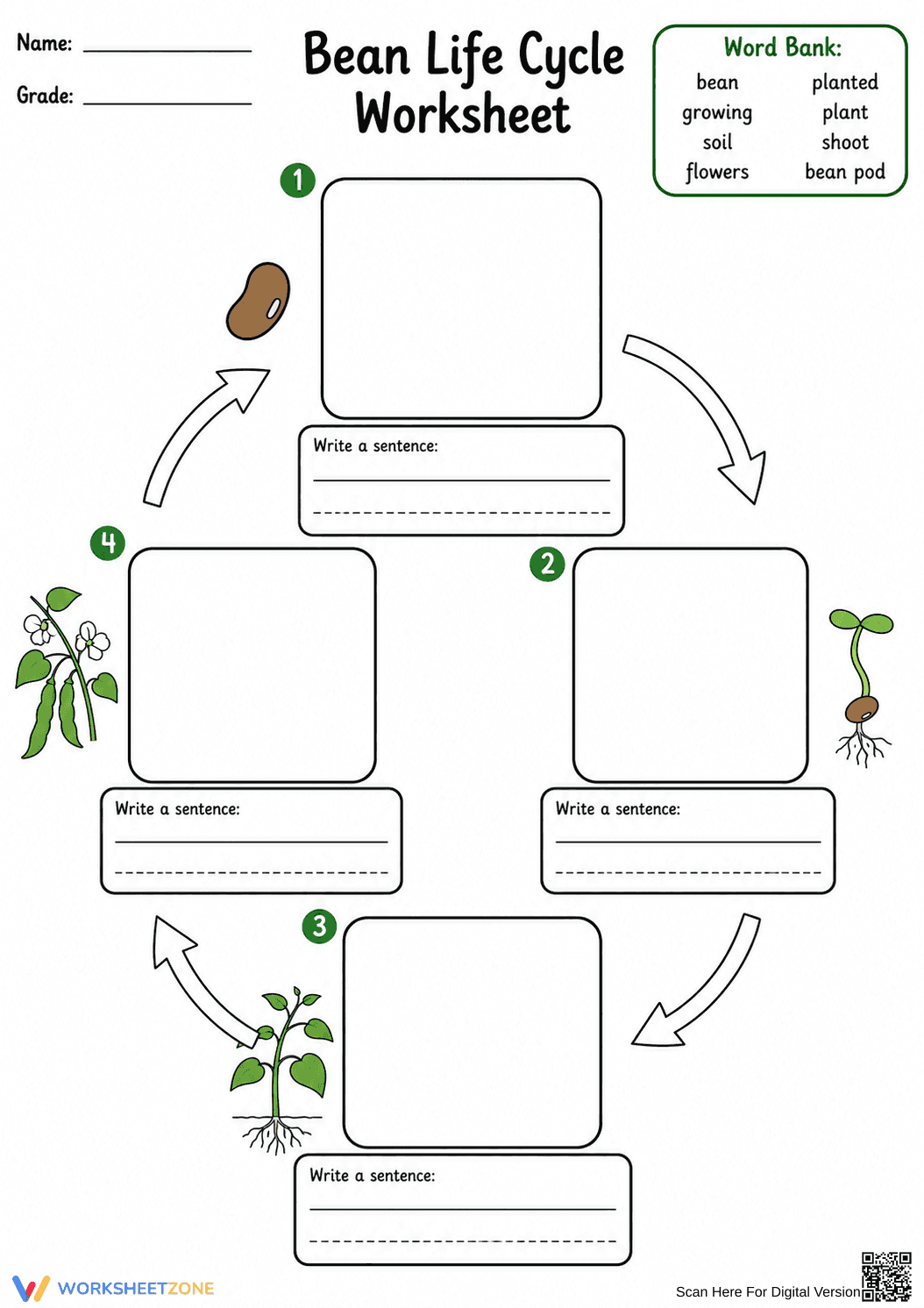
This resource includes two variations of a circular life cycle diagram. The first page provides a blank four-stage cycle where students draw pictures and write sentences using a word bank with terms like "shoot" and "soil." The second page offers a scaffolded version with small illustrations to guide students needing visual cues. Both feature clear writing lines to support neat handwriting.
This resource is designed for immediate classroom implementation with a streamlined workflow:
- Print (1 minute): Select the version and print copies.
- Distribute (1 minute): Hand out worksheets and coloring materials.
- Review (2 minutes): Read the word bank together.
With under two minutes of total teacher prep time, this activity is highly effective for science centers or a substitute teacher plan.
This activity aligns with 3-LS1-1, requiring students to develop models to describe that organisms have unique and diverse life cycles but all have in common birth, growth, reproduction, and death. By drawing and writing about the bean plant, students actively construct a model of this specific biological process. Both standard codes can be copied directly into lesson plans, IEP goals, or district curriculum mapping tools.
Teachers can deploy this worksheet during the core instructional block after reading a text about plant growth. It serves as an excellent independent practice task. For a formative assessment observation tip, check if students correctly sequence the transition from seed to mature plant, and ensure they incorporate vocabulary words from the word bank. Expected completion time ranges from 15 to 20 minutes.
This material is designed for third-grade students, though it functions well for second graders needing enrichment. The inclusion of a word bank and visual cues provides built-in differentiation for English Language Learners. It pairs perfectly with hands-on seed germination experiments or informational anchor charts.
Integrating visual modeling with descriptive writing is a highly effective strategy for solidifying foundational science concepts in elementary classrooms. When students engage with standard 3-LS1-1 to develop models describing diverse organism life cycles, they benefit from multimodal tasks that require both artistic representation and linguistic expression. According to a ScienceDirect TpT Analysis, instructional materials that combine diagramming with targeted vocabulary banks significantly improve student retention of sequential biological processes. By prompting learners to draw the stages of a bean plant and immediately apply terms like "shoot" and "flower" in context, this worksheet bridges the gap between rote memorization and conceptual understanding. Providing structured spaces for these dual representations ensures that students can accurately communicate their scientific knowledge, ultimately fostering deeper engagement with natural phenomena and stronger overall literacy skills.


