


























Views
Downloads

Bean Life Cycle Worksheet | Grade 3 Essential Guide
Paste this activity's link or code into your existing LMS (Google Classroom, Canvas, Teams, Schoology, Moodle, etc.).
Students can open and work on the activity right away, with no student login required.
You'll still be able to track student progress and results from your teacher account.
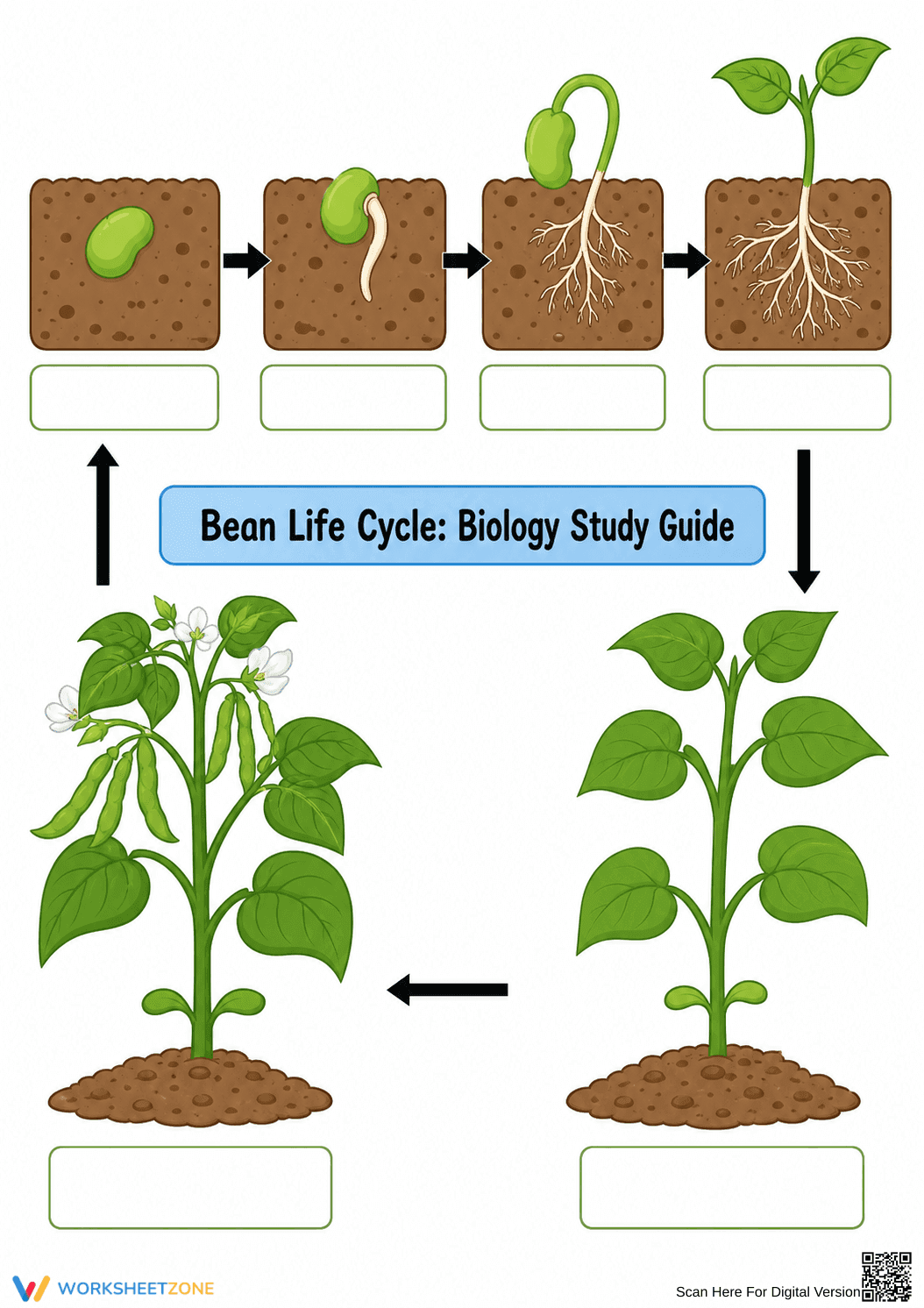
This worksheet provides a clear visual model of the bean plant life cycle, enabling students to identify and sequence the six primary stages of growth. By labeling each phase from seed to mature plant, learners develop a concrete understanding of biological development and reproduction. It serves as an excellent bridge between observation and scientific documentation.
At a Glance
- Grade: 3 · Subject: Science
- Standard:
3-LS1-1— Develop models to describe that organisms have unique and diverse life cycles- Skill Focus: Plant life cycle sequencing
- Format: 1 page · 6 problems · Answer key included · PDF
- Best For: Introduction to botany and plant biology
- Time: 15–20 minutes
This single-page PDF features a high-quality diagram of a bean plant's progression. It includes six distinct illustrations showing the seed, germination, root development, seedling growth, and the final flowering stage with bean pods. Below each illustration is a dedicated text box for students to write the corresponding stage name, encouraging active recall of scientific terminology.
Teachers can implement this resource in under 2 minutes. Simply print the required number of copies (1 minute), distribute them to students as a warm-up or exit ticket (30 seconds), and review the correct sequence using the provided answer key or a classroom projector (5 minutes). It is an ideal zero-prep resource for substitute folders or sudden schedule changes.
The primary standard addressed is `3-LS1-1`, which requires students to develop models to describe that organisms have unique and diverse life cycles but all have in common birth, growth, reproduction, and death. This worksheet serves as a foundational model for plant biology. Both standard codes can be copied directly into lesson plans, IEP goals, or district curriculum mapping tools.
Use this worksheet during the "Explain" phase of a 5E science lesson to solidify vocabulary after a hands-on planting activity. As a formative assessment, observe if students can correctly distinguish between the early germination and seedling stages. Completion typically takes 15 to 20 minutes depending on prior knowledge and writing speed.
This resource is designed for Grade 3 students but is adaptable for Grade 2 or Grade 4 learners. It is particularly effective for visual learners and English Language Learners (ELLs) who benefit from clear pictorial cues. Pair this with a real-time bean planting experiment or a digital time-lapse video of plant growth to provide a multi-sensory learning experience.
According to the RAND AIRS 2024 report on elementary science instruction, visual modeling is a critical component in developing early biological literacy. This worksheet aligns with the 3-LS1-1 standard by providing a structured framework for students to observe the common patterns of growth and reproduction in flowering plants. By engaging with the 6 specific tasks, students move beyond rote memorization toward a conceptual understanding of how organisms change over time. Research from Fisher & Frey (2014) suggests that combining visual aids with labeling tasks significantly improves the retention of scientific vocabulary in primary grades. This printable guide ensures that every student has access to a high-quality, standards-aligned representation of the bean life cycle, making it a reliable tool for both general education and specialized instructional settings.


