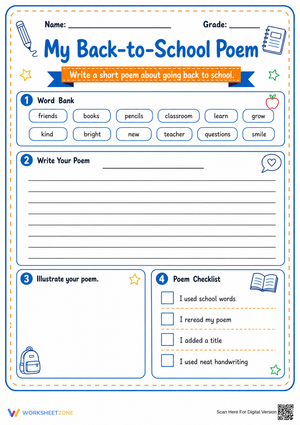
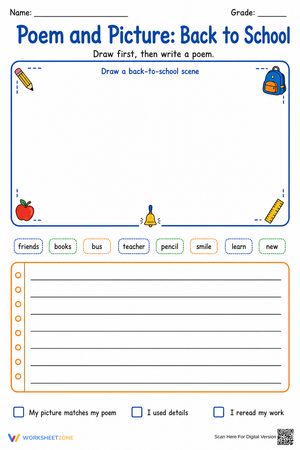
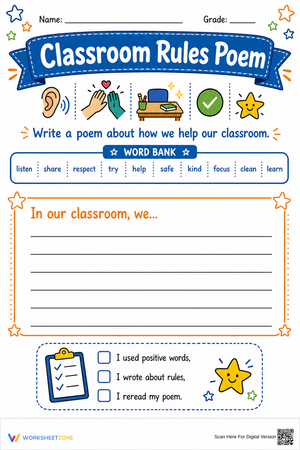
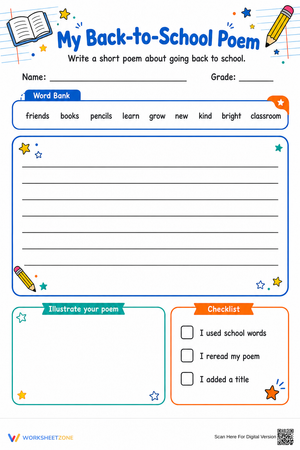
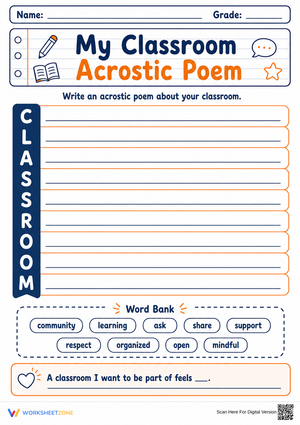
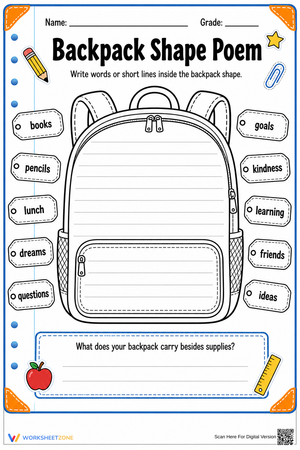
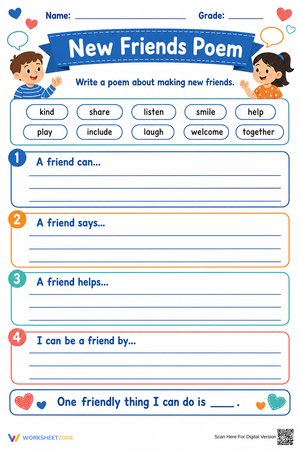
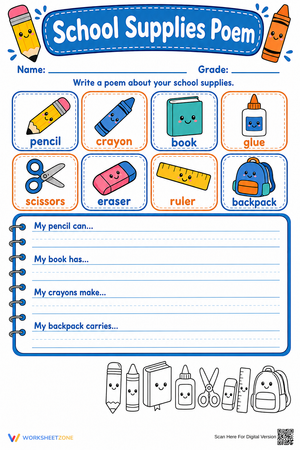
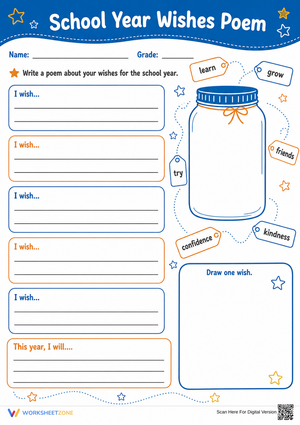
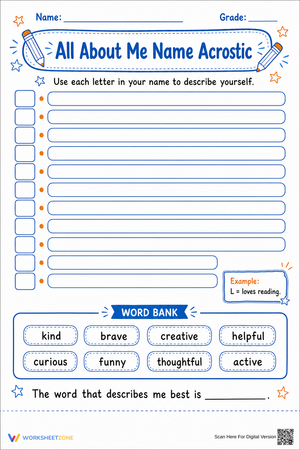
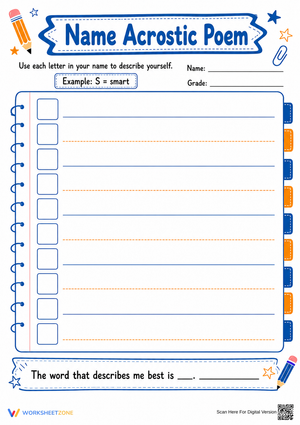
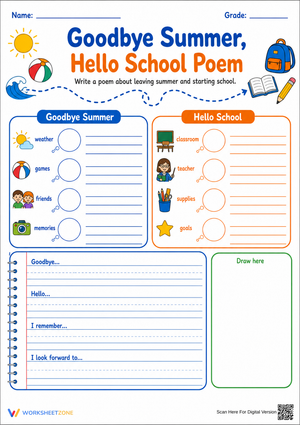
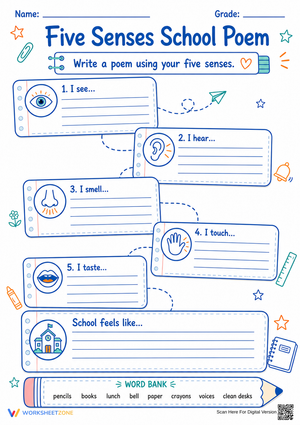
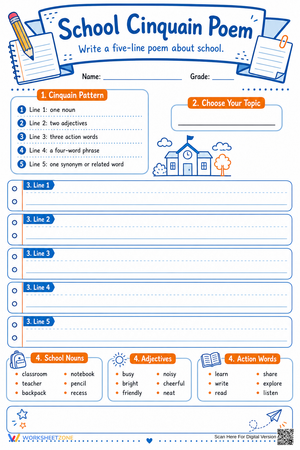
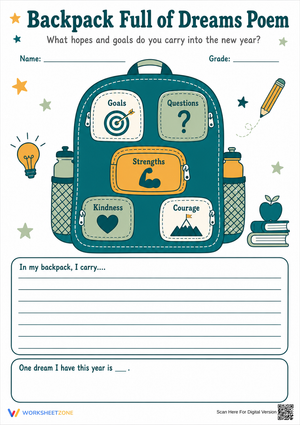
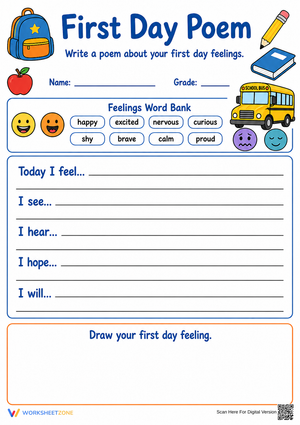
These 3rd grade fiction writing printable worksheets address the single most frustrating gap in third-grade writing instruction: students who can narrate a rich, detailed story aloud but produce three flat sentences when they sit down with a pencil. The set gives teachers ready-to-use organizers for every stage of the fiction writing process — character planning, plot structure, sensory detail, and dialogue — so lesson time goes toward instruction rather than resource building.
What's Inside the Set
Each worksheet targets a specific narrative skill rather than asking students to tackle the whole story at once. Character profile worksheets ask students to name what their protagonist wants, what stands in the way, and how the character feels about that obstacle — not just physical description. A separate plot-structure organizer walks students through exposition, rising action, a single clear climax, and resolution, with explicit space to plan the turning point before drafting begins.
Dialogue worksheets address two distinct sub-skills: choosing vivid speaker verbs (whispered, snapped, insisted) and placing punctuation correctly around spoken text. Sensory detail planning sheets use a five-sense grid tied to the story's main setting, so students collect specific images before drafting rather than stalling mid-sentence to invent details on the fly. A revision checklist organized by narrative element rounds out the set, giving students a consistent framework for evaluating a complete first draft.
When Imagined Detail Replaces Recalled Memory
Second-grade personal narrative draws on memory — students describe something that actually happened, which provides automatic detail. Third-grade fiction demands something harder: students have to construct detail from nothing. That shift is exactly why capable writers in second grade can become evasive or frustrated writers in third grade when the genre changes. The pre-writing organizers in this set slow students down before they draft, a step that reduces cognitive demand during drafting itself. When character traits, plot structure, and sensory images are settled on paper beforehand, students spend their drafting energy on sentence variety and word choice rather than simultaneously inventing and recording a story.
The Errors That Surface in Nearly Every Fiction Draft
The most predictable problem in third-grade fiction is the "and then" chain — a plot that moves forward purely by accumulation with no escalation toward a climax. Students filling in the plot organizer are forced to name the problem and distinguish the turning point from any other middle event, which interrupts that pattern before it becomes a drafting habit.
Dialogue creates its own recurring problems. Students who understand spoken punctuation in isolation will still write He said "come here" without the comma before the quotation mark, or close the quote and capitalize the dialogue tag as though it begins a new sentence: "Let's go." He Said. A worksheet that isolates those two moves — comma placement and tag capitalization — lets teachers use completed exercises as a quick check of who has genuinely internalized the rule versus who applies it only when prompted.
A third pattern worth watching: students who write detailed character profiles during planning but whose characters then behave randomly in the actual draft, as if the planning worksheet and the story existed in separate universes. The revision checklist addresses this directly by asking students to find one moment in their draft where the character's stated trait actually drives a decision.
Building These Worksheets Into Your Instructional Week
The set fits naturally into a writing workshop structure. A ten-minute mini-lesson on a single skill — say, writing a lead that drops the reader into action rather than opening with "One day…" — can be followed immediately by students working through the corresponding organizer before independent drafting begins. That sequence keeps students in a thinking-then-doing rhythm rather than leaving a gap between instruction and application.
The character and plot organizers also work well as Monday entry tasks at the start of a fiction unit, giving students something concrete to produce before they're expected to draft freely. The revision checklist belongs at the end of the drafting cycle — students benefit most from it after a complete first draft exists, not as a tool for stalling before finishing one. Completed planning organizers make strong formative assessment artifacts: a teacher who sees a plot worksheet with no turning point identified knows exactly which conference to hold before that student submits a draft.
Standard Alignment
The set aligns to CCSS.ELA-LITERACY.W.3.3, which requires students to write narratives using effective technique, descriptive details, and clear event sequences. Sub-standard W.3.3a (establishing a situation and introducing characters) maps directly to the character profile and setting worksheets. W.3.3b (using dialogue and description to develop experiences and characters) aligns with the dialogue and sensory detail worksheets. W.3.3d (providing a sense of closure) is addressed in the plot organizer's resolution section. In classroom terms, these 3rd grade fiction writing printable worksheets build the planning and revision skills typically assessed in third-grade narrative writing benchmarks administered in spring.
Adjusting the Set for a Range of Writers
For students who need additional support, the character profile worksheet works best when preceded by a verbal exchange — the student tells a partner about the character, the partner asks follow-up questions, and then writing begins. This oral rehearsal step gives struggling writers something to transcribe rather than invent cold. The plot organizer can also be reduced to three sections (problem, turning point, ending) for students who are not yet ready to manage a five-part story structure.
For students who move through planning quickly, the sensory detail grid offers natural extension: instead of one detail per sense, they return to each row and add a figurative comparison alongside the literal description. The dialogue worksheet's speaker-verb column extends further for writers ready to choose a verb that contradicts what the character is actually saying — a move that opens a conversation about subtext at a level that challenges even the strongest third-grade writers.
Frequently Asked Questions
Do students need to complete the worksheets in a specific order?
The character and setting organizers work best before the plot worksheet, since students need to know who their character is and where the story takes place before they can plan meaningful plot events. The dialogue and sensory detail worksheets can be used in either order or simultaneously during drafting. The revision checklist always comes last — after a complete first draft exists.
How do I handle students who complete the planning worksheet and then ignore it while drafting?
This is one of the most common friction points in fiction writing units. The most direct fix is a brief mid-draft conference where the teacher asks the student to point to one place in the draft where the planning is visible — a character trait showing up in a decision, a sensory image from the grid appearing in a paragraph. Making that connection explicit once usually prompts students to consult their plan more consistently from that point forward. These 3rd grade fiction writing printable worksheets work best placed beside the draft during writing time, not filed away after planning ends.
Are these worksheets suitable for personal narrative as well as fiction?
The character and dialogue worksheets transfer almost directly to personal narrative work — a student writing about a true event still needs to develop real people as characters and punctuate spoken words correctly. The plot-structure organizer is more fiction-specific in its framing, but the underlying structure (problem, escalation, resolution) applies to personal narrative as well. Teachers using the set across both genres typically introduce each worksheet with a brief reframing: "today we're using this same organizer, but your main character is you."
What does a strong set of completed planning worksheets look like at the end of a fiction unit?
A strong planning set shows a character with at least one internal trait beyond physical appearance, a plot organizer with a problem that specifically tests or challenges that trait, at least three sensory details tied to a particular scene rather than generic description, and dialogue that uses at least two different speaker verbs. Students who hit all four of those benchmarks in their planning nearly always produce stronger first drafts than those who rush through the pre-writing stage. These 3rd grade fiction writing printable worksheets give teachers a concrete reference point for pre-draft planning conferences.












 Interactive Worksheet Maker
 Quiz Maker
 Word Search Maker
 Crossword Puzzle Maker
 Word Scramble Generator
 Sentence Scramble Generator
 Handwriting Worksheet Generator
 Name Tracing Generator
 Fill In The Blank Generator