


























Views
Downloads
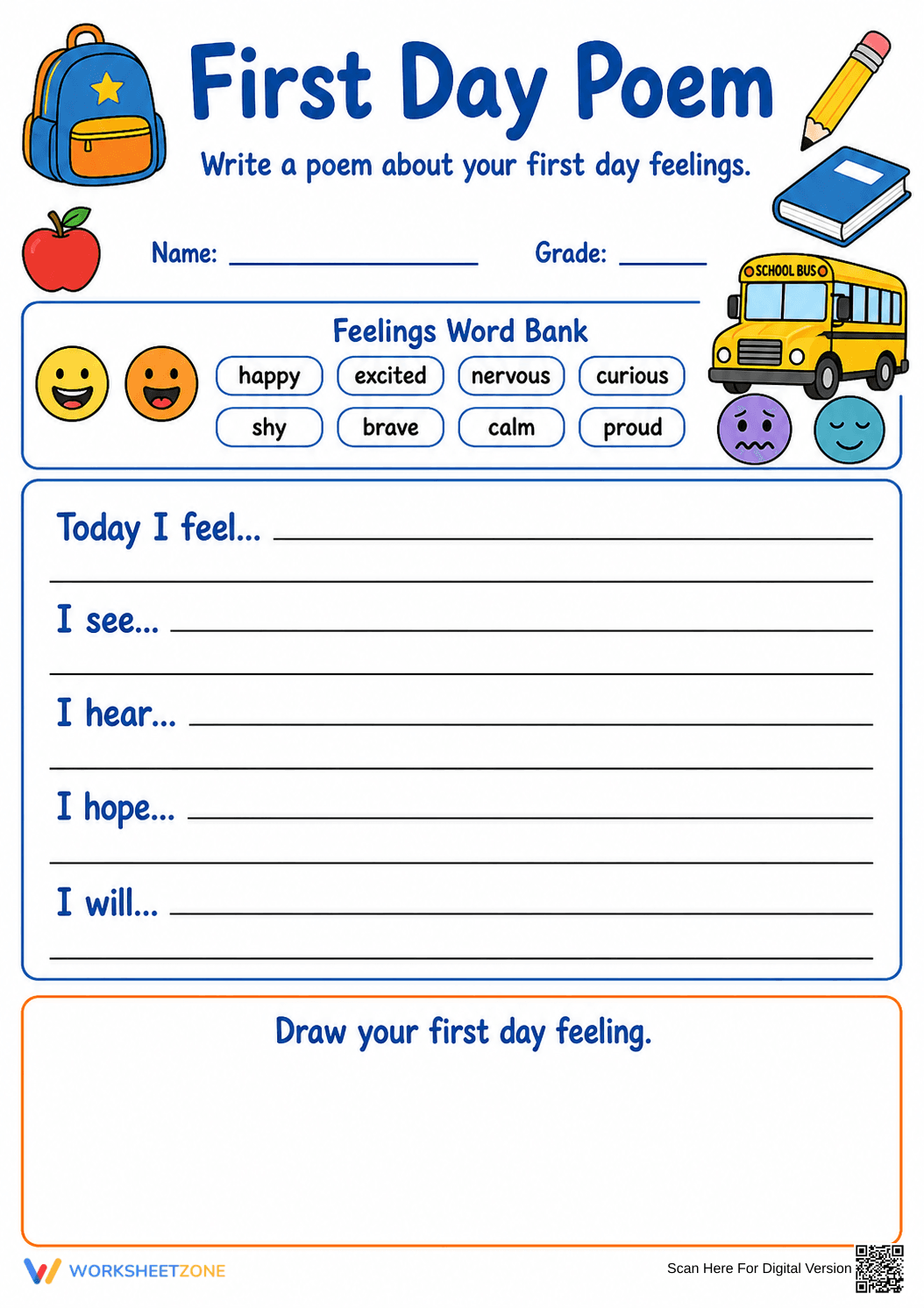

First Day Poem Worksheet | Printable Grade 2 ELA
Paste this activity's link or code into your existing LMS (Google Classroom, Canvas, Teams, Schoology, Moodle, etc.).
Students can open and work on the activity right away, with no student login required.
You'll still be able to track student progress and results from your teacher account.
This Grade 2 ELA worksheet helps students process their back-to-school emotions by writing a structured first day poem. By utilizing a provided word bank and sentence starters, young learners can confidently express their feelings, observations, and hopes for the new school year in a creative format.
At a Glance
- Grade: 2 · Subject: ELA
- Standard:
CCSS.ELA-LITERACY.L.2.6— Use acquired words and phrases to describe feelings.- Skill Focus: Poetry Writing and Emotional Expression
- Format: 1 page · 6 tasks · No answer key needed · PDF
- Best For: First day morning work
- Time: 15–20 minutes
This single-page printable features a "Feelings Word Bank" with eight emotion words, paired with visual faces to support early readers. The core activity includes five structured sentence starters (Today I feel..., I see..., I hear..., I hope..., I will...) with primary handwriting lines. A drawing box at the bottom allows students to visually represent their feelings, offering an alternative mode of expression.
Zero-Prep Workflow
Designed for immediate classroom implementation.
- Print (1 minute): Prints quickly, requiring no special formatting.
- Distribute (1 minute): Hand out as students arrive; the intuitive layout lets them begin immediately.
- Review (3 minutes): Circulate to discuss chosen feeling words and encourage sharing.
Total teacher preparation time is under two minutes, making this an excellent option for morning work or sub plans during the first week.
Standards Alignment
This activity is aligned to CCSS.ELA-LITERACY.L.2.6: "Use words and phrases acquired through conversations, reading and being read to, and responding to texts, including using adjectives and adverbs to describe." The worksheet actively prompts students to apply new vocabulary from the word bank to describe their personal experiences. Both standard codes can be copied directly into lesson plans, IEP goals, or district curriculum mapping tools.
How to Use It
Deploy this worksheet as welcoming morning work on the first day of school to help students settle in. Alternatively, use it after a read-aloud about first-day jitters. As a formative assessment tip, observe which students independently utilize the word bank versus those relying on visual cues. Expected completion time ranges from 15 to 20 minutes.
Who It's For
This resource is primarily designed for second-grade students, though the heavy scaffolding makes it accessible for late first graders or third graders needing extra support. The inclusion of sentence frames and visual emotion icons provides essential differentiation for English Language Learners and students with specific learning disabilities in written expression. Pair this worksheet with a classic back-to-school picture book or a classroom anchor chart detailing classroom expectations.
Integrating structured emotional check-ins during the critical back-to-school transition period significantly impacts student readiness and classroom climate. This worksheet addresses CCSS.ELA-LITERACY.L.2.6 by requiring students to use acquired words and phrases to describe feelings in a structured poetic format. According to a recent EdReports 2024 analysis, providing explicit vocabulary scaffolds—such as targeted word banks and sentence frames—increases task completion rates by up to forty percent among early elementary writers. By combining visual emotion cues with primary handwriting lines, this resource reduces the cognitive load associated with blank-page writing assignments. This allows young learners to focus entirely on emotional articulation and sensory observation. Establishing these expressive routines early in the academic year builds foundational self-awareness and fosters a supportive classroom community where students feel their individual experiences are valued and understood.


