These realistic fiction worksheets for 3rd grade give teachers a concrete set of planning and drafting tools for one of the trickiest transitions in elementary writing: helping students understand that a story can be invented without being impossible. The set covers character development, small-moment plot structure, sensory detail, and the specific challenge of keeping a conflict grounded in real-world cause and effect. Most teachers find these worksheets fit naturally into a four-to-six week genre study that begins with mentor texts and moves toward independent student drafts.
What Each Worksheet Targets
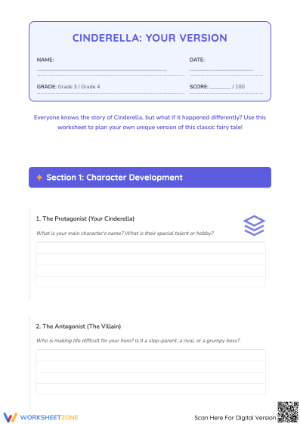
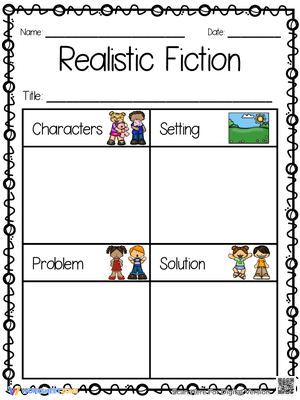
The sequence starts with character. Before students write a word of prose, they work through a planning worksheet that asks for not just a character's name and age but what that character wants and what is standing in the way. A third grader who fills this out carefully — including one internal contradiction, such as a character who appears confident but is terrified of failure — almost always produces a more convincing protagonist than one who skips straight to drafting. The worksheet also asks students to name three specific physical details rather than general ones: not "brown hair" but "a braid that kept coming undone."
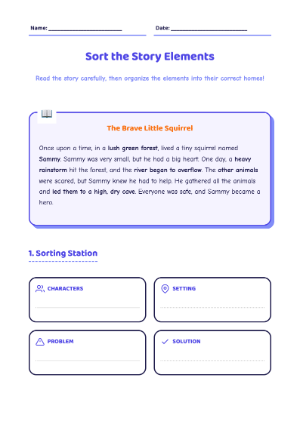
Plot worksheets are sequenced from broad to narrow. One uses a story mountain format to map rising action, climax, and resolution with clear prompts at each stage. Another builds the small-moment skill by asking students to describe a story that takes place in thirty minutes or less of story time — a constraint that forces the descriptive specificity that sweeping narratives almost never produce. A third worksheet focuses on sensory detail, asking students to list two or three observations tied to their setting before drafting begins, so sensory language appears in the story itself rather than getting added (or not added) during revision.
Frequent Student Errors Worth Watching For and Addressing
The most consistent problem in third-grade realistic fiction is what teachers sometimes call fantasy creep: a student plans a careful, believable story and then at the climax something impossible happens. A lost dog follows a glowing trail through the woods. A storm clears on cue. A character suddenly has a power they have never mentioned. This usually is not careless writing — students genuinely lose track of the genre's constraint during the excitement of drafting. Building a reality-check question into the planning worksheet ("Exactly how does your character solve this problem, using only things a real person could do?") catches most of these before a single draft sentence gets written.
The second pattern is a flat internal life. Eight-year-olds write external action well — "Marcus ran to the gym" — but struggle to put a thought or feeling in the same sentence without simply naming it. "Marcus was scared" is the default. The worksheets push past that by asking, after students identify an emotion: "What did your character notice or do that shows this feeling?" The resulting raw material — "he counted the ceiling tiles," "she kept tightening her ponytail" — gives students the specific behaviors that become showing rather than telling in the actual draft. This single shift is often what separates second-grade writing quality from third-grade writing quality in narrative work.
How to Work These Worksheets Into Your Writing Workshop
These worksheets function best as pre-writing and planning tools rather than final-product assessments. The character worksheet has the most impact when it is introduced during the same mini-lesson where students examine a mentor text — asking "How does the author show us who this character is without just telling us?" directly connects what students are reading to what they are about to plan. Running through the worksheet as a shared class exercise before students complete their own copies reduces the confusion that tends to accumulate during independent work time.
A realistic fiction worksheets for 3rd grade planning sequence pairs especially well with a verbal story pitch before anyone drafts. After students complete the plot worksheet, pair them up and assign one role to each partner: the storyteller and the reality-checker. The checker asks two questions only — "Could this actually happen?" and "How does your character solve the problem without luck or magic?" — and the storyteller answers out loud. Students who can answer both questions clearly almost always write more coherent first drafts. This step takes roughly fifteen minutes and recovers that time easily during revision.
Standard Alignment
The worksheets address CCSS.ELA-LITERACY.W.3.3, which requires third graders to write narratives developing real or imagined experiences using effective technique, descriptive details, and clear event sequences. The four sub-standards map directly onto specific worksheets in the set: W.3.3a covers establishing a narrator, characters, and situation — addressed by the character and setting worksheets; W.3.3b addresses dialogue and description to develop events — addressed by the showing-vs.-telling worksheet; W.3.3c targets temporal words and transitional phrases; and W.3.3d calls for a sense of closure, which the resolution section of the plot worksheet directly addresses. Teachers in states using Common Core-aligned standards can treat this set as covering the full W.3.3 narrative writing strand at grade 3.
Differentiating the Set Across Writing Levels
For students who need more structured support, the character and plot worksheets work well alongside sentence frames: "My character wants ___ but can't have it because ___" or "The problem gets worse when ___." Asking students to generate ideas and language simultaneously is a significant cognitive load for many third-grade writers — separating the two tasks keeps planning moving without turning the worksheet into a stalling point. Once students consistently fill out the worksheet without the frames, the frames come off.
The worksheets in this realistic fiction worksheets for 3rd grade set also offer a useful constraint for students writing above grade level: limit their story time to thirty minutes or less of elapsed story time. Strong third-grade writers tend to produce sweeping, episodic narratives and skip sensory detail because fluency does not require it. The time constraint forces compression and specificity. These students can also work through a follow-up revision worksheet that asks them to locate every sentence where they named an emotion and rewrite it as an observable behavior — a task that keeps them genuinely challenged while staying in the same genre the rest of the class is studying.
Frequently Asked Questions
What is the difference between realistic fiction and personal narrative, and should I teach them at the same time?
Realistic fiction is invented — the characters, events, and settings are made up, even if they feel true to life. Personal narrative is drawn from actual experience. Third graders often blur the line, using real events as the basis for what they call fiction. Teaching these genres separately, at least initially, is worth the extra time. Using realistic fiction planning worksheets after students have already studied personal narrative works well because students can borrow the small-moment focus and sensory detail habits from memoir and apply them directly to invented stories.
How do I help students who say they have no ideas?
Most third graders who claim to have no ideas are experiencing choice paralysis — the topic is too open. Narrowing the entry point helps considerably. Ask the student to name one situation that has ever made them feel nervous, embarrassed, or proud. From that emotion, work backward: who was there, what happened just before, what happened right after. A realistic fiction worksheets for 3rd grade brainstorm worksheet structures this conversation by offering five emotion-based entry points and asking students to circle the moment they can still picture most clearly. That moment becomes the story.
Can these worksheets be used for revision as well as initial planning?
Both uses work, but the purpose shifts. For first planning, students fill out the worksheets from scratch as part of generating their story. For revision, the character and conflict worksheets become a comparison tool — students hold their completed draft against what they planned and identify where the story drifted, or where a detail they planned never made it onto the page. This comparison step is especially useful for catching places where the resolution does not follow logically from the conflict, which is the most common structural problem in third-grade realistic fiction drafts.












 Interactive Worksheet Maker
 Quiz Maker
 Word Search Maker
 Crossword Puzzle Maker
 Word Scramble Generator
 Sentence Scramble Generator
 Handwriting Worksheet Generator
 Name Tracing Generator
 Fill In The Blank Generator