




























Views
Downloads

Grade 4 Poetry Writing — Printable No-Prep Worksheet

Paste this activity's link or code into your existing LMS (Google Classroom, Canvas, Teams, Schoology, Moodle, etc.).
Students can open and work on the activity right away, with no student login required.
You'll still be able to track student progress and results from your teacher account.
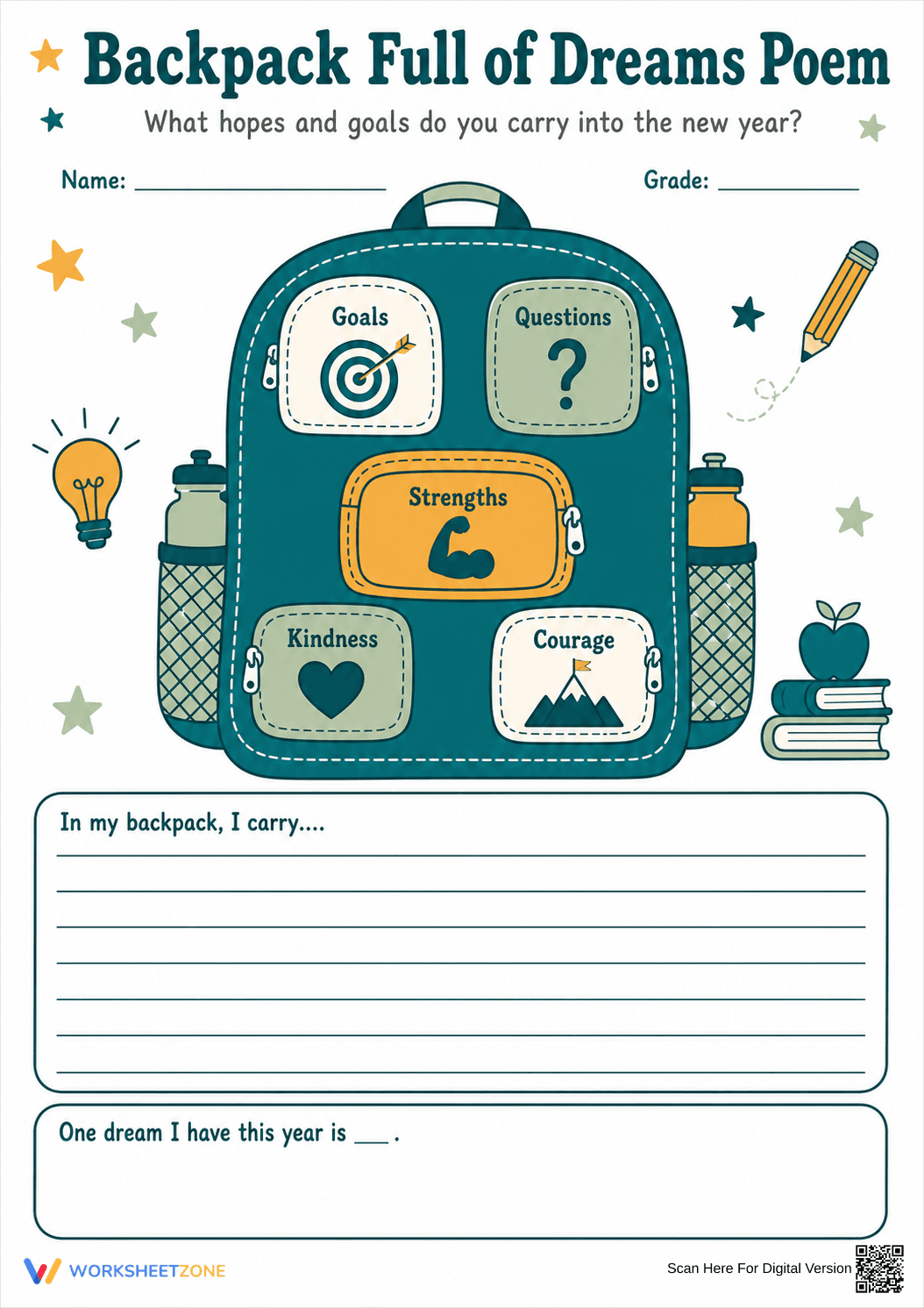
This back-to-school poetry worksheet helps students articulate their hopes and goals for the upcoming academic year. By combining visual brainstorming with structured writing prompts, learners practice expressive writing while reflecting on their personal strengths. The activity sets a positive tone for the classroom community.
At a Glance
- Grade: 4 · Subject: ELA
- Standard:
CCSS.ELA-LITERACY.W.4.4— Produce clear and coherent writing appropriate to task.- Skill Focus: Poetry Writing and Goal Setting
- Format: 1 page · 2 problems · No answer key · PDF
- Best For: Back-to-school morning work
- Time: 15–20 minutes
This single-page resource features an engaging backpack illustration labeled with five thematic pockets: Goals, Questions, Strengths, Kindness, and Courage. These visual cues serve as a brainstorming foundation for the primary task: an eight-line poetry section starting with the sentence frame, "In my backpack, I carry...." Finally, a brief reflection prompt at the bottom asks students to identify one specific dream they have for the year. Because responses are highly individualized, no answer key is required.
Zero-Prep Workflow
This resource is designed for immediate classroom implementation with minimal teacher setup.
- Print (1 minute): Generate enough copies for your roster directly from the PDF file. The clean layout prints beautifully in standard grayscale or color.
- Distribute (1 minute): Hand out the sheets as students enter the room for morning work or during a dedicated advisory period.
- Review (3 minutes): Briefly discuss the five backpack categories and model one example of a poetic line to spark creativity.
Total teacher preparation takes under two minutes, making this ideal for sub plans.
Standards Alignment
This activity aligns with CCSS.ELA-LITERACY.W.4.4: Produce clear and coherent writing in which the development and organization are appropriate to task, purpose, and audience. It also supports broader social-emotional learning objectives by encouraging self-awareness and responsible decision-making. Both standard codes can be copied directly into lesson plans, IEP goals, or district curriculum mapping tools.
How to Use It
Deploy this worksheet during the first week of school to establish classroom culture and assess baseline writing skills. It works exceptionally well as an independent morning activity while the teacher handles attendance and beginning-of-day logistics. As a formative assessment tip, observe how students interpret the abstract concepts (like "Courage" or "Kindness") into concrete poetic imagery. Expect most students to complete the writing and reflection within 15 to 20 minutes.
Who It's For
This resource is primarily designed for fourth-grade students, though its accessible sentence starters make it appropriate for grades three through six. For students needing additional differentiation, teachers can allow them to draw their responses in the poetry lines rather than writing full sentences. It pairs perfectly with a read-aloud of a back-to-school picture book or a direct instruction lesson on setting SMART goals.
Integrating reflective writing tasks like this CCSS.ELA-LITERACY.W.4.4 activity helps students produce clear and coherent writing appropriate to task while simultaneously building essential self-regulation skills. According to a RAND AIRS 2024 report, embedding social-emotional reflection into core academic tasks significantly increases student engagement and retention of writing mechanics. When learners connect personal goals—such as kindness, courage, and academic strengths—to structured poetry formats, they demonstrate higher levels of intrinsic motivation. This specific exercise bridges the gap between creative expression and personal accountability, offering educators a dual-purpose tool for the critical early weeks of the academic year. By providing a structured yet open-ended framework, teachers can effectively capture baseline writing data while fostering a supportive, goal-oriented classroom environment from day one.


