




























Views
Downloads
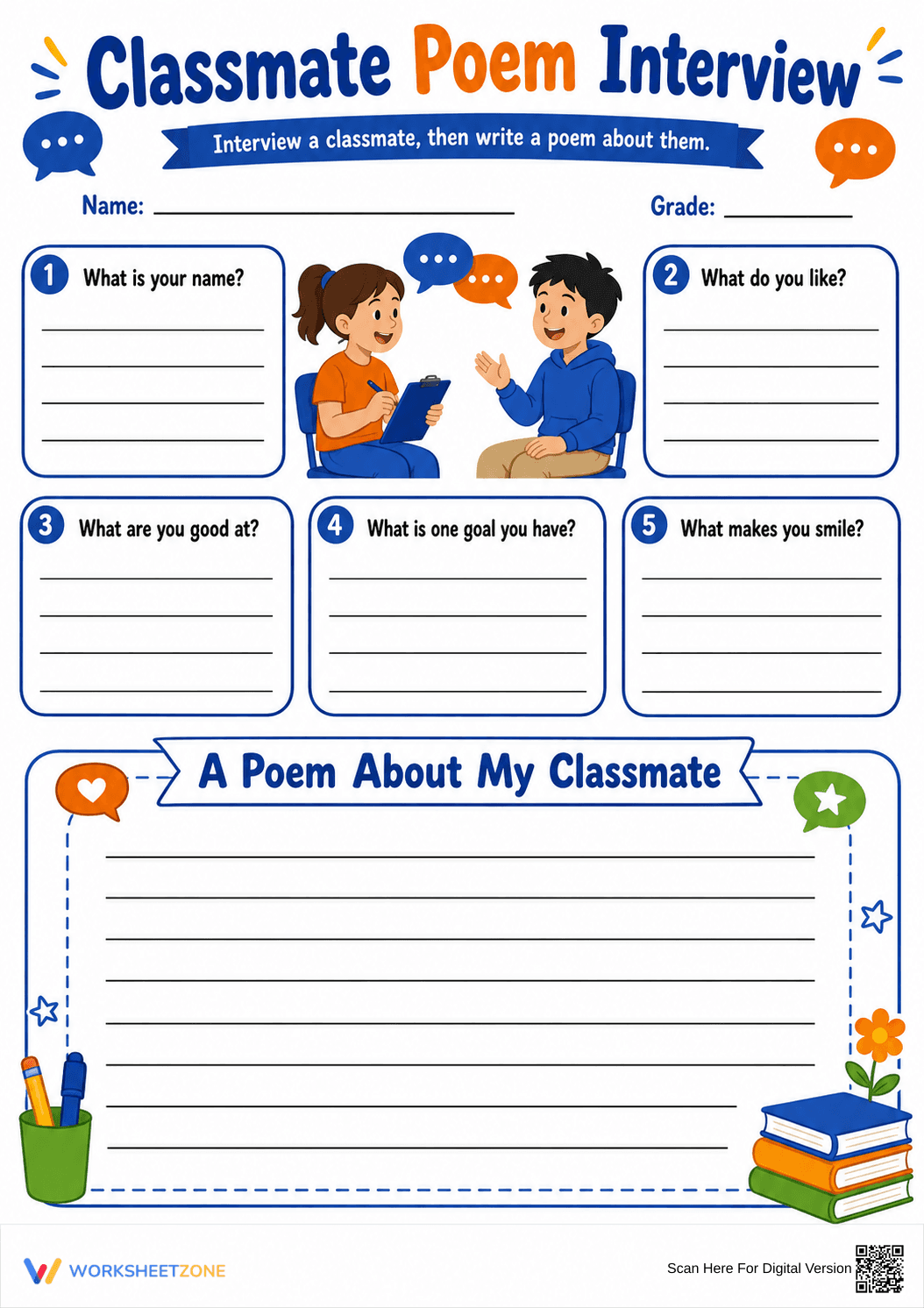

Grade 3 Classmate Poem Interview — Printable Worksheet

Paste this activity's link or code into your existing LMS (Google Classroom, Canvas, Teams, Schoology, Moodle, etc.).
Students can open and work on the activity right away, with no student login required.
You'll still be able to track student progress and results from your teacher account.
This printable classmate interview worksheet helps students build essential speaking, listening, and creative writing skills. By asking structured questions and transforming the answers into an original poem, learners actively practice peer communication while developing their descriptive writing abilities in a fun, engaging format.
At a Glance
- Grade: 3 · Subject: ELA
- Standard:
CCSS.ELA-LITERACY.SL.3.3— Ask and answer questions about information from a speaker.- Skill Focus: Peer Interviewing and Poetry Writing
- Format: 1 page · 6 tasks · No answer key · PDF
- Best For: Back-to-school icebreakers and writing centers
- Time: 25–35 minutes
This single-page resource features five structured interview question boxes designed to prompt meaningful peer conversation. Students ask partners about their likes, strengths, goals, and happiness. Below the interview section, a poem-writing frame provides ample lined space to synthesize gathered information into a personalized poem. The layout uses clear visual cues, like speech bubbles, to guide learners smoothly from data collection to creative writing.
Designed for immediate classroom implementation with a zero-prep workflow:
- Print (1 minute): Simply download the PDF and print a class set. The black-and-white friendly design ensures crisp copies.
- Distribute (1 minute): Hand out the sheets and pair students up. The instructions are self-explanatory, requiring minimal teacher setup.
- Review (3 minutes): Briefly model how to ask the interview questions and transition those facts into a simple poem format.
With teacher prep time under two minutes, this activity suits emergency sub plans or morning work.
This activity aligns with CCSS.ELA-LITERACY.SL.3.3, requiring students to ask and answer questions about information from a speaker, offering appropriate elaboration and detail. It also supports foundational writing standards by asking students to produce clear and coherent writing where the development and organization are appropriate to the task. Both standard codes can be copied directly into lesson plans, IEP goals, or district curriculum mapping tools.
Teachers can utilize this worksheet during the first week of school as a structured icebreaker to help students learn about one another. It also works exceptionally well during a poetry unit as an introductory activity before direct instruction on poetic devices. As students interview each other, teachers can circulate to conduct formative assessments, observing active listening skills and eye contact. Expect the process to take twenty-five to thirty-five minutes.
This resource is primarily designed for third-grade students, though it easily scales for grades four through six. For students needing differentiation, teachers can provide sentence starters for the poem section or allow them to write an acrostic poem using their partner's name. It pairs naturally with introductory lessons on descriptive adjectives or anchor charts detailing different types of poetry formats.
Integrating structured peer interactions with creative writing tasks significantly enhances both social-emotional development and literacy skills in elementary classrooms. According to a RAND AIRS 2024 report on collaborative learning, students who engage in guided peer-to-peer dialogue demonstrate higher retention of vocabulary and improved expressive writing capabilities compared to those working solely independently. This worksheet directly supports CCSS.ELA-LITERACY.SL.3.3 by requiring learners to ask and answer questions about information from a speaker. By transforming spoken interview data into written poetry, students practice synthesizing information across multiple modalities. This dual-focus approach ensures that communication skills are not taught in isolation but are immediately applied to a tangible, creative output. Consequently, educators can foster a deeper understanding of audience and purpose in writing while simultaneously building a supportive classroom community.


