


























Views
Downloads
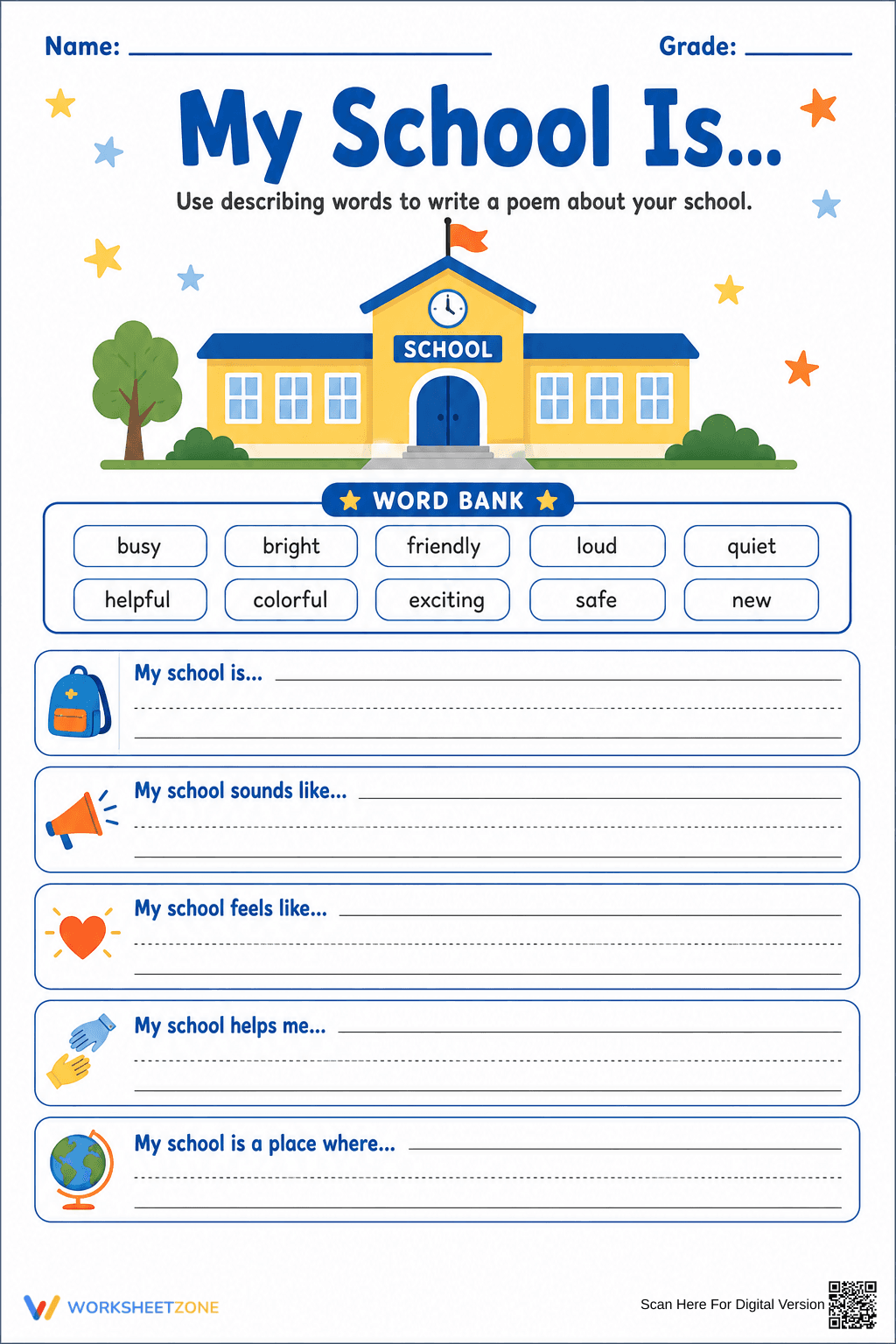

Descriptive Writing Worksheet | Grade 3 Essential
Paste this activity's link or code into your existing LMS (Google Classroom, Canvas, Teams, Schoology, Moodle, etc.).
Students can open and work on the activity right away, with no student login required.
You'll still be able to track student progress and results from your teacher account.
This Grade 3 descriptive writing worksheet helps students compose a sensory poem about their educational environment. By using provided adjectives and structured sentence stems, learners practice identifying and applying descriptive language to express their feelings and observations. It is an ideal back-to-school activity for establishing a positive classroom culture through creative expression.
At a Glance
- Grade: 3 · Subject: ELA
- Standard:
CCSS.ELA-LITERACY.W.3.3— Write narratives using effective technique and descriptive details to develop real experiences- Skill Focus: Sensory language and adjectives
- Format: 1 page · 5 prompts · Word bank included · PDF
- Best For: Back-to-school icebreakers and descriptive writing
- Time: 15–20 minutes
This single-page PDF features a vibrant school-themed design with five specific sentence starters designed to elicit sensory responses. It includes a 10-word bank containing adjectives like "friendly," "exciting," and "safe" to support vocabulary development. The layout provides clear handwriting lines and rounded writing boxes to help young writers organize their thoughts neatly.
Zero-Prep Workflow
The workflow for this resource is designed for immediate implementation. First, print the single-page PDF for your class (30 seconds). Next, distribute the sheets and briefly review the word bank adjectives to ensure student comprehension (1 minute). Finally, allow students to work independently or in pairs to complete their poems, followed by a quick share-out session (15 minutes). Total teacher preparation time is under 2 minutes.
Standards Alignment
This resource aligns with `CCSS.ELA-LITERACY.W.3.3`, which requires students to use descriptive details to develop real experiences. By focusing on sensory input—what the school sounds, feels, and looks like—students meet the criteria for using effective technique in narrative and descriptive compositions. Both standard codes can be copied directly into lesson plans, IEP goals, or district curriculum mapping tools.
How to Use It
Use this worksheet during the first week of school as a formative assessment to gauge student handwriting and descriptive vocabulary levels. It also serves as an excellent "About Me" or "Our School" bulletin board display when paired with student illustrations. Expect completion within 15 to 20 minutes depending on the depth of student responses.
Who It's For
This activity is perfect for general education Grade 3 students, English Language Learners who benefit from the provided word bank, and students requiring writing scaffolds. It pairs naturally with a read-aloud of a school-themed picture book or an anchor chart focused on the five senses.
The "My School Is..." worksheet leverages the "gradual release of responsibility" model by providing a scaffolded word bank and sentence frames to support descriptive writing. According to Fisher & Frey (2014), providing students with linguistic supports like sentence stems allows them to focus on higher-order creative thinking rather than just the mechanics of sentence construction. This resource specifically targets `CCSS.ELA-LITERACY.W.3.3` by encouraging the use of sensory details to describe a familiar environment. Research from the NAEP indicates that students who practice descriptive writing across various contexts show improved proficiency in overall narrative composition. By integrating 10 high-frequency adjectives with 5 sensory prompts, this worksheet ensures that Grade 3 learners can successfully transition from simple sentences to more complex, evocative prose. It serves as a reliable tool for early-year baseline data collection in elementary ELA classrooms while supporting social-emotional learning through school-based reflection.


