




























Views
Downloads
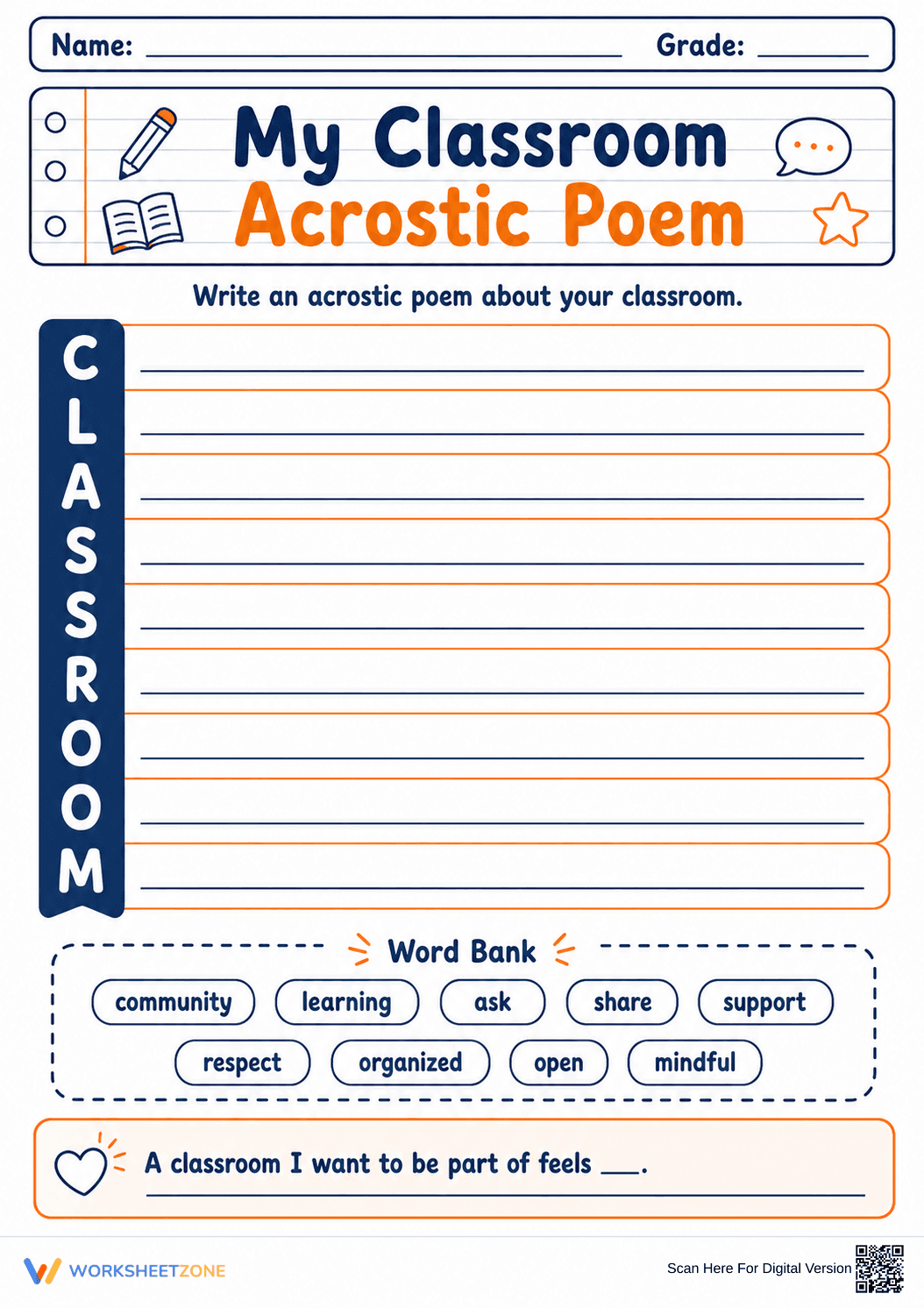

My Classroom Acrostic Poem | Essential Grade 4 Writing

Paste this activity's link or code into your existing LMS (Google Classroom, Canvas, Teams, Schoology, Moodle, etc.).
Students can open and work on the activity right away, with no student login required.
You'll still be able to track student progress and results from your teacher account.
Building Community Through Creative Writing
This Grade 4 acrostic poem worksheet provides a structured way for students to define their learning environment. By using the vertical anchor word "CLASSROOM," students practice descriptive writing and vocabulary selection to express their feelings about their school community. It is an ideal tool for establishing positive culture during the first week of school.
At a Glance
- Grade: 4 · Subject: ELA Writing
- Standard:
CCSS.ELA-LITERACY.W.4.4— Produce clear and coherent writing with organization appropriate to the task- Skill Focus: Acrostic Poetry & Vocabulary
- Format: 1 page · 10 tasks · No answer key · PDF
- Best For: Back-to-school community building and creative writing
- Time: 15–25 minutes
What's Inside
This single-page PDF features a high-contrast design with navy and orange accents. The main activity consists of a vertical "CLASSROOM" margin ribbon with nine ruled lines for poetic composition. To support diverse learners, a dedicated word bank includes nine essential community-focused terms like "mindful," "respect," and "support." The page concludes with a reflective sentence starter for personal connection.
Zero-Prep Workflow
- Print (1 minute): Generate enough copies for your roster; the high-contrast linework ensures crisp reproduction on standard school copiers.
- Distribute (1 minute): Hand out the sheets as a morning work assignment or a transition activity during the first week of school.
- Review (5 minutes): Facilitate a "Gallery Walk" where students read their favorite lines to peers, requiring zero teacher preparation time.
This resource is designed to be a "grab-and-go" solution for busy educators, making it a perfect addition to any substitute teacher folder or emergency lesson plan bank.
Standards Alignment
This resource aligns with `CCSS.ELA-LITERACY.W.4.4`, which requires students to produce clear and coherent writing appropriate to the task. By following the acrostic format, students must organize their thoughts within a specific structural constraint. Both standard codes can be copied directly into lesson plans, IEP goals, or district curriculum mapping tools.
How to Use It
Use this worksheet as a primary icebreaker during the first days of the school year. It serves as an excellent formative assessment to gauge student handwriting, spelling, and ability to follow multi-step directions. For a deeper reflection, have students circle one word from the word bank they want to embody most. Expect students to spend approximately 20 minutes on the poem.
Who It's For
This activity is tailored for Grade 4 students but is highly adaptable for Grades 3-6. The included word bank provides necessary scaffolding for English Language Learners (ELLs) and students who struggle with brainstorming. It pairs naturally with a read-aloud of a community-focused picture book or a direct instruction lesson on descriptive adjectives.
According to research by Fisher & Frey (2014), the use of structured writing templates like acrostic poems helps students bridge the gap between vocabulary acquisition and independent composition. This worksheet utilizes a "CLASSROOM" anchor to focus student attention on social-emotional learning while meeting CCSS.ELA-LITERACY.W.4.4 requirements for coherent writing. By providing a curated word bank with terms like "mindful" and "organized," the resource reduces the cognitive load associated with brainstorming, allowing students to focus on the creative arrangement of ideas. Data from NAEP suggests that frequent, short-form writing opportunities significantly improve overall literacy outcomes in middle-elementary grades. This printable resource provides a low-stakes, high-engagement entry point for students to practice descriptive language within a community-building context. The inclusion of a reflection prompt ensures that the writing task leads to meaningful personal connection, a key factor in long-term retention of writing skills.


