


























Views
Downloads

School Morning Poem Worksheet | Grade 2 Essential
Paste this activity's link or code into your existing LMS (Google Classroom, Canvas, Teams, Schoology, Moodle, etc.).
Students can open and work on the activity right away, with no student login required.
You'll still be able to track student progress and results from your teacher account.
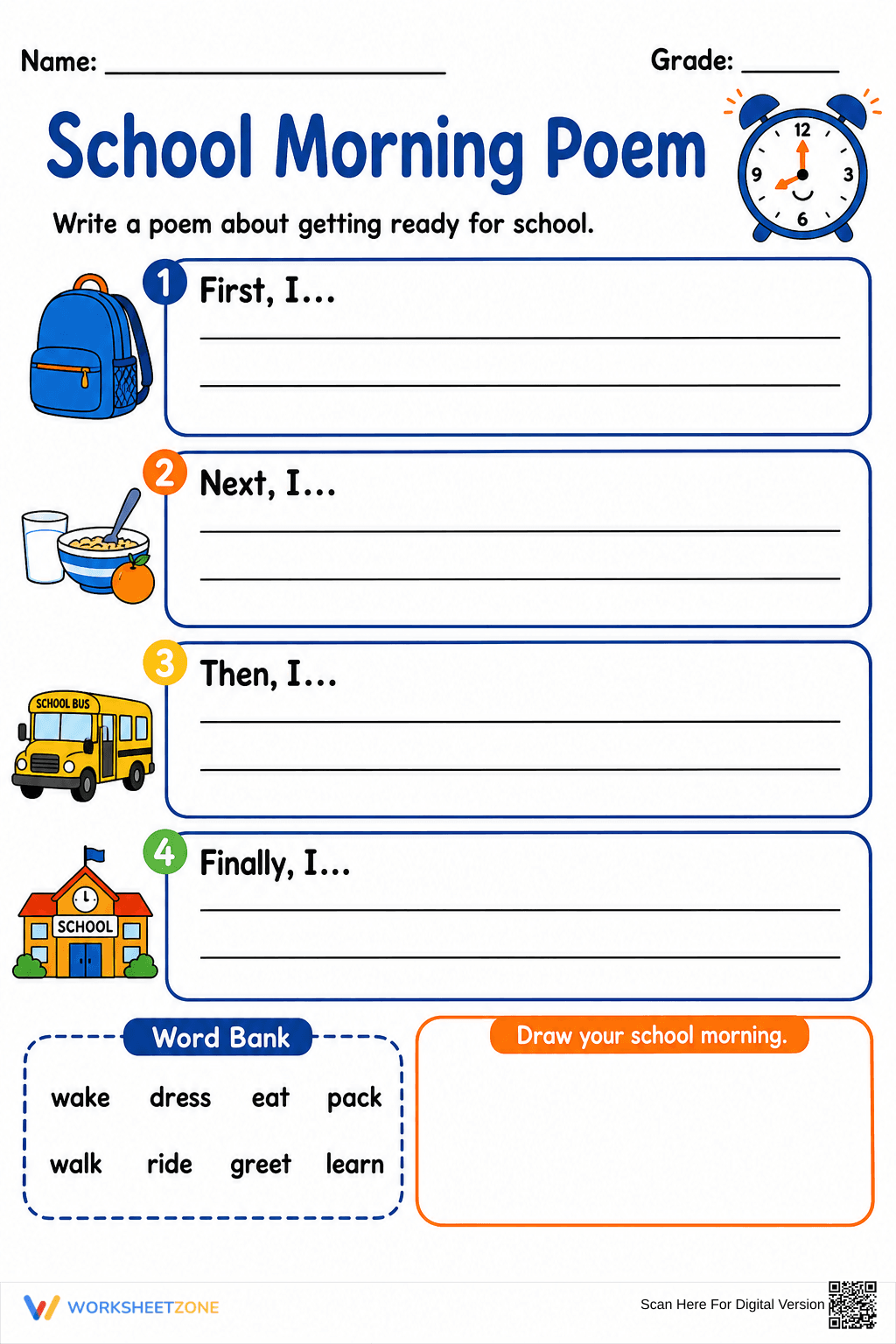
This Grade 2 School Morning Poem worksheet helps students master narrative sequencing by documenting their daily routines. By using structured temporal words, learners transform simple tasks into a cohesive poem. This activity builds foundational writing stamina while encouraging personal expression through both text and illustration.
At a Glance
- Grade: 2 · Subject: ELA Writing
- Standard:
CCSS.ELA-LITERACY.W.2.3— Write narratives that recount a well-elaborated event or short sequence of events- Skill Focus: Narrative Sequencing & Poetry
- Format: 1 page · 4 tasks · Word bank included · PDF
- Best For: Morning work or back-to-school activity
- Time: 15–20 minutes
This single-page PDF features four distinct writing zones labeled with sequence markers: First, Next, Then, and Finally. To support vocabulary development, a dedicated word bank includes eight high-frequency verbs like wake, pack, and greet. The layout also provides a creative drawing box for visual representation and clear primary lines for handwriting practice.
- Print: Select the single-page PDF and print enough copies for your class in under 2 minutes.
- Distribute: Hand out the sheets as students arrive; the self-explanatory icons and prompts require minimal teacher explanation.
- Review: Spend 5 minutes at the end of the block having students share one line of their poem to check for logical sequencing.
The primary focus is `CCSS.ELA-LITERACY.W.2.3`, which requires students to write narratives that recount a short sequence of events, including details to describe actions, thoughts, and feelings, and use temporal words to signal event order. This resource also supports language standards by encouraging correct verb usage. Both standard codes can be copied directly into lesson plans, IEP goals, or district curriculum mapping tools.
Use this as a morning work activity during the first week of school to establish classroom routines while assessing baseline writing skills. It also functions well as a formative assessment after a lesson on transition words. Observe if students can independently select appropriate verbs from the word bank to complete their sentences. Completion typically takes 15 to 20 minutes.
This resource is designed for Grade 2 students but is highly effective for Grade 1 enrichment or Grade 3 review. The included word bank makes it an excellent scaffold for English Language Learners (ELLs) and students with IEPs who need help generating ideas. Pair this with a mentor text about school routines or a classroom anchor chart on transition words.
Research from Fisher & Frey (2014) emphasizes the importance of scaffolded writing frames in developing student agency and narrative coherence. By providing temporal anchors like First and Finally, this worksheet reduces the cognitive load associated with structural organization, allowing Grade 2 learners to focus on word choice and descriptive detail. The inclusion of a word bank aligns with NAEP findings suggesting that vocabulary support significantly improves writing outcomes for early elementary students. This worksheet directly addresses CCSS.ELA-LITERACY.W.2.3 by requiring a logical progression of events. According to the RAND AIRS 2024 report, integrating visual arts with writing tasks—such as the drawing box provided here—increases engagement and helps students internalize the sequence of their narrative before committing it to paper. This multi-modal approach ensures that students of varying ability levels can successfully demonstrate mastery of chronological storytelling.


