


























Views
Downloads
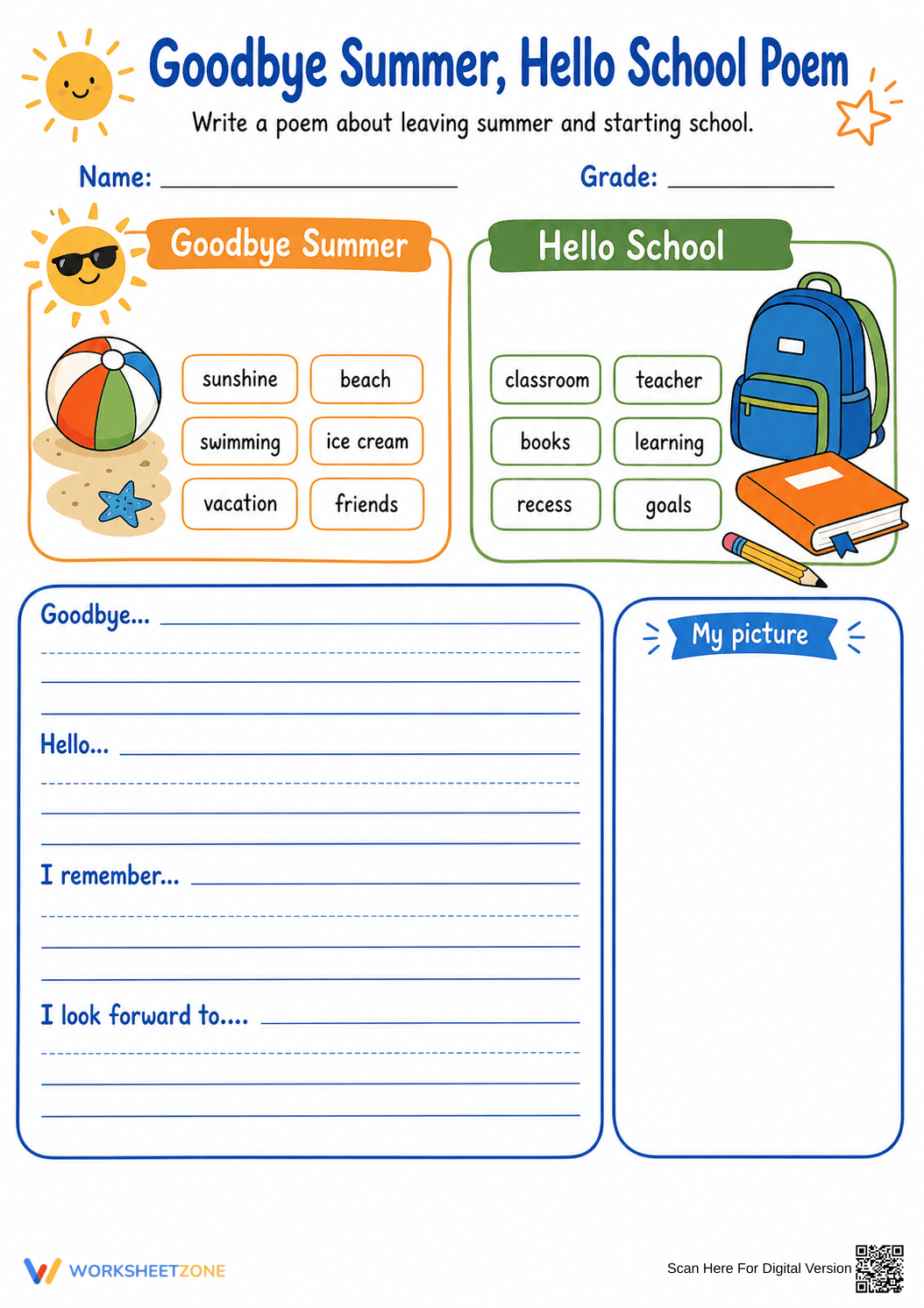

Grade 2 Summer to School Poem — Printable No-Prep Worksheet
Paste this activity's link or code into your existing LMS (Google Classroom, Canvas, Teams, Schoology, Moodle, etc.).
Students can open and work on the activity right away, with no student login required.
You'll still be able to track student progress and results from your teacher account.
This back-to-school poetry worksheet helps students transition from summer vacation to the new academic year by writing a structured, reflective poem. By utilizing provided word banks and sentence frames, young writers can confidently express their feelings and memories while practicing foundational creative writing skills.
At a Glance
- Grade: 2 · Subject: ELA
- Standard:
CCSS.ELA-LITERACY.W.2.3— Write narratives describing thoughts and feelings- Skill Focus: Poetry Writing
- Format: 1 page · 2 tasks · No answer key · PDF
- Best For: First week morning work
- Time: 15–20 minutes
Inside this single-page resource, teachers will find a scaffolded poetry activity. The top half features thematic word banks for "Goodbye Summer" and "Hello School" with accessible vocabulary like "sunshine" and "classroom." The bottom half provides a four-line poem frame with alternating sentence starters to guide writing, alongside a space for a matching illustration. As an open-ended creative task, an answer key is not required.
This resource requires zero teacher preparation.
- Print (1 minute): Simply download the PDF and print a class set. The clean, black-and-white friendly design ensures crisp copies.
- Distribute (1 minute): Hand out the worksheets during morning arrival or as a calm transition activity after recess.
- Review (3 minutes): Briefly read the word bank vocabulary aloud and model how to complete one sentence frame before letting students work independently.
Total teacher prep time is under two minutes, making this an excellent sub plan or stress-free addition to your first week.
Aligned to CCSS.ELA-LITERACY.W.2.3, this worksheet requires students to write narratives recounting events and including details to describe actions, thoughts, and feelings. The sentence frames prompt students to articulate personal memories of summer and expectations for the school year. Both standard codes can be copied directly into lesson plans, IEP goals, or district curriculum mapping tools.
Use this worksheet as a first-day icebreaker or morning work assignment. Place a copy on each desk to provide a quiet task while you handle attendance. Alternatively, use it during your first ELA block to assess handwriting and sentence construction. As a formative assessment observation tip, note which students independently utilize the word banks versus those generating their own vocabulary. Expected completion time is 15 to 20 minutes.
This activity is primarily designed for second-grade students, though it works beautifully for third graders needing a gentle start to the year. The built-in scaffolds—specifically the categorized word banks and predictable sentence starters—make it highly accessible for English Language Learners and students receiving special education support. Pair this worksheet with a classic back-to-school read-aloud book to create a comprehensive, literacy-rich morning routine.
Integrating structured writing frames during transitional periods reduces student anxiety while building literacy skills. According to Fisher & Frey (2014), providing explicit scaffolds like sentence starters and vocabulary banks allows novice writers to focus on idea generation rather than the cognitive load of formatting. This worksheet applies that research by offering categorized word banks to support early elementary students. By aligning with CCSS.ELA-LITERACY.W.2.3, the activity ensures students practice how to write narratives describing thoughts and feelings. The combination of visual cues and creative expression fosters a positive classroom environment. Educators can rely on this evidence-based approach to assess baseline writing abilities while celebrating the transition to the academic year.


