




























Views
Downloads

Printable Classroom Acrostic Poem | Grade 3 ELA

Paste this activity's link or code into your existing LMS (Google Classroom, Canvas, Teams, Schoology, Moodle, etc.).
Students can open and work on the activity right away, with no student login required.
You'll still be able to track student progress and results from your teacher account.
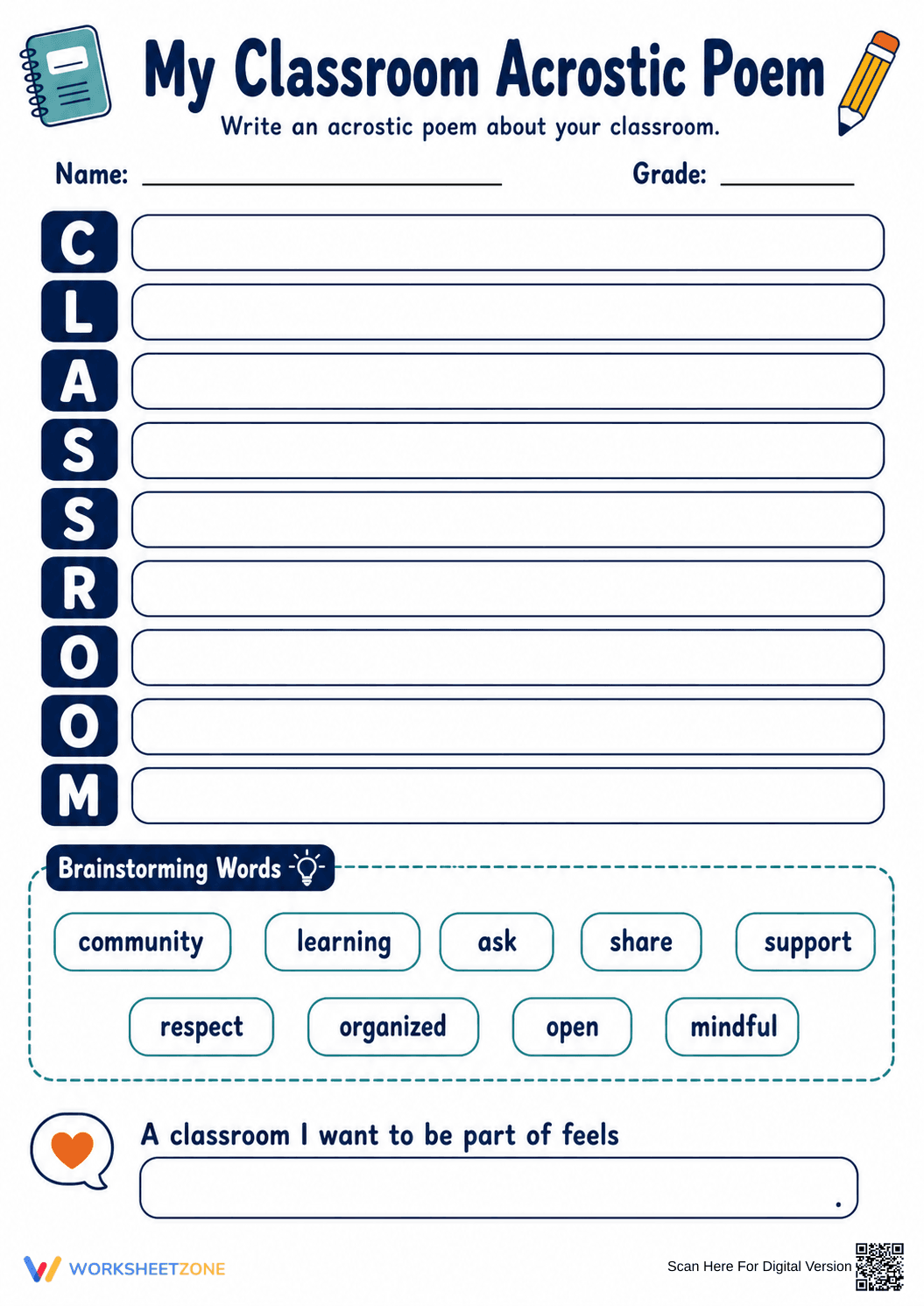
This Grade 3 ELA worksheet guides students through writing an acrostic poem to build classroom community and practice descriptive vocabulary. By using the provided brainstorming word bank, learners construct meaningful sentences for each letter of the word "CLASSROOM," fostering a positive environment while developing foundational creative writing skills.
At a Glance
- Grade: 3 · Subject: ELA
- Standard:
CCSS.ELA-LITERACY.W.3.4— Produce writing appropriate to task and purpose- Skill Focus: Acrostic Poetry Writing
- Format: 1 page · 2 tasks · No answer key · PDF
- Best For: Back-to-school community building
- Time: 15–20 minutes
This single-page resource features a structured acrostic poem template centered around the word "CLASSROOM." It includes nine dedicated writing lines, a helpful brainstorming box with nine positive vocabulary words like "community," "respect," and "mindful," and a concluding reflection prompt. The clean, organized layout provides clear visual boundaries for student writing, making it highly accessible for young authors without requiring additional teacher modeling or complex instructions.
Zero-Prep Workflow
- Print (1 minute): Generate copies of the PDF for your class. The black-and-white friendly design ensures crisp printing.
- Distribute (1 minute): Hand out the worksheets during morning work, a dedicated writing block, or a social-emotional learning session.
- Review (3 minutes): Briefly read the brainstorming words aloud to ensure comprehension, then let students work independently.
Total teacher preparation requires under two minutes. The self-explanatory format makes this an excellent, reliable option for emergency sub plans or independent literacy centers.
Standards Alignment
This resource aligns directly with CCSS.ELA-LITERACY.W.3.4: With guidance and support from adults, produce writing in which the development and organization are appropriate to task and purpose. The structured poetry format helps students organize their thoughts while selecting vocabulary that fits the specific theme of classroom community. Both standard codes can be copied directly into lesson plans, IEP goals, or district curriculum mapping tools.
How to Use It
Deploy this worksheet during the first weeks of school to establish positive classroom norms. Before direct instruction on classroom rules, have students complete the poem to express their ideal learning environment. As a formative assessment tip, observe which students successfully integrate the provided brainstorming words into complete, coherent thoughts rather than just writing single words on each line. Most students will complete the writing and reflection prompt within 15 to 20 minutes.
Who It's For
This worksheet is designed for third-grade students, though it easily scales for grades four through six. The built-in word bank provides essential scaffolding for English Language Learners and students who struggle with vocabulary recall, ensuring all learners can participate in the community-building exercise. Pair this activity with a read-aloud book about classroom expectations or a collaborative anchor chart detailing what respect looks and sounds like in the classroom.
Integrating structured creative writing tasks into daily routines significantly enhances both literacy development and social-emotional growth. By aligning with CCSS.ELA-LITERACY.W.3.4 to produce writing appropriate to task and purpose, this resource ensures students practice meaningful vocabulary application in a highly relevant context. According to Fisher & Frey (2014), providing targeted scaffolds like brainstorming word banks reduces cognitive load, allowing students to focus on sentence construction and thematic expression rather than basic word retrieval. This acrostic poetry format specifically encourages learners to synthesize their understanding of community expectations into concise, descriptive lines. When students actively articulate their vision for a positive learning environment, they demonstrate higher levels of ownership and engagement throughout the school year. This targeted practice bridges the gap between foundational vocabulary acquisition and expressive, purpose-driven writing.


