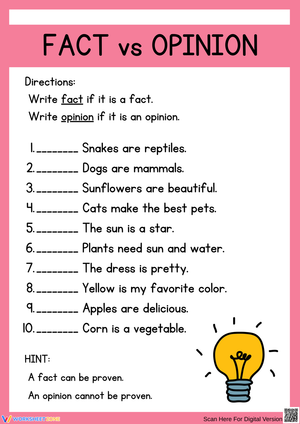
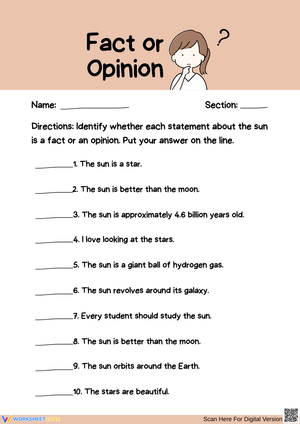
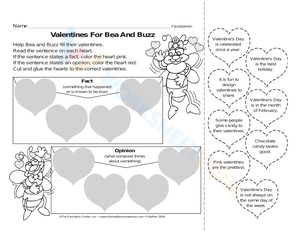
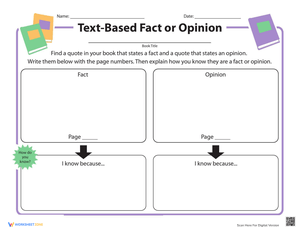
These 3rd grade fact vs opinion worksheets give teachers a ready-to-download set of standalone practice resources for one of the most instructionally layered skills in the third-grade ELA curriculum. Each worksheet targets the same core concept through a different task format—sorting sentences into a T-chart, underlining signal words, rewriting evaluative statements as verifiable claims, and analyzing short informational passages. The variety in format matters because students who can categorize an isolated sentence often stumble the moment an opinion is embedded inside a paragraph.
Concepts and Skills in Each Worksheet
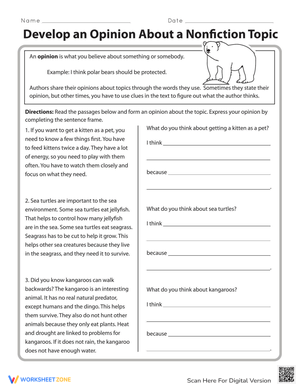
The central task across the set is recognizing whether a statement can be tested against evidence or whether it reflects a personal judgment. Third graders work with signal words—think, feel, believe, best, worst, always, should—that act as reliable first clues. Beyond word-level signals, students practice asking whether a claim could be checked in a reliable source, which moves them toward a more flexible understanding of the concept rather than a mechanical checklist.
Several worksheets in the set draw from content students already encounter in science and social studies: weather data, animal characteristics, historical events. Using familiar academic contexts keeps the cognitive load on the fact-opinion distinction itself rather than on decoding unfamiliar subject matter. One worksheet asks students to read a short passage about weather patterns, then underline factual sentences in one color and opinion sentences in another—a visual differentiation that makes the distinction between objective reporting and evaluative language concrete and easy to scan for feedback.
Student Errors Worth Anticipating Before You Teach This
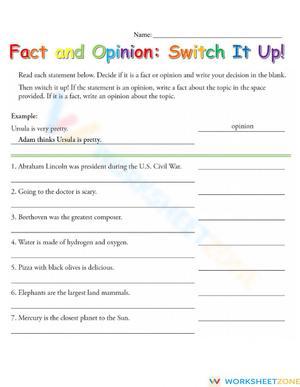
The most predictable stumbling point appears when a signal word like believe or think attaches to a statement that reflects scientific consensus. "Scientists believe the cheetah is the fastest land animal" trips up third graders reliably: they see believe and mark the whole sentence as an opinion, even though the underlying claim is verifiable. This is worth addressing directly before students work independently—signal words are clues, not rules, and a single counterexample discussed as a class saves a lot of confusion later.
A second consistent error involves false statements. When students see something like "The moon is made of cheese," many third graders label it an opinion because it sounds wrong. That confusion is actually instructionally useful. It opens a direct path to explaining that a fact is any statement that can be tested and proven true or false—incorrect facts are still facts, just wrong ones. Distinguishing false statements from opinions does more to sharpen the concept than additional sorting practice, and it tends to stick.
Standard Alignment
The primary standard addressed across these resources is CCSS.ELA-LITERACY.RI.3.6, which requires students to distinguish their own point of view from that of the author of a text. Practically, that standard asks students to identify which sentences carry the author's judgment rather than reporting verifiable information—which is exactly what the sorting and underlining tasks in this set build toward. Teachers working toward RI.3.1, asking students to cite textual evidence to support an analysis, find this set useful as a prerequisite: before students can anchor a claim in evidence, they need to recognize what counts as a factual claim in the first place. The two standards reinforce each other, and this skill is best taught before students move into formal argument writing.
Fitting These Worksheets Into Your Weekly Reading Block
The most reliable entry point is the reading warm-up—five minutes at the start of the literacy block where students sort six to eight sentences before the lesson begins. A 3rd grade fact vs opinion worksheets works well here because the task has a clear stopping point and generates immediate discussion material. Teachers who follow the warm-up with a brief whole-class share consistently find that the argument students have over borderline cases does more instructional work than the sorting itself. "Is 'the ocean is deep' a fact or an opinion?" is exactly the kind of productive disagreement that builds more precise thinking.
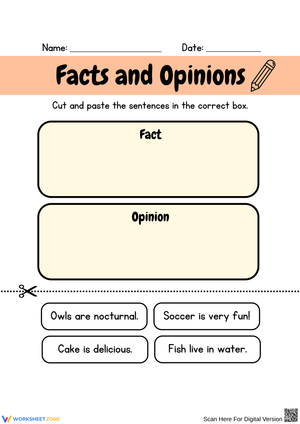
For small-group rotations, the passage-based worksheets are the stronger choice. In those groups, listening to how students justify their categorizations reveals far more about their comprehension than the written answer does. The T-chart cutting-and-sorting worksheet functions well as an independent literacy center task for groups who are ready to work without direct teacher support—it has enough structure to stay on track and enough ambiguity in a few sentences to keep the task from feeling automatic.
Adjusting the Work for a Range of Learners
Students who are still building reading fluency often have their comprehension capacity stretched thin when processing unfamiliar sentences, which makes the fact-opinion judgment harder than it needs to be. For those students, restrict early practice to sentences drawn from highly familiar topics—classroom objects, weather, school food—so they can give their full attention to evaluating the statement rather than working through the vocabulary. Once the concept is solid on familiar content, move to passage-based tasks. A 3rd grade fact vs opinion worksheets that uses short nonfiction excerpts makes a logical next step for students who can handle isolated sentences but haven't yet applied the skill to continuous text.
Students who grasp the concept quickly benefit from a different kind of challenge: locating opinions buried inside otherwise factual writing. Many informational texts use subtle evaluative language—words like unfortunately, surprisingly, or remarkable—that signal a writer's perspective without triggering the standard signal-word checklist. Asking those students to annotate a paragraph and flag every evaluative word pushes the same skill into more sophisticated territory without requiring a separate resource and keeps them productively engaged during independent work time.
Frequently Asked Questions
Can these worksheets be used with students reading below grade level?
Yes, but sentence-level worksheets serve below-grade-level readers better than passage-based ones. Keeping the reading text simple concentrates effort on the fact-opinion judgment rather than on comprehension. Once those students can sort sentences reliably, the short-passage worksheets become accessible—especially when the passage topic is something they already know well.
How is fact versus opinion different from identifying an author's point of view?
Fact-opinion identification is the more discrete skill: students learn to recognize linguistic markers and test whether a statement can be verified. Author's point of view is a broader inference task—students identify a perspective that may be expressed through word choice, emphasis, and omission, not just signal words alone. The skills build on each other, and fact-opinion work lays the groundwork for the larger analysis that author's-point-of-view tasks require at later grade levels.
Do state ELA assessments test this skill at third grade?
Most state ELA assessments include items aligned to RI.3.6, which covers distinguishing point of view and recognizing how an author's perspective shapes a text. The 3rd grade fact vs opinion worksheets in this set address the foundational layer of that standard—recognizing evaluative language and verifiable claims—which directly supports students on passage-based reading questions that ask whose view is being expressed or what evidence an author uses to support a position.