These author's purpose printable worksheets for 3rd grade give teachers short, targeted passages paired with structured response tasks that move the PIE framework from a classroom anchor chart into actual reading practice. Each worksheet stands alone, so you can pull one for a morning warm-up, hand the full set to a literacy center, or drop an item into small group work without reteaching the format every time.
What Each Worksheet Has Students Practice
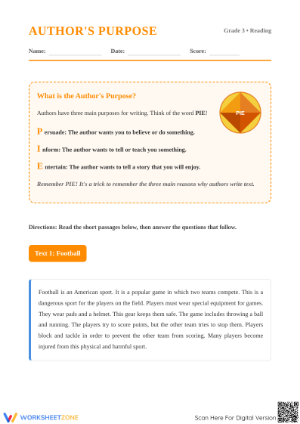
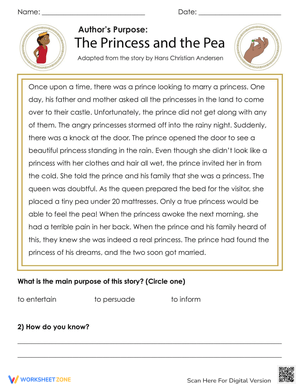
The set covers all three PIE categories — Persuade, Inform, Entertain — across the text types 3rd graders encounter regularly in both reading and writing instruction. Students work with passage excerpts drawn from opinion letters, how-to texts, news reports, narrative fiction, and short poems. The task structure stays consistent: read the passage, identify the purpose, then mark the specific words or sentences that support the answer.
- Circling signal words and persuasive language in opinion and advertisement excerpts
- Underlining facts, dates, or procedural steps that mark a text as informational
- Identifying character focus, dialogue, or sensory description as markers of entertaining text
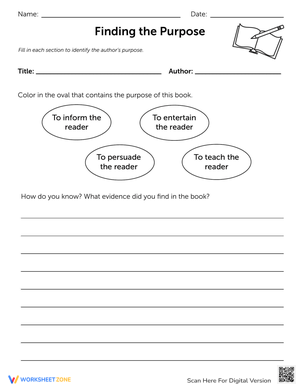
- Writing a one-sentence justification using explicit evidence from the passage
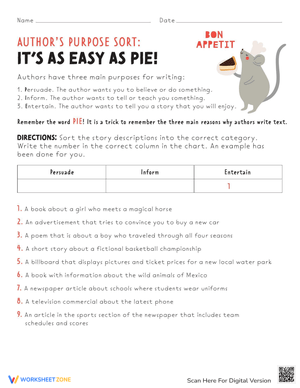
- Sorting paired passages — two texts on the same subject, different purposes — into the correct PIE category
That paired-passage task is where the real thinking happens. Placing a paragraph about monarch butterfly migration next to a short story where a monarch narrates her own journey puts the contrast in sharp relief. Students who could guess "entertain" on an obvious fairy tale have to actually look at structure and word choice when both texts share a subject.
Student Errors Worth Anticipating Before You Teach This Unit
The most consistent pattern in student work is defaulting to "entertain" when a passage is unfamiliar or hard to follow. If a student does not track what an author is saying, guessing "entertain" feels like a safe middle ground — it seems the most neutral answer. A 3rd grader will write "entertain" for a paragraph about weather systems because she did not read the facts closely enough to recognize inform. Catching that pattern early tells you who needs more exposure to nonfiction text features before PIE instruction actually lands.
A trickier error shows up with well-written informational text. When a nonfiction passage opens with an engaging anecdote — "Marcus had always wondered why the sky turned red at sunset" — students often mark it as entertain because it reads like a story. They are attending to voice and tone instead of content and structure. That is actually a sophisticated misread, and it is worth naming explicitly: interesting writing can still be informational. The purpose is about what the author is doing with the text, not how enjoyable it is to read.
Standard Alignment
These author's purpose printable worksheets for 3rd grade target CCSS.ELA-LITERACY.RI.3.6, which asks students to distinguish their own point of view from the author's. That standard sits inside the Craft and Structure strand — explicitly about what the author is doing and why, not simply what the text says. In most 3rd grade classrooms, RI.3.6 appears in the second reading unit, after students have worked on main idea and key details. Author's purpose fits there naturally: once students know what a text says, asking why it was written is the next analytical layer.
The evidence-based response tasks — "which sentence told you the author's purpose?" — also support RI.3.1, which requires students to ask and answer questions using explicit text evidence. That overlap makes the set useful for addressing two standards within the same short practice session without forcing the connection.
How to Work These Worksheets Into Your Weekly Lessons
The most efficient entry point is the Monday morning warm-up block. A single worksheet takes roughly eight to ten minutes — long enough to re-anchor the concept after the weekend, short enough to leave time for the main lesson. Students who finish early can flip the worksheet over and write their own three-sentence persuasive pitch for anything they want more of at school, which layers a low-stakes writing task onto the reading practice without requiring a separate handout.
For literacy centers, these author's purpose printable worksheets for 3rd grade run well as a three-rotation setup: one group works independently on a passage, one pair does the cut-and-paste sorting version together, and a third group meets with the teacher for guided reading. The independent format keeps non-teacher groups on task without requiring complex directions, which matters when you have seven minutes before a group transitions.
Small group instruction is where the justification-writing task earns its place. Sitting with four students and asking each one to read their evidence sentence aloud — "what in the text made you think persuade?" — surfaces immediately who holds the concept and who is still guessing. That formative check is harder to get from a whole-class discussion where stronger students carry the answers.
Differentiating These Worksheets Across Ability Levels
For students still building reading fluency, reduce the cognitive load by pre-annotating short sections of the passage before you hand it out. A brief note in the margin — "this is a fact," "this word is an opinion signal" — lets students with weaker decoding put their working memory toward categorizing rather than decoding. They still practice the reasoning; the added context keeps them from spending all their effort just getting through the text.
Students who have the PIE categories solidly in place need more friction, not more of the same task. Give them dual-purpose texts — a biography that clearly also celebrates its subject — and ask them to argue for a primary purpose in a short written response. Moving from identifying to defending is a meaningful step up in analytical thinking, and it previews the author's-purpose reasoning that appears consistently in 4th and 5th grade ELA.
For English language learners, the signal-word tasks in these author's purpose printable worksheets for 3rd grade serve as a particularly useful entry point. Persuasive language and factual language carry distinct vocabularies — should, must, believe versus according to, research shows, for example — and students building academic English benefit from seeing those patterns labeled and repeated across multiple short passages before they identify them independently.
Frequently Asked Questions
Does PIE cover all possible author purposes, or are there purposes it leaves out?
PIE covers the three purposes that appear most often in 3rd grade ELA and on standardized assessments at this level. Some curricula add a fourth category — Express — for texts where an author shares personal feelings, such as personal narratives or journal entries. At the 3rd grade level, those texts are usually grouped under Entertain unless your school's curriculum explicitly introduces a four-part framework. Stick with the framework your curriculum uses; switching between systems mid-unit introduces confusion that costs more than the added nuance is worth.
What is the difference between Inform and Explain for 3rd graders?
Most 3rd grade classrooms keep both under the Inform umbrella, and that is appropriate. If the distinction comes up, a practical frame: inform tends to answer "what" — what a dolphin eats, what the water cycle is — while explain tends to answer "how" or "why" — how the water cycle works, why dolphins travel in pods. Both involve facts and evidence, and both contrast with persuasion and fiction in the same way. The distinction rarely affects standardized assessment at this grade level, so do not let it derail early instruction.
Can a text have more than one purpose?
Yes, and that complexity is real — but it is a lesson for after students have the basic categories solidly. A biography can inform and entertain simultaneously. A fundraising letter can inform and persuade. For initial instruction, ask students to identify the primary purpose. Once they do that reliably across multiple text types, paired-purpose discussions make a strong extension lesson, usually in the second half of the unit when the concept has settled.
How long does each worksheet take in a typical class period?
Most 3rd graders finish the passage-and-response format in eight to twelve minutes. The cut-and-paste sorting worksheets run a few minutes longer because of the physical manipulation involved. If a student consistently takes more than fifteen minutes, that is usually a fluency issue with the passage rather than a conceptual gap with author's purpose — worth noting when you look at the work and plan your next step.












 Interactive Worksheet Maker
 Quiz Maker
 Word Search Maker
 Crossword Puzzle Maker
 Word Scramble Generator
 Sentence Scramble Generator
 Handwriting Worksheet Generator
 Name Tracing Generator
 Fill In The Blank Generator