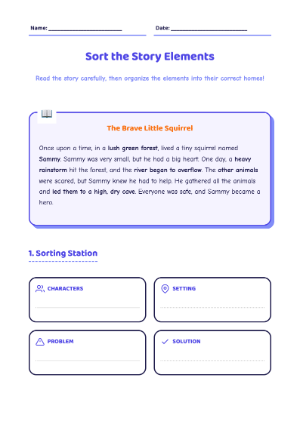
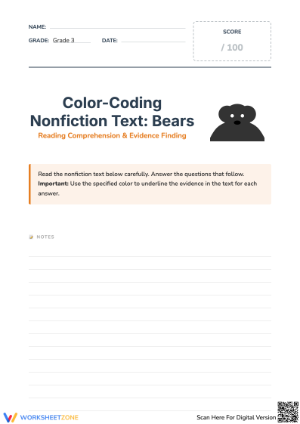
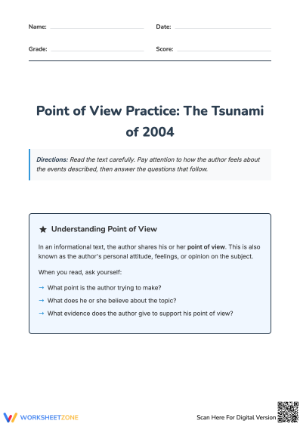
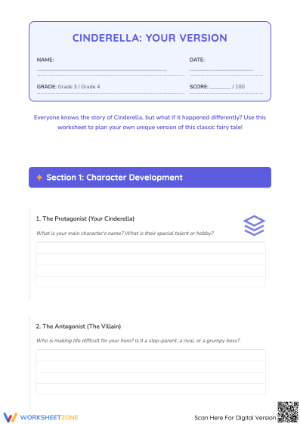
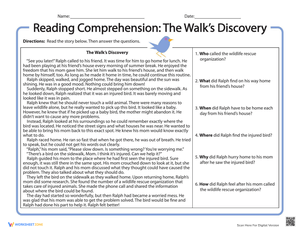
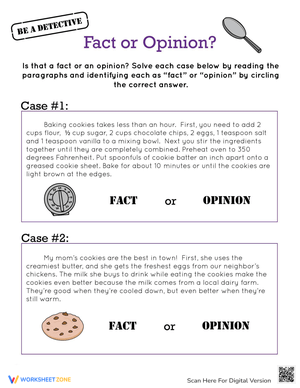
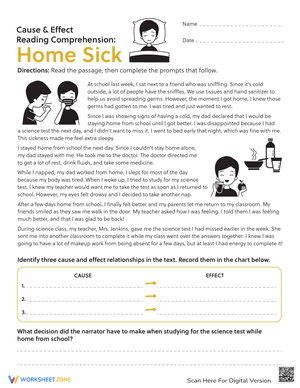
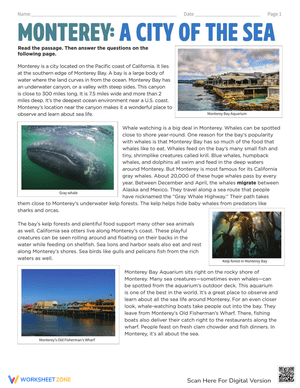
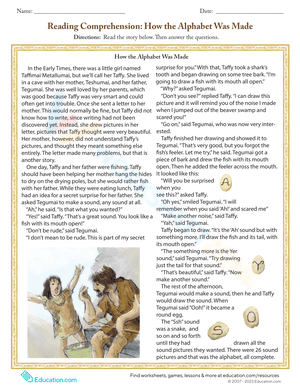
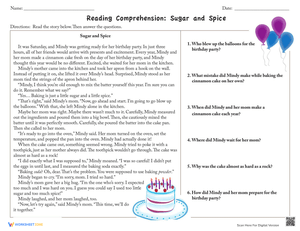
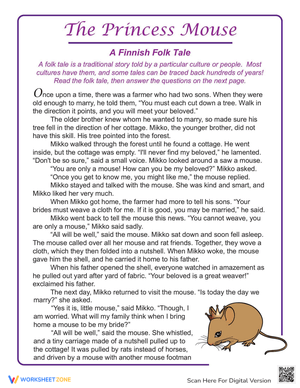
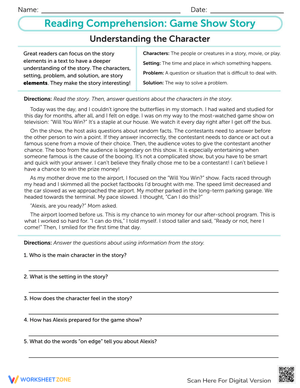
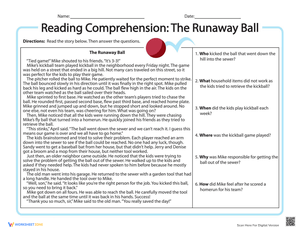
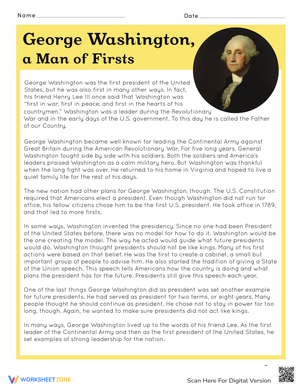
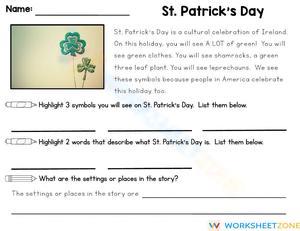
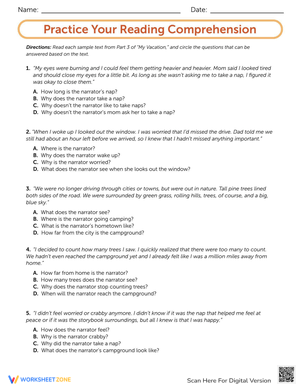
These text evidence printable worksheets for 3rd grade give teachers a ready set of structured reading tasks built around one of the hardest habits to develop at this grade level: going back into the text to prove an answer rather than simply stating it. Each worksheet pairs a short passage with targeted questions that require students to underline, copy, or paraphrase the specific words that support their thinking — and the answer key tells you at a glance which students are still working from memory rather than from the page.
The Specific Skills These Worksheets Target
The tasks in this set sit at the intersection of reading comprehension and written response. Students are not just answering questions — they are marking where the answer lives. Across the worksheets, the specific work includes:
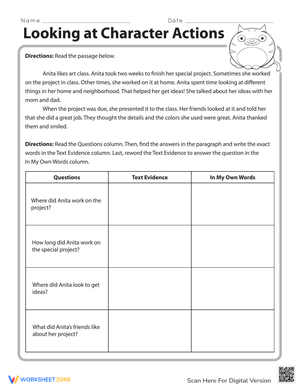
- Underlining the sentence or phrase that directly answers a given question
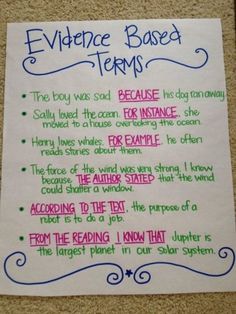
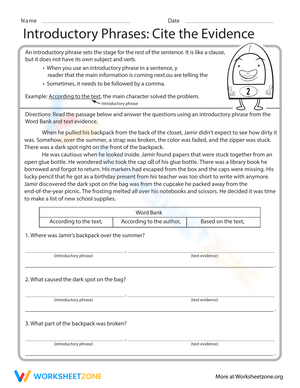
- Writing out quoted text using provided sentence frames ("The text says..." or "According to the passage...")
- Explaining the connection between a piece of quoted evidence and the question being answered
- Distinguishing between direct quotes and their own inferences — a distinction third graders find genuinely difficult
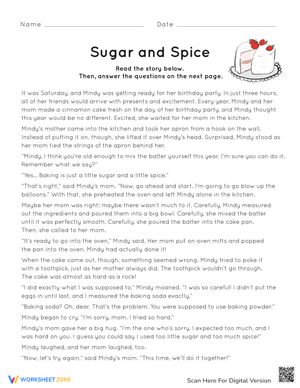
- Locating evidence across both literary passages (character traits, motivation, plot details) and informational texts (stated facts, author's claims)
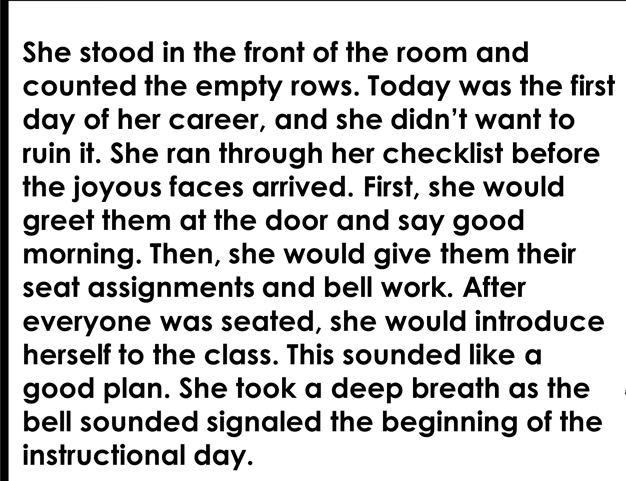
The fiction-nonfiction split matters. A third grader who can find evidence that a character "felt nervous" by pointing to "her hands shook and she looked at the floor" is doing something meaningfully different from locating a fact in a science article. Both types of evidence work appear in the set, and both get enough repetitions that the habit of returning to the text becomes automatic rather than effortful.
Frequent Student Errors Worth Anticipating Before You Hand These Out
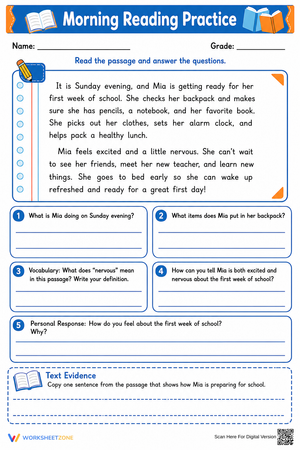
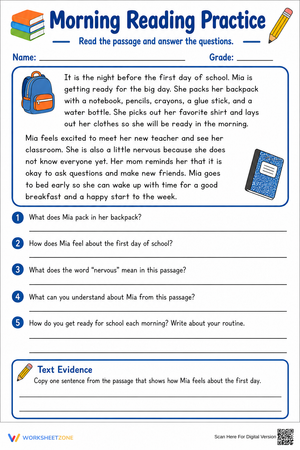
The most consistent third-grade error is not an unwillingness to cite — it is a misunderstanding of what counts as evidence. Many students copy the sentence that contains a vocabulary word from the question rather than the sentence that actually proves the answer. A student asked "How do you know Mia was brave?" will often write "Mia ran into the building," when the real textual proof is the line that follows: "She knew it was dangerous, but she went anyway." They find word-match, not meaning-match. Naming that error explicitly before students begin an independent worksheet saves significant time in the discussion that follows.
A second pattern: students who copy an entire paragraph because the answer was "somewhere in there." They have not yet developed the precision to isolate the one sentence doing the work. The response boxes on each worksheet are intentionally narrow — one or two lines — which quietly forces students to make a selection rather than produce a transcript. That constraint is doing real instructional work.
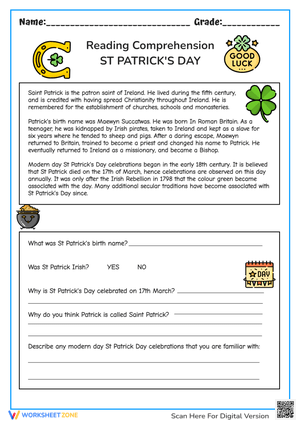
In nonfiction, watch for a third error: students citing text that is true but irrelevant to the specific question asked. The fact is in the passage; it just does not answer what was asked. A five-minute class discussion after an independent practice worksheet, spent on exactly that distinction, is one of the more productive uses of these materials.
How to Work These Worksheets Into Your Lesson Plans
These work particularly well as the ten-minute opener that follows a shared read-aloud. While the class's attention is still high and the text is fresh, a short worksheet asking students to locate two pieces of evidence functions as both reinforcement and formative check. Reading the responses that afternoon tells you quickly which students are answering from memory and which ones know how to find proof.
Text evidence printable worksheets for 3rd grade also drop naturally into the Friday review block when the week's anchor text has already received full discussion. By Friday, students have heard teacher modeling and peer conversation — an independent worksheet at that point measures whether they can execute the skill on their own, which is exactly the data you need before moving to a new text.
A few practical notes: shorter passages — four to six sentences — work better early in the year, when students are still managing the two-step cognitive load of reading and searching simultaneously. Save the longer nonfiction passages for late October and beyond, once the routine is settled. Peer review, where students swap worksheets and argue whether their partner's cited line actually answers the question, generates the kind of text-based disagreement that no teacher-led discussion quite replicates.
Standard Alignment
These worksheets address CCSS.ELA-Literacy.RL.3.1 and RI.3.1, both of which require third graders to ask and answer questions by referring explicitly to the text. The RL standard covers literary texts; the RI standard covers informational ones — which is why the set includes both passage types rather than defaulting to one genre. In classroom terms, RL.3.1 and RI.3.1 mark the first grade level where "refer to the text" appears as an explicit student requirement rather than an implicit teacher expectation. Third grade is when citing evidence transitions from a teacher prompt ("Can you find that in the story?") to a student responsibility ("I'll write the sentence that proves it"). These worksheets target that transition directly, providing the structured repetition needed to make the expectation stick before students hit the heavier evidence demands of fourth grade.
Differentiating the Set Across Ability Levels
For students who struggle to locate evidence at all, the most effective adjustment is pre-marking. Before distributing the worksheet, highlight two or three candidate sentences in the passage. The student's task becomes evaluating which highlighted sentence best answers the question — a judgment task rather than a cold search through unfamiliar text. This keeps them working on the actual skill (distinguishing relevant from irrelevant evidence) without the added cognitive load of an open-ended search. Students who need this support often surprise you once the search burden is removed.
For students who find the standard worksheets too easy, add a second layer: after they cite the evidence, ask them to write one sentence explaining why that line proves their answer and not a different line. This pushes well past recall into analytical reasoning, and the written responses reveal quickly who is ready for the more demanding evidence tasks that fourth-grade instruction will require.
Frequently Asked Questions
How do I stop students from copying an entire paragraph as their evidence?
Name the skill explicitly before they begin: their job is to find the one sentence that does the most work. Have students underline the evidence first, then circle the tightest version of that underline before writing anything down. Modeling this trimming process under a document camera — reading a passage aloud and physically crossing out sentences that are true but not relevant to the question — gives students a concrete procedure they can repeat on their own.
Which sentence starters actually hold up with 8- and 9-year-olds?
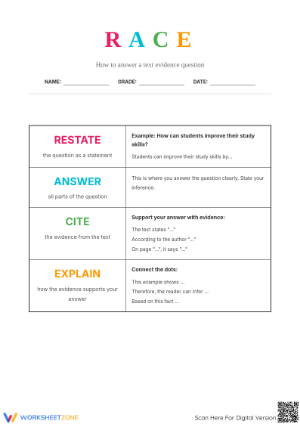
Short ones. "The text says...", "The author wrote...", and "In the passage, it says..." are the three that work in practice without turning into a crutch. The RACE frame gets introduced in many third-grade classrooms, but starting only with the C — the citation step — prevents students from getting lost in a four-part process before they have part one under control. Add the rest of the frame later, once isolating evidence feels routine.
Do these worksheets support standardized test preparation?
Yes, and the connection is direct. Most third-grade assessments include at least one item asking students to identify the best evidence for a stated answer, and some require a written response with a direct citation. Regular practice with text evidence printable worksheets for 3rd grade from September onward — not just during a test-prep sprint — builds the retrieval habit that those assessment formats measure. Students who have cited evidence three or four times a week all year approach test-format questions as familiar work rather than a new task under pressure.
How often should third graders practice this skill?
Three to four times per week is the range where the habit solidifies without crowding out other reading instruction. That does not mean a full worksheet every session — a single question with one citation, dropped into a read-aloud as a quick written stop, counts toward that total. What matters most is that the expectation appears frequently enough that rereading to find proof becomes a reflex rather than a chore.
Why do the worksheets include both fiction and nonfiction passages rather than sticking to one?
Because the evidence work is genuinely different across genres, and students need to know that. In fiction, they are usually locating character behavior, dialogue, or description to prove a trait or feeling. In nonfiction, they are finding stated facts or data points. Both appear on the text evidence printable worksheets for 3rd grade in this set so that students do not arrive at a science or social studies text surprised that citing evidence looks different from what they practiced during reading workshop.












 Interactive Worksheet Maker
 Quiz Maker
 Word Search Maker
 Crossword Puzzle Maker
 Word Scramble Generator
 Sentence Scramble Generator
 Handwriting Worksheet Generator
 Name Tracing Generator
 Fill In The Blank Generator