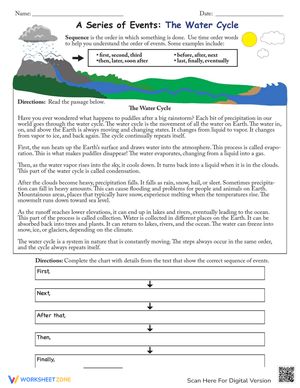
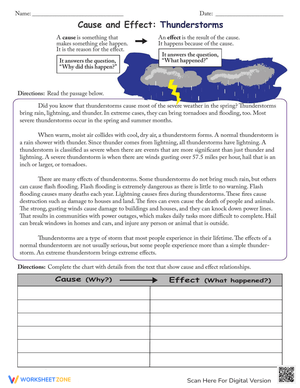
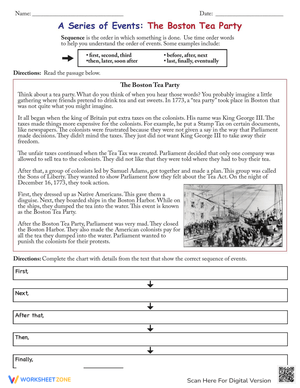
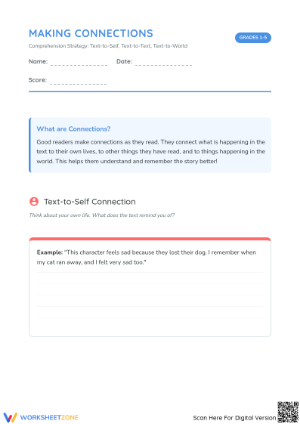
These making connections in reading printable worksheets for 3rd grade give teachers a structured set of resources for one of the most productive comprehension moves at this grade—drawing on prior knowledge to track meaning in new text rather than treating reading as an isolated decoding exercise. Third grade is a genuine developmental hinge: most students have cracked the mechanics of reading, and instruction shifts toward using what they already know to build schema, infer character motivation, and compare texts across sources. Each worksheet targets one connection type so teachers can sequence instruction deliberately instead of asking eight-year-olds to manage all three frameworks before they've internalized any of them.
Three Connection Types, Three Distinct Skill Sets
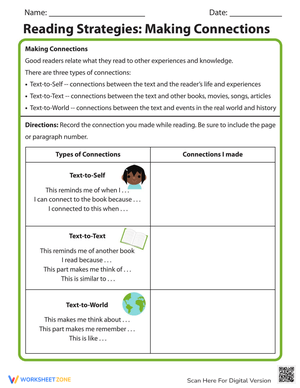
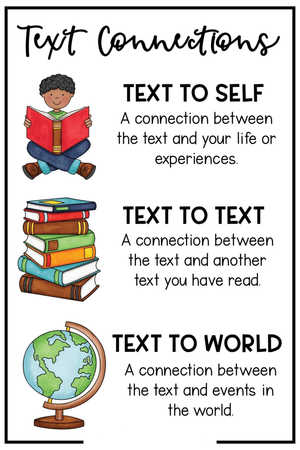
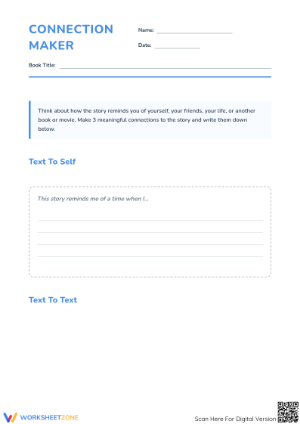
The making connections in reading printable worksheets for 3rd grade set is organized around the standard three-part framework—text-to-self, text-to-text, and text-to-world—but each type gets its own dedicated resources rather than being grouped onto a single organizer. Text-to-self worksheets use sentence frames—This part reminds me of a time when I... and I understand how the character feels because...—followed by a follow-up prompt asking how the connection changes the student's understanding of the text. That second step is what separates the strategy from free association.
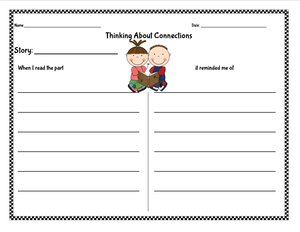
Text-to-text worksheets pair an anchor passage with a structured comparison task. Students name a book, article, or poem they've previously read, then annotate two or three specific parallels—not just shared topic ("both involve animals") but theme or structure ("both main characters learn that avoiding a problem makes it worse"). Some worksheets use Venn diagrams; others use a two-column comparison format, which tends to work better for students who overcrowd circle diagrams and can't read what they wrote.
Text-to-world worksheets are deliberately narrow in scope. Instead of asking "How does this connect to the world?"—a prompt that produces blank stares from most eight-year-olds—they ask something more bounded: "What does this story make you think about that happens in real life outside your home or school?" Tighter prompts get actual writing. Students mark the relevant passage, write the connection, and then identify the type using a labeled sorting box in the corner of each worksheet, which builds metacognitive awareness gradually across the set.
The Connection Errors Third Graders Make Most Often
The most persistent problem in this work isn't wrong connection types—it's thin ones. A student who writes "I have a dog too" next to a passage about a boy and his dog has technically completed the task but hasn't moved any closer to comprehending the text. The follow-up prompt embedded in each worksheet—"How does this connection help you understand the story better?"—is where you see who is doing genuine comprehension work versus who is pattern-matching to finish. Read those responses carefully in your formative review. The gap between "it helps me because I like dogs" and "it helps me understand why losing the dog hurt him so much, because I know that feeling and how long it stays with you" is exactly the gap you're teaching toward.
Text-to-text and text-to-world connections get confused with each other regularly, and it's an understandable mix-up. A student comparing a story to a documentary she watched doesn't know whether that's a T-T or T-W connection—and honestly, the line is blurry. Use the confusion as a discussion anchor rather than correcting it with a rule. The question that clarifies most quickly is where the student encountered the comparison: in a text she read, or through lived experience and the broader world?
How to Fit These Worksheets Into a Real Reading Block
The gradual release model fits this skill well. Start the first week with a read-aloud that has clear emotional stakes—a character facing an unwanted change, or a nonfiction passage about something students have direct experience with. Read aloud and pause visibly, name the connection type out loud, and fill in the T-S worksheet on the projector while thinking through the decision. Third graders benefit from watching an adult hesitate: "I'm trying to decide if this is text-to-self or text-to-world—let me work through it." That modeled deliberation is more instructionally useful than a clean, confident demonstration.
Move to shared-text practice before assigning any independent worksheets. Students annotate the passage together, discuss possible connections in pairs, and then write independently before a brief whole-class share. This sequence means the first solo attempt doesn't happen without any prior model or talk time. Exit tickets near the close of a reading block—just the connection frame and the follow-up question—take about six minutes and immediately surface which type is stalling. If text-to-world responses are mostly blank or one-word on a Wednesday, spend Thursday's read-aloud on T-W before moving forward. That kind of responsive adjustment is what these worksheets make possible when you use them diagnostically rather than just for completion credit.
Standard Alignment
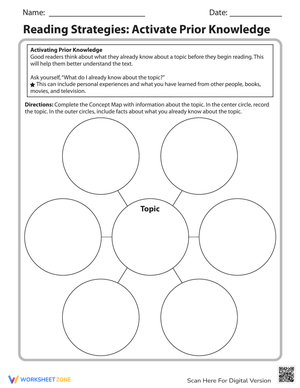
The set most directly supports CCSS.ELA-LITERACY.RL.3.9, which asks third graders to compare and contrast themes, settings, and plots across texts by the same author—a task structurally identical to a text-to-text connection made explicit and supported with evidence. The worksheets also reinforce RL.3.1, since making a connection activates the prior knowledge students need to answer inferential questions accurately rather than guessing. When a student writes a text-to-world connection linking a fictional drought to something studied in a science unit on water cycles, that response demonstrates the cross-subject inference work RL.3.1 expects at this grade. Both standards appear prominently on third-grade ELA assessments, which makes this a skill worth returning to in short cycles throughout the year rather than teaching once in a unit and moving on.
Adjusting the Set for Struggling and Advanced Readers
For students who stall before they start, pre-selecting the passage and limiting each session to one connection type already reduces the difficulty considerably. Adding a word bank of emotion words alongside the T-S frames helps students who struggle to name feelings move past the blank box and into the explanatory writing more quickly. For students reading well below grade level, pairing each worksheet with a read-aloud rather than independent silent reading keeps the comprehension strategy in focus without letting decoding difficulty swallow the lesson.
For students who write surface responses and finish quickly, the making connections in reading printable worksheets for 3rd grade set includes open-ended follow-up prompts that push past the connection itself: "Did making this connection change what you predicted would happen? Why or why not?" Students comfortable at this level can also be asked to write their own sentence frames for a connection type—a harder task than filling in a provided frame, because it requires understanding the structure well enough to generate one independently.
Frequently Asked Questions
Do these worksheets require specific passages, or can I use my own classroom texts and read-alouds?
Each worksheet leaves the passage slot open—you attach your own text to it. This makes the set workable across fiction, nonfiction, and poetry without modification. The main variable is passage length: very brief excerpts sometimes leave students without enough content to find a meaningful connection, especially on T-T and T-W tasks. Two to four paragraphs gives most students enough material to work with across all three worksheet types in the set.
Should I introduce all three connection types together, or teach them one at a time?
Teach them in sequence, one type per instructional cycle. Introducing all three at once reliably produces students who can recite the labels but can't apply any of them accurately. A week on T-S, a week on T-T, a week on T-W—followed by regular review cycles—gives students real practice with each type before adding complexity. The making connections in reading printable worksheets for 3rd grade set is arranged by connection type to support exactly this kind of sequenced instruction rather than mixing all three from day one.
How do I know if students are using connections as a real comprehension tool, or just completing the form?
Read the follow-up prompt response, not just the connection box. A student who writes "It helps me because I've felt nervous too" has made a connection but hasn't used it to understand anything. A student who writes "It helps me understand why Jaylen didn't tell his teacher—I know that feeling of hoping a problem disappears if you ignore it long enough" is doing genuine comprehension work. Score those two parts of each worksheet separately in your formative notes. The connection box is the entry point; the follow-up response is the comprehension evidence.












 Interactive Worksheet Maker
 Quiz Maker
 Word Search Maker
 Crossword Puzzle Maker
 Word Scramble Generator
 Sentence Scramble Generator
 Handwriting Worksheet Generator
 Name Tracing Generator
 Fill In The Blank Generator