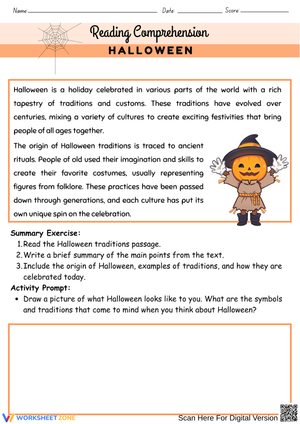
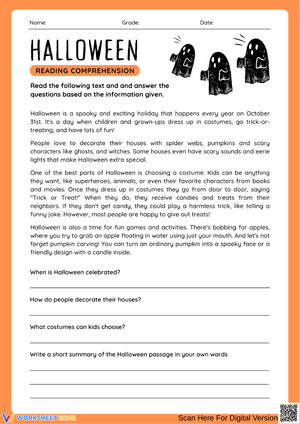
3rd grade summarizing printable worksheets give students a concrete place to practice the cognitive move that defines third-grade reading comprehension: deciding what counts and leaving out what doesn't. The set covers literary and informational texts separately, which matters because the mental process is genuinely different depending on the type of text in front of a student.
The Specific Skills Each Worksheet Targets
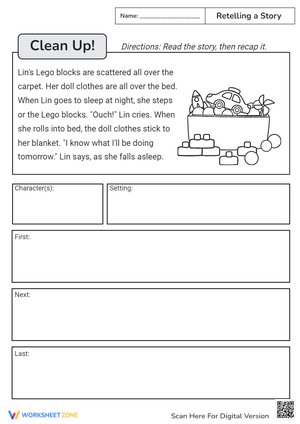
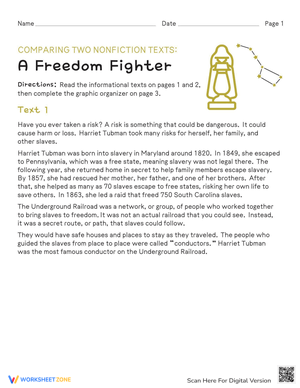
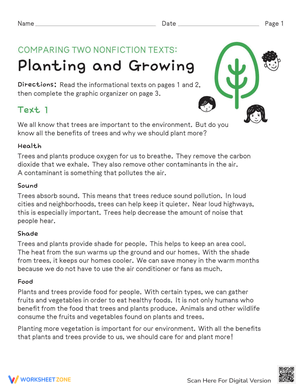
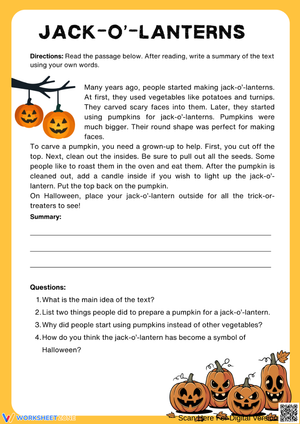
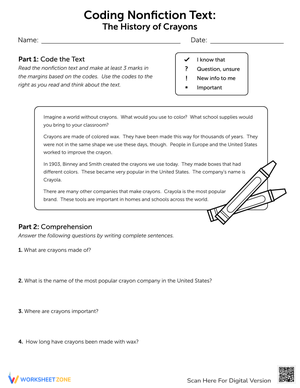
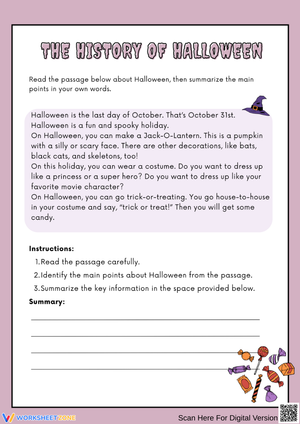
Fiction worksheets are built around the SWBST framework — Somebody, Wanted, But, So, Then — which gives students a reliable structure for identifying a character's goal, the obstacle standing in the way, and how the story resolves. Students complete each cell, then use their notes to produce a two- to four-sentence summary. Non-fiction worksheets shift to main idea and key details, asking students to mark the central claim and distinguish it from supporting evidence. Several worksheets in the set use a deletion approach: students receive a paragraph and cross out details that could disappear without changing the core meaning. That exercise changes how students think about the task — instead of hunting for what to include, they start asking what the text can lose.
Across both text types, students practice these moves:
- Identifying the main idea versus a supporting detail in a labeled paragraph
- Completing partially written summaries by filling in the most important missing information
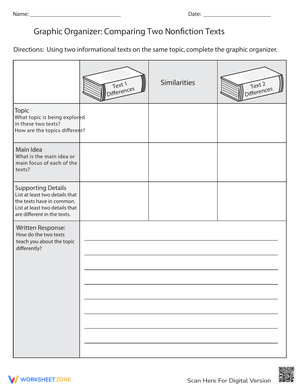
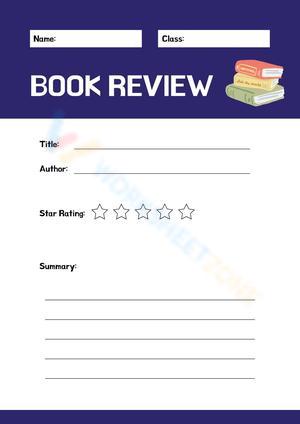
- Writing a summary from scratch using a graphic organizer as a guide
- Sorting a list of statements into "essential to the summary" and "interesting but not essential"
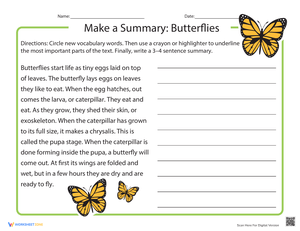
- Rewriting an over-long retelling into a focused three-sentence summary
Common Mistakes That Show Up in Student Summaries
The most persistent error in third grade is what teachers sometimes call the retelling trap: a student produces a perfectly accurate account of every event in the story, in order, and calls it a summary. The writing isn't wrong — it's just too complete. A student who can tell you that Marcus found the dog on Tuesday, brought it home on Wednesday, hid it under his bed Thursday, and finally convinced his mom on Friday has read the passage carefully. But a summary of that story is considerably shorter: a boy secretly adopts a stray dog and convinces his mother to keep it. Getting students to see the difference between a thorough retelling and a brief summary is the central instructional challenge these worksheets address.
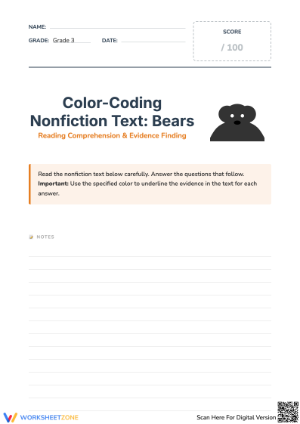
A related error appears more often in non-fiction work. Students lock onto a striking detail — a cheetah's top speed, the exact height of Mauna Kea — and treat it as the main idea, even when the passage is clearly organized around a broader claim. The worksheets build in a step where students identify the heading or topic sentence before reading the supporting details. That sequencing reduces how often this happens because it gives students an anchor before the interesting facts start competing for attention.
Fitting These Worksheets Into the Reading Block
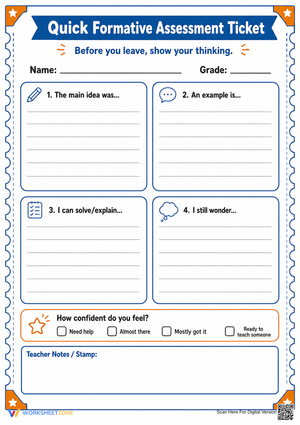
These work well as a follow-up to whole-class read-alouds. After finishing a short text, hand out the matching worksheet and give students eight to ten minutes to complete it independently before a brief share-out. That's enough time for students to capture their thinking while the text is still fresh, and the completed worksheet becomes an immediate formative snapshot — you can see in thirty seconds whether a student is still retelling or has started summarizing.
Literacy centers are another natural fit. Two students read a leveled passage together, then each completes the worksheet independently. The comparison that follows — "did you pick the same main idea I did?" — generates productive disagreement that builds comprehension. These resources also pull weight during the five minutes after a science or social studies read when there isn't time for a full discussion: students jot the main idea and one or two key details, and you collect the worksheets as an exit check. 3rd grade summarizing printable worksheets run short enough to fit these marginal instructional windows without eating into transition time.
Tiering the Work for Different Readers
For students who freeze in front of a blank response box, the most useful adjustment is adding a sentence starter directly on the worksheet — something like "The most important idea in this text is..." or "This story is mainly about..." That small structural support reduces the activation cost of getting started without changing the cognitive demand of the task itself.
Advanced readers benefit from tighter constraints rather than more open-ended prompts. Give them a word limit — twenty words, or two sentences at most — and the task becomes considerably harder than an open summary. Students who typically rush through will slow down when they realize they have to cut their first draft in half. For this group, 3rd grade summarizing printable worksheets serve as a starting point; the real challenge is the self-imposed restriction that follows. You can also ask these students to write a one-sentence headline version of their summary after finishing the worksheet, which pushes toward genuine synthesis rather than polished retelling.
Standard Alignment
These worksheets align with CCSS.ELA-LITERACY.RL.3.2 (recount stories and determine the central message) and CCSS.ELA-LITERACY.RI.3.2 (determine the main idea of an informational text and explain how key details support it). Both standards land at third grade for a specific reason: prior to this level, the CCSS asks students to retell with key details; at third grade, the language shifts explicitly to "recount" and "determine," signaling that analysis and selection are now the expectation, not recall alone. The worksheets address exactly that developmental shift, making them a direct instructional match for where the standards place the skill.
Frequently Asked Questions
What is the difference between retelling and summarizing at the third-grade level?
Retelling covers the sequence of events in order — who did what, when, in what order. Summarizing asks students to step back and name the central point or message without tracking every event. Third graders are developmentally ready to begin making that distinction, but most need explicit instruction and repeated practice before the difference feels real to them. A retelling of Charlotte's Web runs several pages; a summary fits in two sentences.
How do the fiction and non-fiction worksheets differ in structure?
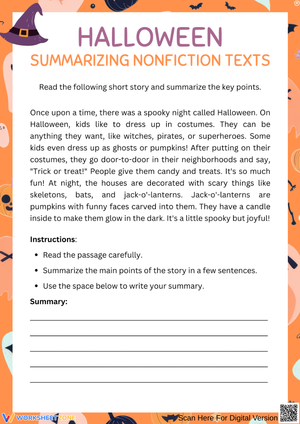
Fiction worksheets are organized around narrative structure — character, conflict, and resolution — so students have a reliable frame for any story they encounter. Non-fiction worksheets are built around main idea and supporting details, which mirrors the way informational texts are actually constructed. Keeping the two formats distinct matters because treating them the same produces a common error: students summarize a science article the way they'd summarize a story, which results in a confused sequence of "first it says... then it says..." rather than a central claim with evidence.
Can these worksheets support small-group instruction?
In a small group, the worksheet becomes a discussion tool rather than a silent independent task. Read a passage together, then work through the worksheet collaboratively, pausing to talk through disagreements about what counts as the main idea. The graphic organizer sections are especially useful here because students can see each other's thinking laid out side by side. This format also gives you real-time information about which students are still conflating interesting details with central ideas — a distinction that is genuinely hard to spot when students are working quietly at their seats.
How do I help a student who consistently writes summaries as long as the original passage?
Give that student a word budget before they begin. Tell them their summary can be no more than twenty-five words, and let them count as they write. The constraint forces a decision-making process that lengthy open-ended summaries don't require. Some students also benefit from crossing out sentences in the original text before they begin writing — physically removing what won't appear in the summary makes the selection process visible rather than abstract. 3rd grade summarizing printable worksheets that include a built-in deletion step develop this habit from the first attempt rather than waiting until students have already formed the retelling pattern.












 Interactive Worksheet Maker
 Quiz Maker
 Word Search Maker
 Crossword Puzzle Maker
 Word Scramble Generator
 Sentence Scramble Generator
 Handwriting Worksheet Generator
 Name Tracing Generator
 Fill In The Blank Generator