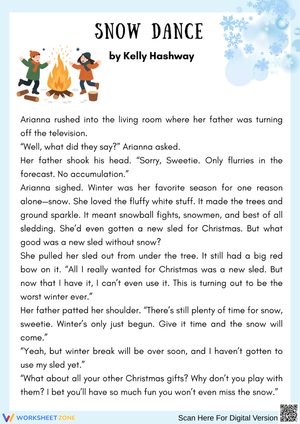
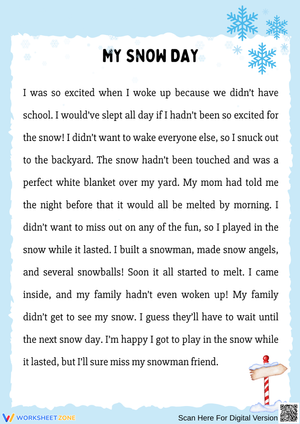
Reading fluency printable worksheets for 3rd grade give teachers a repeatable, data-ready practice structure for the skill that determines whether a third grader reads to learn or just reads at words. Each worksheet in the set targets accuracy, reading rate, or prosody — or some combination of the three — using leveled passages with line-by-line word counts, recording grids for multiple timed reads, and short comprehension questions printed directly on each worksheet. Teachers who build consistent fluency practice into their blocks see measurable gains in words correct per minute and, more importantly, in reading confidence.
What Each Worksheet Targets
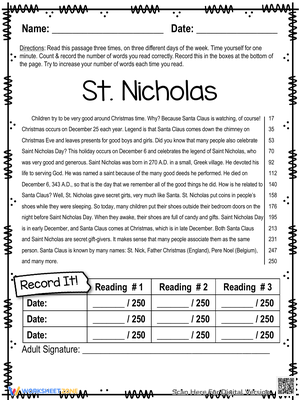
The three components of fluency don't develop in lockstep. A third grader who reads every word correctly may still read at 55 words per minute with a flat, word-by-word cadence. Another student may race through a passage at 120 words per minute but miss eight words per hundred. These reading fluency printable worksheets for 3rd grade address both profiles — and every variation between them — by building accuracy tracking, timed reading grids, and prosody prompts into each worksheet itself rather than leaving teachers to construct those structures separately.
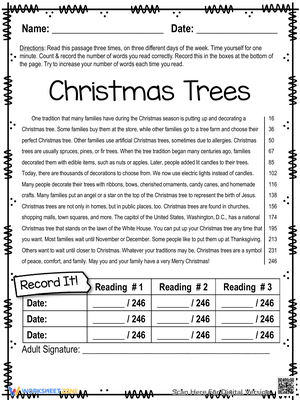
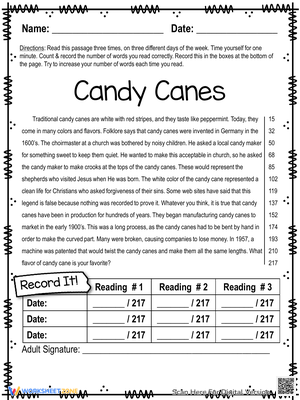
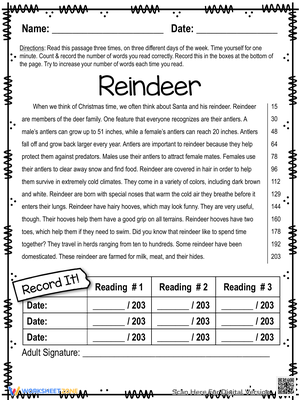
Each worksheet in the set includes:
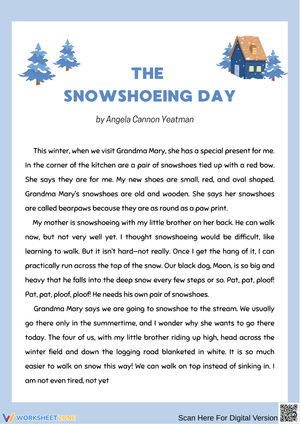
- A leveled passage in the 520L–820L Lexile range, matched to the Grade 3 complexity band
- Cumulative word counts at the end of each line for quick WCPM calculation after a one-minute read
- A recording grid for three to four timed attempts on the same passage
- Two to three comprehension questions that confirm reading speed is not substituting for understanding
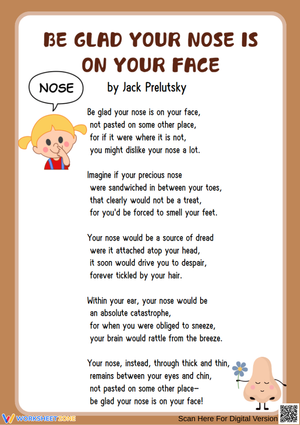
Prosody-focused worksheets add bold punctuation and phrase-boundary markers to prompt students to pause meaningfully at commas, shift tone at question marks, and carry energy through exclamation points. Many third graders read with a uniform, clipped cadence even after accuracy stabilizes — the phrase-marking format makes the expected phrasing visible before students practice independently.
Mistakes Students Make That These Worksheets Help You Catch
One of the most consistent patterns in third-grade oral reading: students who read accurately in isolation will insert function words under time pressure. "The girl walked to the door" becomes "The girl walked to the big door" — a word the student's brain expected was there, so it appeared. Error-tracking columns on each worksheet make this pattern visible during timed reads. The fix is usually quick once identified: briefly slow the pace, have the student point under each word, then release back to normal reading. Without a consistent error tally, the habit persists undetected for weeks.
Students who read for speed tend to drop morphemes. "Jumped" becomes "jump," "running" becomes "run." These miscues rarely destroy comprehension in a third-grade passage, but they indicate the student is not reading through complete words — a habit that creates real problems in Grade 4 when inflectional endings and derivational suffixes carry meaning the text depends on. The error column on each worksheet separates raw WCPM from accuracy-adjusted WCPM, which shifts the conversation from "you read fast" to "you read fast and accurately."
The prosody error we see most consistently in student recordings is treating a comma like a full stop. Students pause hard after every comma, which destroys phrasing and, counterintuitively, slows their rate. A two-minute teacher demonstration — reading the same sentence both ways — followed by whisper practice at each student's seat resolves this faster than extended drill. The annotated phrase-mark passages in this set make the expected pause pattern explicit before students attempt independent reading.
How to Work These Worksheets Into Your Week
The five minutes before reading groups start is one of the most consistently wasted instructional windows in a third-grade classroom. A timed passage fits there without any restructuring: students pull their worksheet folder, read while a partner marks errors, stop at one minute, count WCPM, and record the score. That routine takes under six minutes and generates usable data three times a week — without touching the rest of the block plan.
Partner reading with each worksheet's built-in feedback section works well mid-week, after students have encountered the passage at least once on their own. One student reads aloud while the other follows along and rates accuracy, rate, and expression using the three-point rubric printed at the bottom of the worksheet. The rubric language is simple by design — "mostly accurate," "some mistakes," "many mistakes" — because the purpose is accountability, not detailed assessment. Roles reverse. The full activity runs in about twelve minutes inside a 45-minute block.
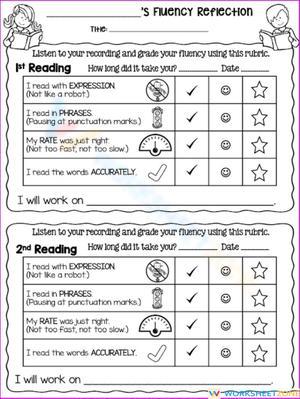
Once per quarter, record students reading the same passage at the start and end of a two-week cycle, then play both recordings back to back. Third graders are concrete thinkers. Hearing their own voice improve is more motivating than watching a WCPM number move by eight points on a tracking chart. Pair the playback with a printed self-reflection sheet where students circle whether they improved in speed, accuracy, or expression. That naming step builds a metacognitive habit that transfers well beyond the fluency unit itself.
Adjusting These Worksheets for a Range of Learners
Reading fluency printable worksheets for 3rd grade work well across a wide ability range when teachers make a few targeted adjustments. Students reading below the 40th percentile on the Hasbrouck-Tindal chart — roughly below 70 WCPM in winter — do better with shorter passages and narrow, achievable goals: four to six WCPM of growth over two weeks rather than a comparison to the grade-level benchmark. The visual progress bar on the tracking worksheet makes even small gains concrete, which matters more than teachers often expect at this age.
Students already reading above 115 WCPM with strong accuracy need a different challenge: prosody and comprehension depth rather than more rate work. The dialogue-heavy and expository passages in the set work well for this group. Use the comprehension questions on each worksheet as discussion prompts rather than written recall items — ask students to explain how they arrived at an answer, not just what it is.
Students with active decoding gaps need passages at their actual reading level, which may fall below the Grade 3 Lexile band. Each worksheet's recording grid and error-tracking column function at any text level and passage length, so a teacher can substitute a lower-level passage while keeping the data format consistent. That keeps below-grade-level students inside the same tracking system as the rest of the class instead of requiring a visually and structurally separate set of materials.
Standard Alignment
CCSS.ELA-LITERACY.RF.3.4 requires Grade 3 students to read with sufficient accuracy and fluency to support comprehension. The standard has three sub-components: RF.3.4a targets oral reading with accuracy, appropriate rate, and expression on successive readings; RF.3.4b addresses using context to confirm or self-correct word recognition; RF.3.4c covers reading grade-level text both orally and silently. Using reading fluency printable worksheets for 3rd grade addresses all three sub-standards directly — the repeated-reading format maps to "successive readings" in RF.3.4a, error-tracking columns support the self-correction practice described in RF.3.4b, and comprehension questions after each timed read extend naturally to RF.3.4c when students complete a silent read before or after their timed attempt.
In classroom terms, these worksheets belong in the independent and partner practice phases of a fluency lesson — after teacher-modeled reading and echo-reading warm-ups, not as a cold-read opener. Students should hear and attempt the passage with teacher support at least once before a timed score appears on their recording grid. The research on repeated reading, as summarized on Reading Rockets, is consistent: guided first exposures improve the quality of every subsequent independent practice attempt.
Frequently Asked Questions
What is the average reading fluency rate for a 3rd grader?
The Hasbrouck-Tindal Oral Reading Fluency Chart places Grade 3 students at roughly 90–100 WCPM by winter and 100–115 WCPM by spring at the 50th percentile. About half of third graders read faster than those benchmarks and about half read slower. A student at 75 WCPM in winter with improving accuracy and solid comprehension is on a sound trajectory — the benchmark is a reference point, not a pass/fail cut score.
How does repeated reading actually improve fluency?
Each time a student rereads the same passage, word recognition becomes more automatic, which frees cognitive resources for phrasing, expression, and meaning. Research on repeated reading consistently shows gains in both rate and accuracy over three to four readings of the same text. The recording grid on each worksheet makes that improvement visible to the student after every attempt — third graders respond directly to watching their own numbers move, which keeps engagement high across a multi-week practice cycle.
How do I handle a student who rushes and sacrifices accuracy for speed?
Shift the goal from raw WCPM to accuracy-adjusted WCPM: words read correctly per minute, minus errors. When a student sees that jumping from 95 to 110 words per minute while adding seven errors produces a lower adjusted score, the incentive to slow down becomes concrete rather than abstract. Several worksheets in this set include a pre-printed accuracy column built into the recording grid for exactly this purpose.
Can these worksheets be used during small-group instruction?
Yes — they hold up well in groups of two to four. One format that works consistently: one student reads aloud while the others follow along silently on their own copy, then each student rates accuracy and expression using the rubric at the bottom of the worksheet. The teacher listens to one reader per rotation and records brief notes. Every student stays engaged without everyone reading simultaneously, which keeps the noise level manageable and the teacher's observation data clean.