These making inferences printable worksheets for 3rd grade give teachers a repeatable, structured way to work on one of the hardest comprehension milestones of the elementary years — reading between the lines rather than pulling facts directly off the surface. The set covers both fiction and informational passages, so every worksheet fits naturally into a guided reading group, a whole-class lesson, or an independent reading block without requiring extra preparation.
What Each Worksheet Targets
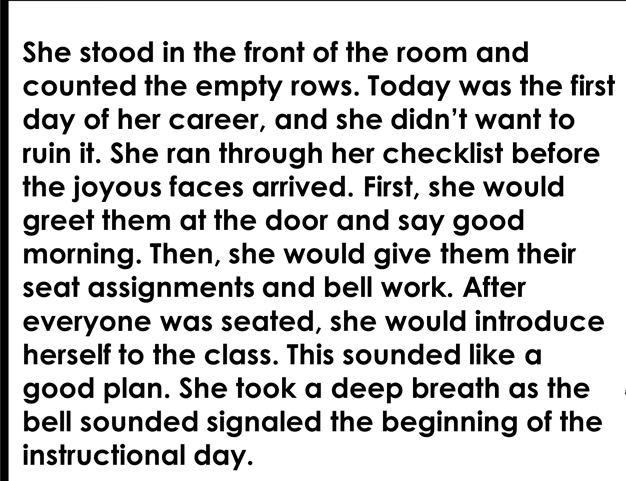
Inference sits at the intersection of text evidence and background knowledge. Students have to locate something the author left unstated, find the clues that point toward it, and connect those clues to what they already know. That three-part process is harder than it sounds, especially in third grade, where students are simultaneously managing fluency demands and shifting from narrative to informational reading.
Across the set, students practice these specific moves:
- Identifying which sentences in a short passage carry inferential weight — not every sentence does, and knowing the difference is a real skill in its own right.
- Completing a three-column It Says / I Say / And So organizer that separates text evidence from personal reasoning before combining them into a stated conclusion.
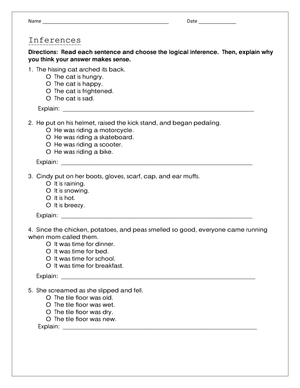
- Answering multiple-choice inference questions and eliminating options that require information the passage does not actually provide.
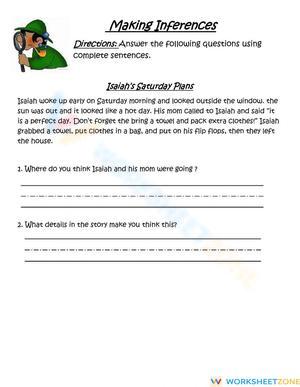
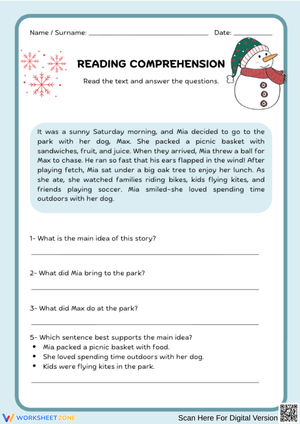
- Writing a full-sentence inference response and citing a specific text excerpt that supports it.
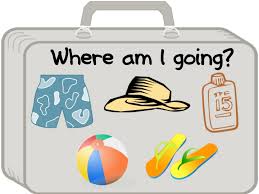
- Working through picture-based inference tasks, where a single image stands in for a passage so students practice the same reasoning moves without any decoding pressure.
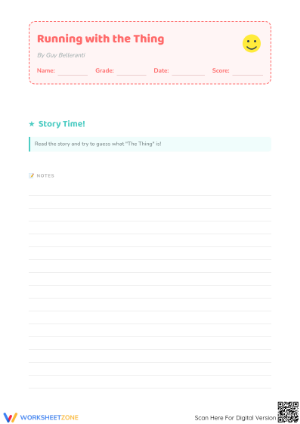
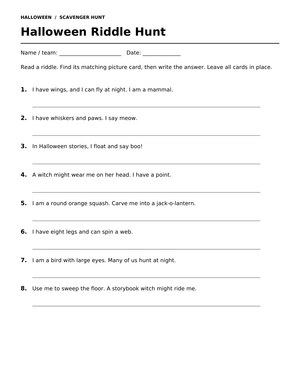
- Solving riddle-style problems built from four or five descriptive clues, a format that requires students to hold multiple clues in mind simultaneously before committing to a conclusion.
Errors Worth Anticipating Before You Distribute These Worksheets
The most consistent error at this grade is what I'd call the "copy-and-paste answer" — a student who responds to an inference question by scanning for the nearest sentence containing related vocabulary and transcribing it verbatim. They are not making an inference; they are locating text. The And So column of the three-part organizer catches this cleanly, because a copied sentence cannot serve as an "And So" — that column requires a student-generated conclusion, not a retrieved quotation.
A second pattern: students who fill the I Say column with genuine personal conviction but anchor it to nothing in the text. "I think he's scared because I would be scared too" is a prediction shaped by empathy, not an evidence-based inference. Circling an empty It Says column and asking the student to return to the passage for one specific clue before continuing stops the habit early.
Third graders also consistently confuse inference with prediction at the start of a unit. Prediction is forward-looking; inference is about what the author has already established but chosen not to name directly. The riddle-style worksheets address this confusion well because they are entirely backward-looking — every clue is already present, and nothing remains unknown.
How to Work These Worksheets Into Your Reading Block
The riddle cards are a natural opening move. Give students four to five minutes at the start of a reading lesson to solve one riddle independently before discussing it as a class. That quiet-then-shared cycle models the habit of drawing on multiple clues before announcing an answer, and over several weeks, students begin applying the same patience to longer passages.
For whole-class instruction, project a blank copy of the It Says / I Say / And So organizer and work through a short passage together before students complete any making inferences printable worksheets for 3rd grade on their own. Think aloud through each column — not just the final inference, but the specific moment of locating the evidence. That narrated evidence-hunt is what students most need to hear.
In small-group reading, match the passage complexity to the group rather than the calendar. A group still building fluency reads a simpler text but practices the identical inference process. The format shifts the cognitive challenge from decoding to reasoning, which is where their attention belongs.
One genuinely useful late-week routine: collect the three-column organizers on a Thursday and scan the It Says column. If students are writing long quoted passages rather than pinpointed clues, Friday's lesson addresses what counts as evidence. If the I Say column is blank or filled with one-word answers, spend that time on background knowledge activation. Each column isolates a separate cognitive step, which makes these worksheets a sharper formative check than a simple right-or-wrong comprehension question.
Standard Alignment
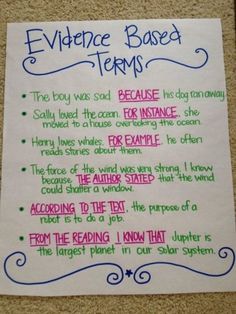
RL.3.1 (Reading Literature) and RI.3.1 (Reading Informational Text) both require third graders to ask and answer questions about a text by referring explicitly to what the text says. That explicit-evidence requirement is the engine of inferential reading — an inference untethered from text evidence is just a guess. Fiction worksheets in this set align to RL.3.1; informational passages align to RI.3.1. Teachers working toward RL.3.6 or RI.3.6 (point of view and author's purpose) will find that strong inference practice builds the foundation for both, since recognizing unstated author intent is itself an inference task.
Adjusting These Worksheets Across a Range of Learners
For students reading below grade level, begin with picture-based worksheets before introducing any text passage. The inference process is identical, but the decoding demand drops entirely, which means students can practice the reasoning moves cleanly. Once they can verbalize an inference from an image and explain what in the image supports it, the shift to short text passages is considerably smoother. These students benefit from having making inferences printable worksheets for 3rd grade that use the three-column organizer, since the labeled columns provide a built-in thinking structure without oversimplifying the task itself.
Grade-level students who freeze on open-ended responses do well with sentence starters printed directly on the worksheet — I can infer that ___ because the text says ___ — which removes blank-page paralysis without reducing the inference demand.
For advanced readers, remove graphic organizers entirely and assign longer passages containing two or three distinct inference opportunities. Ask these students to identify which inference is best supported by the text and to explain in writing why one of the other possible inferences is weaker. That comparative analysis pushes well past the standard's baseline expectation.
Frequently Asked Questions
What is the difference between a prediction and an inference at the 3rd-grade level?
Prediction is forward-looking — students guess what might happen next. Inference is about what is already true in the text but unstated: the author has left a gap, and the reader fills it using text clues combined with background knowledge. Third graders conflate the two because both require going beyond what is literally written, but an inference does not depend on what happens next — it depends on what is already there.
Can these worksheets be used for assessment, not just practice?
Yes. The open-ended response format — where students write a full inference sentence and cite a specific text excerpt — gives teachers concrete evidence of both comprehension and writing ability. Used early in a unit, it establishes a baseline. Used after several lessons, it shows whether students have moved from surface recall to evidence-based reasoning. The multiple-choice worksheets work better for quick checks or test-prep review, where speed and format familiarity matter more than written explanation.
How many worksheets should I use per week?
Most teachers find two to three worksheets per week builds inference as a sustained habit rather than a single-week unit. One riddle or picture-based task early in the week, one passage-based task mid-week, and a short review item on Friday produces steady repetition without consuming the reading block. These making inferences printable worksheets for 3rd grade work best as a recurring element of the reading routine, not a standalone skill sprint that ends after five days.
Do the worksheets cover both fiction and nonfiction?
The set includes literary and informational passages, which matters because third graders often treat inference as a fiction skill. Informational text inference looks different — students infer an author's purpose, the implication of a comparison, or the significance of a detail the author chose to include — and exposure to both text types early prevents that narrow view from hardening. Students who only practice inference with stories regularly stall when asked to infer anything from a science or social studies passage.
What should I do when a student gets the right inference for the wrong reason?
This is common and worth addressing directly rather than marking it correct and moving on. Ask the student to point to the exact words in the passage that led to the answer. If they cannot, the correct answer was arrived at through background knowledge alone, which is half the process at best. These making inferences printable worksheets for 3rd grade are structured so that every answer can be traced back to a text clue — the organizer format makes that verification a natural next step rather than a correction.












 Interactive Worksheet Maker
 Quiz Maker
 Word Search Maker
 Crossword Puzzle Maker
 Word Scramble Generator
 Sentence Scramble Generator
 Handwriting Worksheet Generator
 Name Tracing Generator
 Fill In The Blank Generator