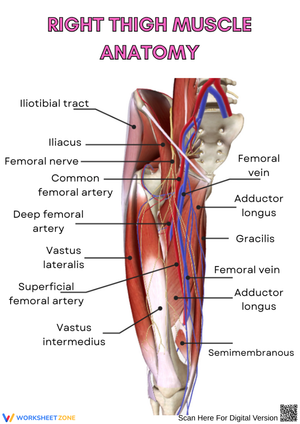
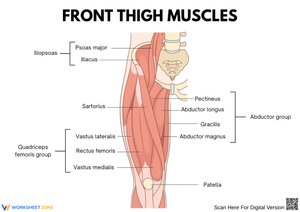
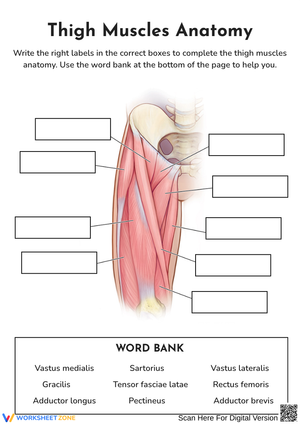
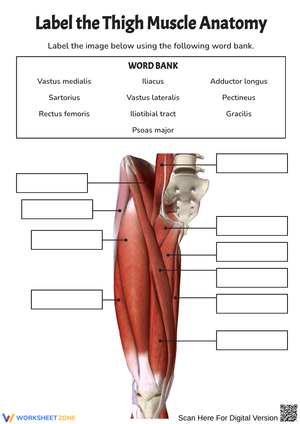
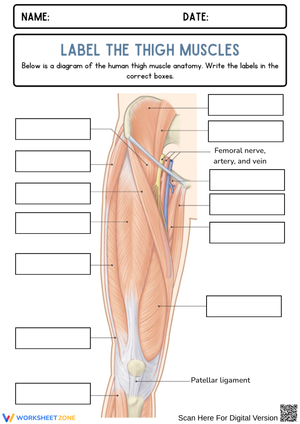
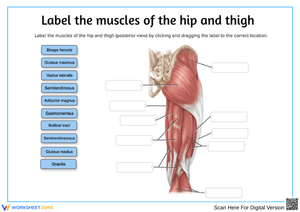
These thigh muscle worksheets for 11th grade give anatomy and health science teachers structured practice built around the three main compartments of the upper leg — anterior, medial, and posterior — with tasks that require students to connect muscle location to movement, not just memorize a list of names. Each worksheet targets skills that appear regularly in unit assessments and lab discussions: compartment identification, diagram labeling, and movement classification.
What the Set Covers
The upper leg divides into three compartments, each with a distinct set of muscles and a primary movement role. For Grade 11 students, the goal is not to catalog every individual structure; it is to recognize the major groups, place them accurately on a diagram, and link them to the joint actions they produce.
- Anterior compartment: quadriceps femoris and sartorius, emphasized for knee extension and hip flexion.
- Medial compartment: the adductor group — adductor longus, brevis, and magnus, along with gracilis — associated with hip adduction.
- Posterior compartment: the hamstring group (biceps femoris, semitendinosus, semimembranosus), responsible for knee flexion and hip extension.
Each worksheet asks students to do something with that structure — label it, sort it, or apply it to a movement scenario. A matching task might present six movement descriptions and ask students to assign each to the correct compartment. A short-answer prompt might ask students to explain why the quadriceps and hamstrings are described as antagonist pairs. These are the kinds of tasks that move students past surface recognition into usable understanding.
Frequent Student Errors Worth Watching For
The most consistent error in Grade 11 anatomy is misplacing the hamstrings. Students who anchor their thinking to "the back of the leg" as a visual concept often extend that logic too far and slide any muscle with a medial attachment into the posterior compartment. This shows up clearly on labeling tasks: a student will correctly place biceps femoris, then shift semimembranosus or even gracilis to the wrong region because it "seems like it's toward the back." Sorting tasks that require compartment assignment before diagram labeling catch this pattern early, before it hardens into quiz errors.
A second predictable confusion involves sartorius. Because it runs diagonally from the anterior superior iliac spine across to the medial tibia, students who think about attachment points rather than compartment classification place it in the medial group almost every time. Prompts that require students to state both the compartment and the primary action — not just write the name next to a line — surface this confusion in a way that pure labeling tasks do not.
Building These Worksheets Into a Grade 11 Anatomy Week
For a 35 to 40 minute block, one practical sequence runs like this: spend the first 6 to 8 minutes reviewing the three compartments using a projected diagram, naming one muscle group per compartment and its primary movement. Distribute the labeling worksheet and give students 10 minutes to work independently. Follow that with a 10 minute partner comparison — not "did you get the right answer" but "can you explain why that group belongs there?" A 3-question exit ticket closes class: name one muscle in the anterior compartment, one in the posterior, and identify the movement most associated with the medial compartment.
These thigh muscle worksheets for 11th grade also work well as a review tool the day before a unit quiz. Have students complete the diagram from memory, then correct it against a projected answer key. The act of noticing where they misplaced a group — and immediately seeing the correct compartment — does more for retention than a second round of reading notes.
For block scheduling or longer periods, stations hold the content well. One station focuses on diagram labeling, a second on matching muscles to movements, and a third on sports or clinical scenarios: which muscle group decelerates the leg during sprinting, which is active when a soccer player pulls the leg inward for a short pass. Anchoring anatomy to real movement gives students more than one entry point into the material, particularly for learners who find purely structural content difficult to hold.
Adapting Each Worksheet for Different Learners in the Same Room
In a general biology course, narrow the focus to broad compartment identification and the three or four muscle groups most commonly assessed. Students label the diagram using group names — quadriceps, adductors, hamstrings — and match each group to one primary action. That scope works for a general course and avoids overloading students who have not had dedicated anatomical preparation.
In a dedicated anatomy and physiology course, the same worksheets support more demanding tasks. Add a column to the matching activity requiring students to name at least two individual muscles within each group. Include a short written response asking students to predict how gait would change if the anterior compartment were significantly weakened. This shifts the worksheet from recall practice to applied reasoning, which is appropriate for students building toward further science coursework.
One concrete adjustment that consistently helps mid-level learners: before any labeling task, have students color-code the compartment regions on a blank thigh outline — anterior in one color, medial in another, posterior in a third. Students who do this first make noticeably fewer placement errors when they move to muscle labeling. The visual separation reduces the load of tracking compartment boundaries and muscle names simultaneously, which is where most errors originate.
Frequently Asked Questions
Which thigh muscles should Grade 11 students actually be responsible for knowing?
At the high school level, the practical target is compartment recognition plus major group identification: quadriceps femoris and sartorius for the anterior compartment, the adductor group for the medial compartment, and the hamstrings for the posterior compartment. Individual muscle names within those groups — biceps femoris, semitendinosus, adductor longus — belong in a dedicated anatomy course, not a general biology unit.
Can these worksheets fit into a unit that also covers hip muscles?
Yes, and the transition is natural. Several thigh muscles — particularly the adductors and sartorius — act across the hip joint, so thigh compartment knowledge carries directly into hip muscle study. Using one worksheet to reinforce thigh structure before introducing the hip region builds continuity rather than treating the two areas as separate chapters.
Do I need a strong anatomy background to teach from these materials effectively?
A working understanding of the three compartments and their primary movements is enough for most Grade 11 instruction. Kenhub's thigh muscle overview and TeachMeAnatomy's thigh section are reliable reference points for confirming terminology before class. Both use the same compartment framework these worksheets are built around, so cross-referencing is quick.
How do these worksheets serve as formative versus summative tools?
Thigh muscle worksheets for 11th grade function well in both roles. Used during instruction, they generate real-time data on where students are misplacing muscle groups or confusing movement terms — information that shapes the rest of the lesson. Used at the end of a unit, a completed and corrected worksheet gives students a clear visual record of the three compartments to return to during final exam review. The answer key makes either use practical without requiring significant additional prep between applications.
What if some students have already encountered this content in a previous course?
Some Grade 11 students arrive with exposure to basic muscle anatomy from middle school or an earlier biology unit. For those students, skip straight to movement-based tasks: matching muscle groups to specific sport actions, explaining antagonist pairs, or predicting injury consequences. These thigh muscle worksheets for 11th grade include enough function-based prompts that they stay useful for students who already know where the muscles sit but have not yet been asked to apply that knowledge analytically.