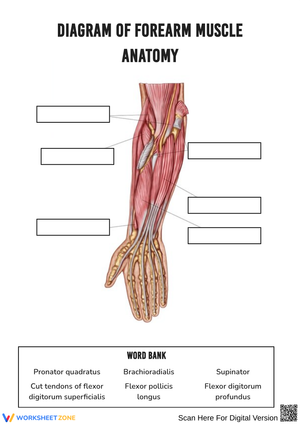
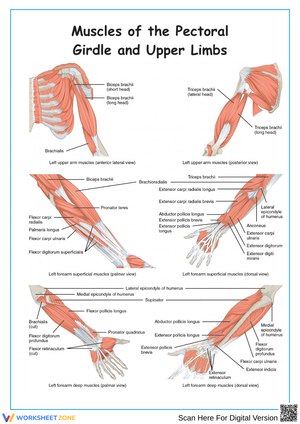
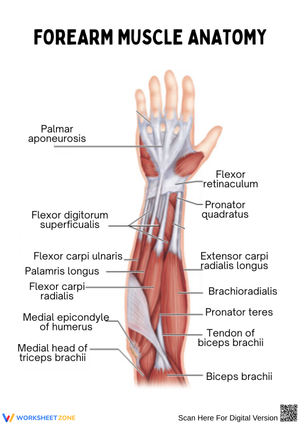
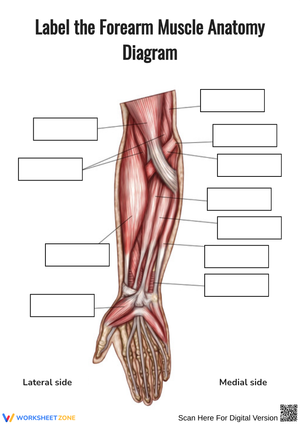
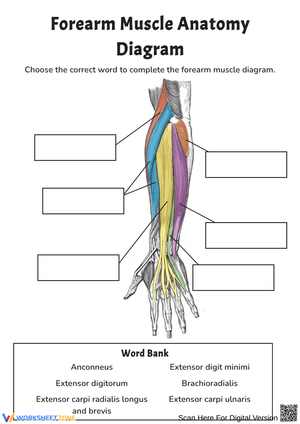
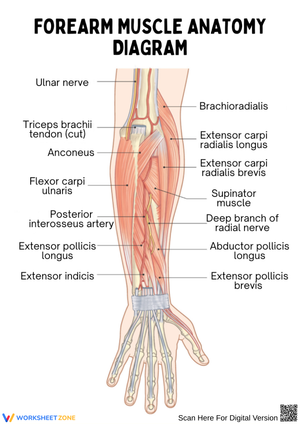
These 11th grade forearm muscle printable worksheets give anatomy teachers a reliable set of resources for one of the more organizationally demanding topics in a musculoskeletal unit. Each worksheet moves students from diagram identification toward functional reasoning — not just labeling a structure but connecting it to the wrist or forearm movement it drives.
What the Set Covers
The two-compartment framework is the organizing principle that makes forearm anatomy teachable at the high school level. Students work with the anterior flexor-pronator group and the posterior extensor-supinator group, sorting muscles into the correct compartment before connecting them to specific actions. That framework does most of the conceptual work: once students can place pronator teres, flexor carpi radialis, and flexor carpi ulnaris in the anterior compartment, they have a reliable mental anchor for the others.
Each worksheet addresses one specific skill rather than covering everything at once. Some worksheets focus on labeling — students identify structures on anterior and posterior forearm diagrams. Others ask students to match a muscle to its primary action: wrist flexion, wrist extension, finger extension, pronation, or supination. A sorting task asks students to place a mixed list of muscle names into the correct compartment, which tests conceptual grouping rather than name recall alone. The final worksheet in the set combines all three task types and works well as a unit review or pre-quiz warm-up.
Errors Worth Anticipating Before the Lesson
The naming patterns that genuinely help — muscles with flexor in the name flex, muscles with extensor extend — create a specific trap with brachioradialis. The name gives no action clue, and students frequently assign it to the wrong compartment or give it the wrong movement. It sits anatomically in the posterior compartment but acts primarily as a forearm flexor, and that mismatch genuinely confuses students who have learned to treat naming as a reliable shortcut. Address this directly rather than letting the diagram carry the explanation.
Pronation and supination are the other reliable error site. A common mistake: students associate "supination" with "superior" and conclude it means turning the palm downward. Introducing the soup bowl mnemonic — supination means the palm faces up, as if holding a bowl of soup — before students attempt the function-matching sections prevents most of that confusion. Without it, a measurable portion of the class will flip both actions and mark every related item incorrectly. Catching that pattern during circulation saves students from cementing the wrong association in their notes.
A subtler error appears with students who learn kinesthetically. When asked which compartment drives wrist flexion, some students flex their fingers and feel tension along the back of the forearm — and conclude flexion is a posterior function. A quick correction: have them place one hand on their own anterior forearm, flex the wrist slowly, and feel which side contracts. That 30-second check resolves the confusion more durably than pointing at the diagram again.
Fitting These Worksheets Into the Lesson Sequence
The most effective placement for 11th grade forearm muscle printable worksheets is the class period immediately after initial diagram instruction — the point when students have seen the structures but haven't yet consolidated the names or functions. A labeling worksheet during the last 12 to 15 minutes of that class gives students a low-stakes retrieval opportunity while the content is still fresh. Returning to a function-matching worksheet two days later, then using the combined review worksheet the day before the unit quiz, creates a spaced retrieval pattern that produces stronger retention than a single study session before the test.
Station work is another strong fit. One group labels an unlabeled anterior diagram. A second completes a function-matching task using a word bank. A third sorts a mixed muscle list into anterior and posterior columns. Stations let the teacher circulate and catch compartment errors or action-matching mistakes before they appear on the test. Each worksheet in this set has a self-contained task, so station rotation requires no modification.
For substitute plans, the labeling worksheet with a word bank is self-sufficient. A brief board note — "Use the word bank, label both diagrams, then match each muscle to its action" — is enough for the class to work independently. That reliability matters when anatomy units land in the same stretch as testing windows or departmental obligations that pull teachers away from their rooms.
Meeting Different Readiness Levels Within the Same Class
Students still building anatomical vocabulary work better with a word bank and a partially labeled diagram — two or three muscle names already filled in as reference points. That structure reduces the retrieval load enough that students can focus on learning the compartment logic rather than stalling on identification. Removing the word bank on a subsequent worksheet, once the major names are familiar, is a natural progression that doesn't require creating a separate modified version for most students.
For students ready for deeper challenge, extend the function-matching items by asking them to explain why a muscle's anterior or posterior position determines its action at the wrist or fingers. That shifts the task from recall to structural reasoning. A meta-cognitive extension also works well: ask advanced students to identify which of the 11th grade forearm muscle printable worksheets in this set would be most difficult for a classmate who read the textbook chapter but never worked with a diagram — the discussion that follows reliably surfaces the most important conceptual distinctions of the unit.
Students with fine motor writing challenges can work through the sorting and matching sections verbally, with a partner recording their answers. The diagrams are clear enough for discussion-based completion even when a student can't write at classroom speed, which means the same resources serve most learners without requiring a separately formatted version.
Frequently Asked Questions
Which forearm muscles should Grade 11 students be expected to know?
Most high school anatomy courses expect students to identify and describe pronator teres, flexor carpi radialis, palmaris longus, flexor carpi ulnaris, brachioradialis, and extensor digitorum as a core group. Some courses add extensor carpi radialis longus or flexor digitorum superficialis. The 11th grade forearm muscle printable worksheets in this set address the core group and flag additional structures separately, so teachers can assign selectively based on course scope.
Do students need to memorize origin and insertion at this level?
In a standard Grade 11 anatomy survey, origin and insertion are generally not required, though AP-level or dual-enrollment courses sometimes include them. These worksheets focus on compartment placement, muscle identification, and primary function — the skills most commonly assessed at the high school level. The diagrams provide enough visual detail to support discussion of origin and insertion if a teacher needs to introduce it, but that content would need to be supplemented with additional notes or textbook reference.
How do I keep students from confusing pronation and supination?
The most durable fix is pairing the label with a brief physical demonstration before students attempt the worksheet. Have students hold one arm at their side with the elbow bent and rotate the forearm — palm down for pronation, palm up for supination. Then ask them to complete the matching item while their arm is still in that position. Students who experience the movement while reading the muscle name retain the distinction far more reliably than students who only read a definition. The function-matching sections in these worksheets are built to support that kind of active reinforcement during class.
Should labeling worksheets be assigned as homework?
Labeling worksheets work as homework when they include a word bank. Without one, students who are uncertain of muscle name spellings tend to write approximations — "flexer carpi" instead of "flexor carpi" — and those spellings can embed in memory before anyone corrects them. With a word bank, homework attention stays on compartment placement and function, which is the appropriate independent practice task before the class has done full function review together.