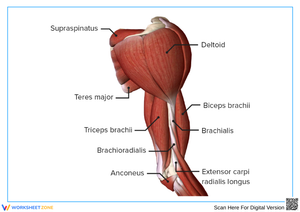
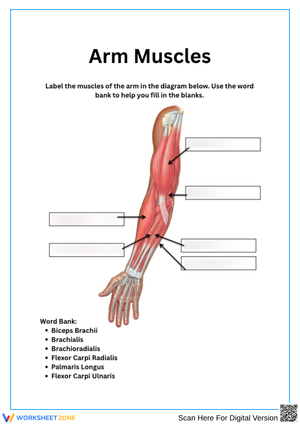
Arm muscle pdf worksheets for 11th grade anatomy give teachers a reliable printed format for upper-limb review—one where the diagram layout stays identical whether the file is printed on a classroom copier, opened on a student Chromebook, or shared through a learning platform. That consistency matters more in anatomy than in most other subjects because spatial relationships are part of the content itself. The resources covered here focus on major muscles of the upper arm, shoulder, and forearm, built around identification, action, and movement reasoning rather than disconnected memorization.
Muscle Concepts These Worksheets Build
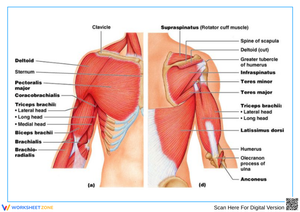
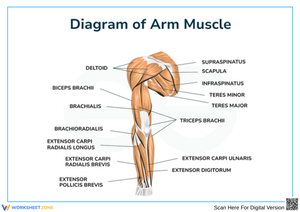
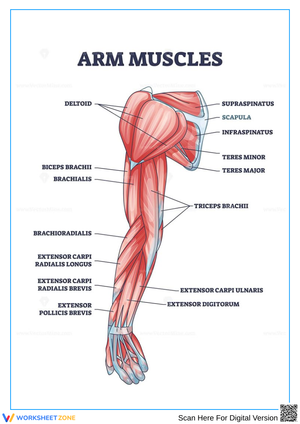
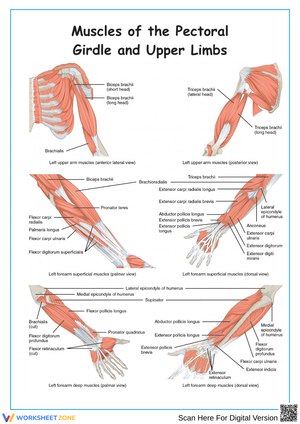
The scope stays where most high school anatomy courses need it: biceps brachii, triceps brachii, brachialis, deltoid, and the major forearm flexor and extensor groups. Each worksheet moves students from location to function. They first identify where a muscle sits, then connect it to the joint it acts on, then explain the resulting movement—elbow flexion, elbow extension, shoulder abduction, forearm pronation, and supination are the core action vocabulary the set develops.
The agonist-antagonist relationship gets deliberate attention. When students work through an elbow curl on paper—labeling the biceps brachii as the prime mover and placing the triceps brachii in its relaxed, lengthened role—they stop treating muscle names as isolated vocabulary items and start reading them as parts of a coordinated system. That shift is the actual instructional goal at this level, not name recall.
One distinction worth emphasizing in class: the brachialis and biceps brachii both contribute to elbow flexion, but they are not redundant. The brachialis acts regardless of forearm rotation; the biceps brachii is more effective when the forearm is supinated. Students who grasp that difference handle movement-analysis questions more precisely than students who lump both muscles together as "elbow benders."
Frequent Student Errors Worth Catching Early
The most consistent error in upper-arm diagram work is label drift—students place the biceps brachii label somewhere generally on the anterior upper arm without anchoring it to the muscle belly. On actual student work, the label line points to a region rather than a structure. Requiring students to draw an arrow from their label directly to the muscle belly, not just the general upper arm, tightens accuracy immediately.
A second pattern: students confuse movement terms with muscle names when answering action questions. Asked "which muscle performs elbow flexion?" they write "flexion" instead of "biceps brachii." This often reflects that the student hasn't yet separated the anatomical noun from the motion it produces. A reliable fix: ask students to point to the joint that moves before writing the muscle name. That physical act of identifying the elbow or shoulder first anchors the question in structure rather than in terminology, and it reduces that confusion more reliably than re-reading the question does.
Students also underestimate the deltoid. Because it's visible and familiar, they assume they know it—then draw it incorrectly, placing it only on the anterior shoulder or missing its role in abduction entirely. One minute of kinesthetic checking (students raise their arm to 90 degrees and press the opposite hand against the lateral shoulder to feel the contraction) saves multiple correction cycles later.
Smart Ways to Work These Worksheets Into Your Week
In practice, arm muscle pdf worksheets for 11th grade most often appear as a 7-minute opening routine: students label three or four muscles on the diagram, match each to its primary action, and answer one short question about an opposing muscle pair. After a quick whole-class check, the lesson moves into direct instruction or small-group discussion on how muscle pairs coordinate during movement. That routine builds daily exposure to vocabulary before the unit assessment and prevents anatomy from becoming a one-night cram.
Station rotation works especially well with this content. Station one: diagram labeling using the full upper-limb image. Station two: action-matching tasks where students sort muscle names under flexion, extension, abduction, and rotation headings. Station three: a short movement scenario—a baseball throw, a pull-up, or a bicep curl—where students identify prime movers and describe which muscles are relaxing while others contract. Three distinct retrieval passes in one period, without repetitive drill.
For substitute coverage, each worksheet functions as a standalone task needing no introduction beyond the printed directions. Teachers who leave a short answer key with the sub consistently report fewer off-task minutes than when they leave open-ended anatomy activities with no answer structure.
Standard Alignment
These worksheets support NGSS HS-LS1-2, which asks students to develop and use models to illustrate how the structure of an organism enables its function. A labeled upper-limb anatomy diagram is a direct application: the model is the diagram itself, and the function component is the movement analysis attached to it. In instructional terms, teachers can use the labeling items as the structure portion of the standard and the action-matching and written-response items as the function portion—addressing both in the same class period rather than splitting them across two separate lessons.
Differentiating the Set Across Student Readiness Levels
Arm muscle pdf worksheets for 11th grade can run at three distinct levels without requiring separate lesson plans for each. The entry-level version includes a labeled reference diagram alongside the blank one, a full word bank, and matching items with only four answer choices. Students with limited prior anatomy exposure use the reference image during practice and cover it during the check—a structured approach to building visual memory before removing the support. The standard version removes the word bank and reference image, adds short-answer function questions, and includes one agonist-antagonist scenario requiring written explanation.
Advanced students get the same base diagram with none of the entry-level supports and instead answer comparative questions: explain why the brachialis is the more reliable elbow flexor across all forearm positions, or identify which muscles are active during each phase of a push-up and describe what each is doing at the transition point. Students working ahead in anatomy consistently push harder on those questions than on pure identification tasks, which makes the challenge version a genuine extension rather than just more of the same work.
Frequently Asked Questions
Which muscles should 11th graders actually be expected to name and locate?
Most high school anatomy courses hold students to the biceps brachii, triceps brachii, brachialis, deltoid, and major forearm flexor and extensor groups. General location and primary action for each is the standard expectation. Detailed origin and insertion points are typically reserved for AP-level or college anatomy coursework.
How does PDF format specifically help with anatomy diagrams?
Anatomy diagrams depend on spatial accuracy. A PDF preserves exact label placement, image scaling, and line weight regardless of whether the file prints on a classroom printer, a school copier, or renders on a student device. A diagram that displays differently across devices undermines the spatial learning the task depends on—students can't reliably compare their labeled version to a teacher's reference if the proportions have shifted.
Can these worksheets serve as formative assessment tools?
Arm muscle pdf worksheets for 11th grade work as exit tickets, quick checks, and unit-review tasks at multiple points across a unit. The labeling items give teachers fast binary data—right location or wrong. The written-response items reveal whether students are applying movement vocabulary accurately or simply recalling isolated terms. Together, both item types give a cleaner read on understanding than a single multiple-choice quiz.
What makes an answer key actually useful for grading these?
An answer key that shows arrow placement on the diagram—not just a list of muscle names in order—speeds up grading and helps teachers identify exactly where a student's spatial understanding broke down. For written-response items, allow correct anatomical reasoning even when the student's phrasing differs from the model. A student who writes "the triceps contracts to push the arm straight during a push-up" has demonstrated functional understanding, even if the model answer uses "elbow extension" as the operative phrase.