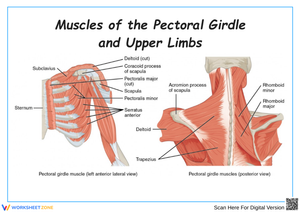
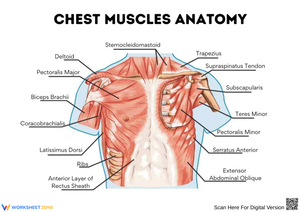
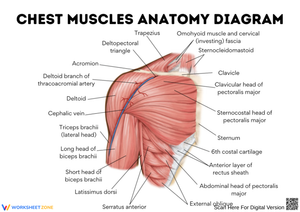
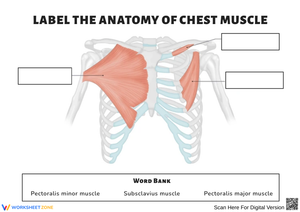
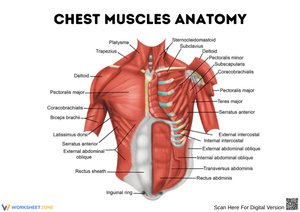
These pectoral muscle printable worksheets for 11th grade put four muscles — pectoralis major, pectoralis minor, serratus anterior, and subclavius — in front of students in a format built for the kind of detail work that anatomically literate high schoolers can handle. Teachers get labeling exercises, fiber-direction diagrams, nerve mapping activities, and movement-analysis tasks, each targeting a distinct layer of what students need to know about the anterior thoracic wall.
What Students Practice Across the Set
Each worksheet in the set asks students to do specific anatomical work rather than passively read or color. The core tasks include identifying origin and insertion points on unlabeled skeletal diagrams, tracing innervation from the brachial plexus to individual muscle heads, and matching the pectoralis major's two heads — clavicular and sternocostal — to their distinct functional roles. One worksheet focuses entirely on neurovascular supply: students map the thoracoacromial trunk, the lateral thoracic artery, and the internal thoracic artery onto a diagram, then annotate which structures each vessel serves.
There is also a fiber-direction exercise that asks students to draw the angle of the clavicular fibers (running downward and laterally) against the sternocostal fibers (running more horizontally and upward), then predict the resulting pull on the humerus for each. That task lifts the work out of memorization and into biomechanical reasoning — exactly the thinking that prepares students for kinesiology or pre-med coursework. The pectoral muscle printable worksheets for 11th grade are ordered so that surface anatomy comes before deep structures, which keeps cognitive load manageable when students are encountering the medial pectoral nerve and the coracoid process for the first time.
Mistakes Students Make That These Worksheets Help Surface
The most consistent error at this level is the origin-insertion reversal. Students who can recite that the pectoralis major "attaches to the intertubercular sulcus" will still label the humerus as the origin on a diagram, especially if they haven't internalized that the origin is the stationary, proximal attachment. A related problem: students routinely treat the two heads of the pectoralis major as a single functional unit and cannot explain why the clavicular head flexes the humerus while the sternocostal head extends it from a flexed position. These are two distinct biomechanical actions driven by fiber-group geometry, and the distinction shows up on clinical and AP-level assessments.
For the deeper muscles, students almost universally underestimate the pectoralis minor. They know it inserts on the coracoid process but miss its accessory respiratory function when the scapula is fixed. The nerve supply creates its own confusion: students see "lateral pectoral nerve" and "medial pectoral nerve" and assume the lateral one supplies the lateral muscle and the medial one goes to the medial muscle. In fact, the medial pectoral nerve primarily innervates the pectoralis minor and part of the pectoralis major's sternocostal head — an arrangement that defies positional logic and requires direct, explicit attention in class.
Building These Worksheets Into Your Weekly Anatomy Block
The set works well across three to four class periods in an upper-level anatomy or physiology unit. The pectoral muscle printable worksheets for 11th grade move from surface anatomy into deep structures and then into function, so a teacher can run them in sequence or pull individual worksheets to reinforce a specific day's content. A common approach: assign the pectoralis major labeling worksheet the day before a palpation exercise, so students arrive with the attachment points already mapped. When students can feel the clavicular head contract during shoulder flexion and the sternocostal head activate during a push motion, the diagram they labeled the night before becomes immediately meaningful.
The fiber-direction worksheet works well as a structured small-group task — four students, one worksheet, each student assigned one muscle to explain aloud to the group. That format reduces passive copying and forces students to use anatomical vocabulary in real explanation, which is where retention actually happens. The neurovascular mapping worksheet runs about ten to twelve minutes and works cleanly as an exit task: it shows immediately whether students connected the day's key brachial plexus content to the individual muscle heads.
Standard Alignment
These worksheets align to NGSS HS-LS1-2, which calls for students to develop and use models to illustrate the hierarchical organization of interacting systems that provide specific functions within multicellular organisms. In classroom terms, the pectoral region is a strong example of that hierarchy: individual muscle fibers are arranged into functionally distinct heads, those heads combine into layered muscles, and those muscles work alongside named nerves and vessels to produce coordinated shoulder movement. The labeling and nerve-mapping tasks in the set ask students to build and read exactly those multi-system diagrams, making the standard's modeling expectation concrete rather than abstract. For states using anatomy-specific course frameworks, the content maps to anterior thoracic wall musculature objectives that typically appear in semester two of a high school human anatomy sequence.
Adjusting the Set for a Mixed-Ability Anatomy Class
For students who are still building confidence with anatomical vocabulary, pre-populate the word bank on each worksheet or allow glossary access during the origin-insertion diagrams. Removing the retrieval burden at that stage keeps attention on the structural logic — which attachment is fixed, which moves — rather than on spelling or recall. These students benefit from completing the pectoralis major worksheet before any of the deeper muscles, and from doing the fiber-direction task as a teacher-guided activity rather than independently.
For students who move quickly, the neurovascular mapping worksheet includes a strong extension question that asks them to predict the functional consequences of lateral pectoral nerve damage — specifically, which shoulder movements would be compromised and why. That requires integrating nerve distribution, muscle function, and biomechanics simultaneously. The pectoral muscle printable worksheets for 11th grade include applied clinical reasoning prompts at the end of several worksheets, making the set usable across a range of readiness levels without requiring entirely separate materials.
Frequently Asked Questions
Can I use individual worksheets without assigning the full set?
Yes. Each worksheet stands alone and covers a distinct anatomical focus — origin and insertion, fiber direction, nerve supply, or movement analysis. A teacher covering only the pectoralis major on a particular day can assign that worksheet without touching the others. The sequence is there if you want a full unit arc, but it isn't required.
Do the worksheets include answer keys?
Each worksheet comes with a full answer key, including the fiber-direction diagram with correct orientation markings and the completed neurovascular map. The answer key for the movement-analysis task includes explanations for why each head of the pectoralis major produces a different action — useful for teachers newer to musculoskeletal anatomy who want to confirm their own understanding before leading discussion.
What prior knowledge do students need before starting the first worksheet?
Students should already be comfortable with anatomical position, core directional terms (medial, lateral, anterior, posterior, superior, inferior), and basic skeletal landmarks — clavicle, sternum, scapula, humerus. Without that foundation, the labeling work becomes guesswork rather than reasoning. If a class is weak on skeletal anatomy, a brief review of the thoracic cage and shoulder girdle before distributing the first worksheet saves considerable reteaching time later.
Is the nerve supply content too advanced for a standard anatomy elective?
Not if students have already covered the brachial plexus in overview. The nerve-mapping worksheet uses only the lateral and medial pectoral nerves — it doesn't require students to know every cord and trunk of the plexus in detail. If a course covers the brachial plexus superficially, the worksheet can serve as the point where that overview becomes specific and applied, which is an appropriate level of challenge for an 11th-grade elective.