


























0
Views
0
Downloads

0.0
0
Save
0 Likes
Share
Label the Thigh Muscles Worksheet
0 Views
0 Downloads
Paste this activity's link or code into your existing LMS (Google Classroom, Canvas, Teams, Schoology, Moodle, etc.).
Students can open and work on the activity right away, with no student login required.
You'll still be able to track student progress and results from your teacher account.
Information
Description
What It Is:
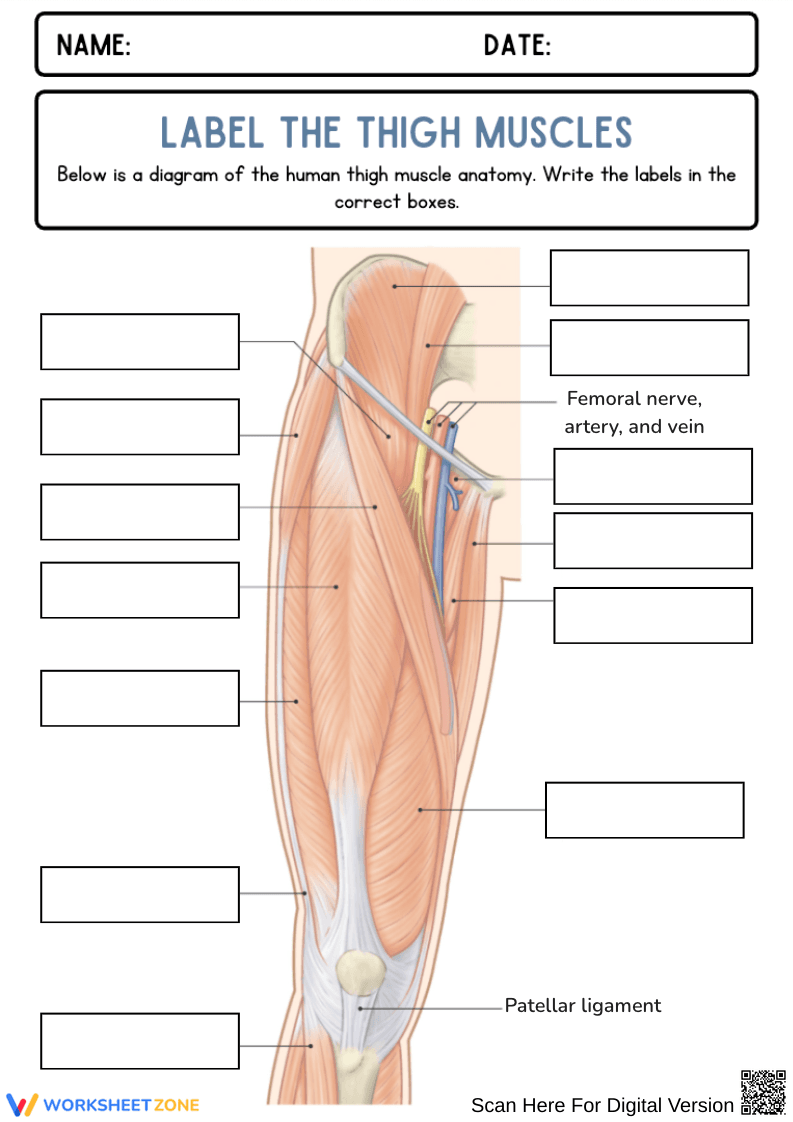
A thigh muscle anatomy worksheet featuring a detailed diagram with blank labels for identifying major muscles, ligaments, and the femoral nerve, artery, and vein.
Why Use It:
Helps students understand and memorize the structure of thigh muscles and supporting anatomy. Great for anatomy, medicine, and physiotherapy studies.
How to Use It:
• Write the correct labels in the provided boxes using a word bank or prior knowledge.
• Practice identifying muscles, ligaments, and nerves.
• Use in class activities, homework, or anatomy labs.
• Reinforce test prep for anatomy or medical exams.
Grade Suitability:
Best for upper high school, college, and medical studies.
• Grades 11–12 – advanced biology and anatomy
• Undergraduate – medicine, physiotherapy, nursing, sports science
Target Users:
Biology students, medical trainees, physiotherapy learners, sports science students, and anatomy educators.
A thigh muscle anatomy worksheet featuring a detailed diagram with blank labels for identifying major muscles, ligaments, and the femoral nerve, artery, and vein.
Why Use It:
Helps students understand and memorize the structure of thigh muscles and supporting anatomy. Great for anatomy, medicine, and physiotherapy studies.
How to Use It:
• Write the correct labels in the provided boxes using a word bank or prior knowledge.
• Practice identifying muscles, ligaments, and nerves.
• Use in class activities, homework, or anatomy labs.
• Reinforce test prep for anatomy or medical exams.
Grade Suitability:
Best for upper high school, college, and medical studies.
• Grades 11–12 – advanced biology and anatomy
• Undergraduate – medicine, physiotherapy, nursing, sports science
Target Users:
Biology students, medical trainees, physiotherapy learners, sports science students, and anatomy educators.


