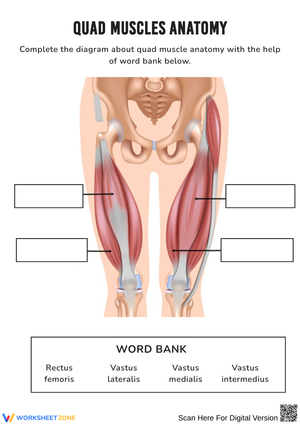
These quad muscle printable worksheets for 11th grade give anatomy teachers targeted labeling, diagramming, and short-answer resources built around the full quadriceps femoris group — its individual muscles, their origins and insertions, femoral nerve innervation, and functional relationship to the knee joint. The set covers depth appropriate for upper-level biology and anatomy courses, where students are expected to move beyond simple identification into biomechanical reasoning and clinical application.
What the Set Covers
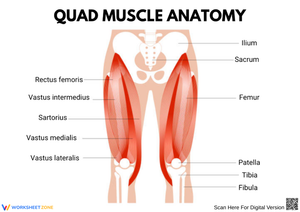
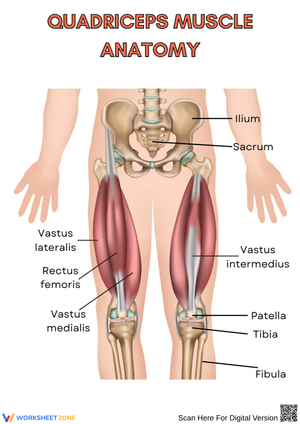
Each worksheet focuses on a specific layer of understanding rather than compressing everything into one task. Students work through identifying the four constituent muscles — rectus femoris, vastus lateralis, vastus medialis, and vastus intermedius — across anterior and lateral view diagrams. Labeling tasks progress from simple muscle identification to marking origin and insertion sites on the femur and tibia. The quadriceps tendon, patella, and patellar ligament pathway down to the tibial tuberosity all appear in the diagrams, because that distal chain is exactly where students' mental models tend to break down.
Beyond identification, the worksheets include questions that require students to explain why the rectus femoris behaves differently from the other three muscles. Because it crosses both the hip and knee joints, it contributes to hip flexion in addition to knee extension — a distinction that matters when students later analyze movements like sprinting or kicking. The femoral nerve and its L2–L4 spinal origins are also addressed, connecting the muscular system content to earlier nervous system units and reinforcing the integrated nature of human physiology.
Frequent Student Errors Worth Anticipating Before the Unit Test
The most persistent confusion we see in student work involves the vastus intermedius. Students who correctly place the vastus lateralis and vastus medialis on a lateral view will still draw the vastus intermedius sitting beside the rectus femoris rather than beneath it. They understand "deep" as a vocabulary word but struggle to translate it into correct diagram placement when all four muscles are labeled simultaneously. Worksheets that include a cross-sectional view of the mid-thigh — showing relative depth of each muscle as a transverse slice — resolve this faster than any amount of re-teaching from a lateral diagram alone.
A second error pattern involves the patella. Students routinely describe it as a joint component rather than a sesamoid bone embedded within the quadriceps tendon. When asked how the patella increases the force of knee extension, they write answers about cushioning or shock absorption. The correct answer — that it shifts the angle of pull of the patellar ligament, increasing mechanical advantage at the tibiofemoral joint — requires understanding the pulley principle, which is not intuitive. Short-answer prompts that specifically ask students to trace the force pathway from muscle belly to tibial tuberosity make this gap visible before the unit test, when there is still time to address it.
Students also tend to assign hip flexion to all four quadriceps muscles, not just the rectus femoris. This usually happens because the general function they memorized — "quads extend the knee" — gets over-applied. A direct question asking which muscle is biarticular and why, placed early in the worksheet sequence, interrupts that overgeneralization before it becomes entrenched.
Building These Worksheets Into Your Unit Flow
The labeling worksheets work best mid-unit, after students have read through the quadriceps section and seen a brief demonstration of patellar tracking but before formal assessment. Use the diagram tasks as a paired activity — ten to twelve minutes is enough for two students to compare placements and debate the vastus intermedius position, which is where the most productive argument happens. Circulating during that exchange tells you more about gaps in their mental models than a written quiz would.
Quad muscle printable worksheets for 11th grade also serve well as a pre-lab warm-up if your course includes cadaver or anatomical model work, giving students a paper reference they can set beside the specimen. Having students physically palpate their own anterior thigh while completing the labeling exercises creates a kinesthetic reference point that aids retention — particularly for the vastus medialis, whose teardrop shape near the medial knee is distinctive enough that most students can locate it on themselves within thirty seconds.
For the short-answer and clinical-application worksheets, assign them as homework the night before a class discussion on the patellar reflex or patellar tendonitis. Students who have already written out the reflex arc in their own words arrive ready for a real conversation rather than passive note-taking. The color-coding approach also pays off here: assign each of the four muscles a color, then have students use those same colors to highlight the corresponding origin and insertion sites on a separate skeletal diagram. That visual linking helps students move from memorizing isolated muscle shapes to understanding how each muscle physically pulls on the bone during contraction.
Standard Alignment
These quad muscle printable worksheets for 11th grade align with NGSS HS-LS1-2, which requires students to develop and use models to illustrate how systems of specialized cells within organisms carry out essential functions. Studying the quadriceps femoris from individual muscle anatomy through neural innervation to joint-level biomechanics directly addresses the performance expectation that students understand how multicellular structures interact at multiple scales. Short-answer questions asking students to connect femoral nerve signaling at L2–L4 to visible contraction output demonstrate the kind of system-level reasoning the standard demands. Accurate anatomical diagram labeling also satisfies the modeling component — representing the muscle group at the organ-system scale is itself a form of scientific modeling.
Differentiating the Set Across Ability Levels
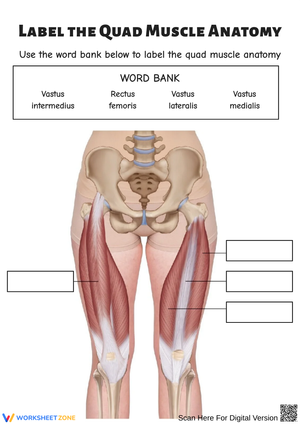
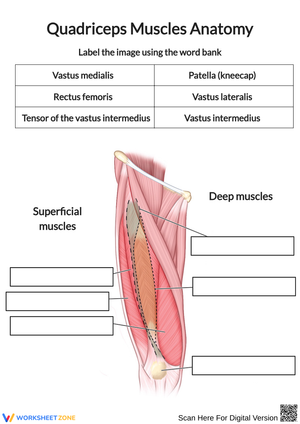
The labeling worksheets can be distributed with or without a word bank. Removing the word bank is the most direct way to raise difficulty for students who have already shown fluency with the four muscle names — it forces retrieval rather than recognition, which produces stronger long-term retention. For students who are still building confidence with anatomical terminology, providing both the word bank and a color-coded reference key gives them enough support to finish the diagram without stalling out mid-task.
Quad muscle printable worksheets for 11th grade that include clinical case studies can be modified by adjusting how much background context appears before the analysis questions. Students with strong prior anatomy knowledge can read a scenario cold and draw their own conclusions; students who need more support benefit from a short summary of patellar tracking before they attempt to explain why vastus medialis weakness leads to lateral patellar displacement. The question stems themselves stay the same — what changes is the reading load leading into the task.
For students who finish early, the agonist-antagonist analysis tasks provide a genuine extension rather than busywork. Those questions ask students to explain how quadriceps and hamstring co-contraction limits anterior tibial displacement during deceleration — content that draws on ligament anatomy from an earlier unit and rewards students who have been making cross-unit connections throughout the course.
Frequently Asked Questions
Which of the four quadriceps muscles is the only one that crosses the hip joint?
The rectus femoris. It is biarticular — crossing both the hip and the knee — which makes it responsible for hip flexion in addition to its role in knee extension. The vastus lateralis, vastus medialis, and vastus intermedius all originate directly on the femur and act only at the knee.
How does the patella function as a mechanical pulley for this muscle group?
The patella is a sesamoid bone embedded within the quadriceps tendon. By displacing the tendon anteriorly, it increases the angle at which the patellar ligament pulls on the tibial tuberosity, improving the mechanical advantage of the quadriceps during knee extension. Without that anterior displacement, the force would be directed at a shallower angle and the muscle group's effectiveness at generating torque would drop substantially.
What does an imbalance between the vastus lateralis and vastus medialis actually do to the knee?
These two muscles pull the patella in opposite directions — the lateralis pulls it outward, the medialis pulls it inward. When the vastus medialis is comparatively weak, the patella tracks laterally within the femoral groove during knee flexion and extension cycles. Over time, that lateral tracking produces anterior knee pain and, in some cases, cartilage breakdown. Vastus medialis strengthening is a standard element of knee rehabilitation protocols for exactly this reason, and students who understand the anatomy can reason through why without needing to memorize the protocol.
How do the quadriceps and hamstrings coordinate during high-speed movement?
They function as an agonist-antagonist pair. During high-velocity activities like sprinting or cutting, both groups co-contract — the quadriceps pulling the tibia anteriorly and the hamstrings resisting that displacement to reduce stress on the ACL. Students who understand this relationship are better positioned to analyze athletic injury patterns and to make sense of why ACL rehabilitation involves hamstring strengthening rather than quadriceps work alone.