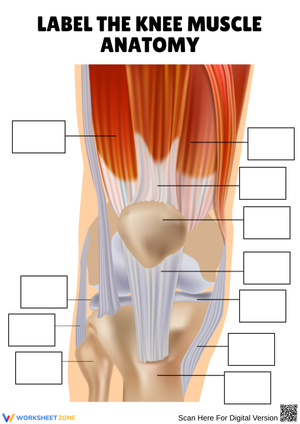
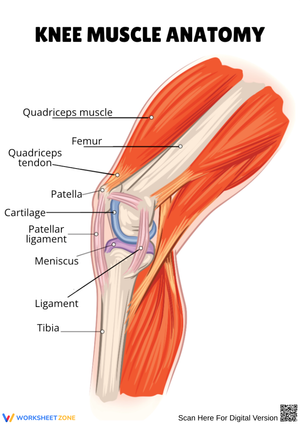
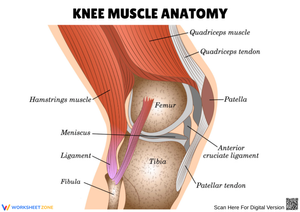
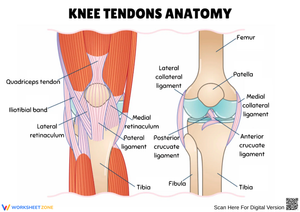
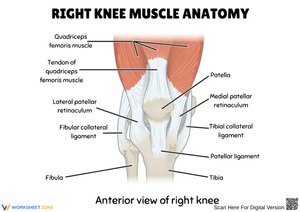
11th Grade Knee Muscle worksheets for Anatomy Class
These 11th grade knee muscle worksheets resources give anatomy teachers a direct path from classroom instruction to student demonstration of understanding — each worksheet moves students through identification, function analysis, and applied reasoning rather than stopping at a labeled diagram. The set covers the major muscles and connective structures acting on the knee joint, a region that combines enough anatomical complexity for genuine study with enough physical familiarity that students can connect the content to their own bodies. Teachers get print-ready materials suited to bell work, guided practice, unit review, and substitute days.
What Students Practice Across the Set
Each worksheet targets a specific combination of anatomy skills. Across the set, students:
- Label anatomical diagrams — identifying the quadriceps group, hamstring group, gastrocnemius, popliteus, and nearby connective structures on clear anatomical figures
- Analyze muscle function — writing short explanations of what each muscle contributes during flexion, extension, or joint stabilization
- Apply anatomical vocabulary in context — using terms like tendon, ligament, patellar region, and tibial tuberosity in response prompts rather than isolated definitions
- Connect anatomy to movement — describing how the knee responds during a squat, sprint, or controlled landing so the anatomy stays tied to function
- Distinguish movement structures from stabilizing structures — sorting muscles that generate motion from tissues whose primary job is keeping the joint aligned
That last task is harder than it looks. Students often arrive at a knee unit believing that stronger muscles automatically produce a more stable joint, without recognizing that ligaments, menisci, and the joint capsule play a structurally separate role. A worksheet that asks students to sort structures by function surfaces that misconception early, before it shows up on a unit test.
The Knee as a Grade 11 Anatomy Topic
The knee appears in grade 11 anatomy for good reason. It is anatomically complex enough to require careful study of overlapping muscle actions, yet concrete enough that students can link the content to experiences they already have — sports injuries, descriptions of physical therapy, the mechanics of jumping and landing. That combination makes it one of the more teachable joints in the body at this level.
Students at this stage are ready to handle the idea that the gastrocnemius both plantarflexes the ankle and assists knee flexion — a two-joint function that consistently surprises students who have learned to think of muscles as acting on a single joint. Including the popliteus adds real depth without overwhelming a class still building its anatomical vocabulary: it gives students a clearer picture of how the knee transitions out of full extension into flexion, which makes the stabilization conversation more precise and harder to reduce to a memorized definition.
How to Build These Worksheets Into Your Lesson Planning
One reason teachers search for 11th grade knee muscle worksheets resources is the flexibility they offer across different lesson formats without requiring supporting materials built from scratch. The most effective pattern across a single class period is three passes through the same anatomy. First, students complete the labeling section — either from memory with a word bank available, or from a projected reference diagram. That portion runs about eight minutes and immediately shows which structures students are confusing or skipping. Second, students annotate each labeled muscle with its primary action, marking flexion and extension functions directly on the figure. Third, they respond to an applied question: how would the knee be affected if one muscle group were strained?
That three-pass sequence reveals something a single labeling task misses. Some students can locate the vastus medialis accurately on a diagram but cannot explain why quadriceps weakness changes how someone descends from a step. Others have the motion language but mix up muscles and ligaments when pushed into a written explanation. Seeing both types of confusion before the unit test is worth the extra few minutes of class time.
For station rotations, each worksheet pairs well with a physical model, a short movement analysis video, or a partner verbal quiz. In a 50-minute block, the worksheet portion typically runs 15 to 20 minutes, leaving time for class discussion or a brief demonstration of knee mechanics.
Errors That Surface Consistently in Student Work
The most persistent mistake isn't mislabeling a muscle — it's conflating muscles with ligaments. Students who correctly identify the hamstrings as knee flexors will still write statements like "the ACL helps flex the knee when you run" because they have absorbed the acronym without understanding the structure's role. Expect this in roughly a third of first-attempt written responses, especially on questions that ask what happens at the knee during athletic movement.
A second pattern: students understand the quadriceps as extensors when the question is phrased directly, but cannot apply that knowledge when the framing shifts — for example, when asked what resists knee flexion rather than what produces extension. The phrasing change breaks the pattern-matching they've been using, and it exposes whether they are reasoning from the anatomy or from a memorized definition. When using 11th grade knee muscle worksheets resources, building in at least one question that frames the motion from the opposing direction catches this gap before a summative assessment does.
A third consistent error involves the patellar tendon and patellar ligament. Students use both terms interchangeably even after explicit instruction, partly because the naming convention seems inconsistent — a ligament connects bone to bone, and the patellar ligament does connect the patella to the tibia, so the name fits, but the quadriceps tendon superior to the patella is sometimes also called the patellar tendon in different textbooks. Flagging that ambiguity directly in the worksheet instructions, rather than expecting students to sort it out independently, prevents it from contaminating written responses across the whole class.
Standard Alignment
These worksheets support NGSS HS-LS1-2, which asks students to develop and use models to illustrate how hierarchically organized, interacting systems provide specific functions within multicellular organisms. In anatomy instruction, this standard becomes most visible when students move beyond identifying isolated structures and begin explaining how those structures cooperate — exactly the progression each worksheet is built around. A student who can describe how the quadriceps group, patellar tendon, and tibial tuberosity form an integrated extension mechanism is demonstrating the system-level thinking HS-LS1-2 targets. These worksheets function as formative checkpoints before a summative lab or model-building assessment tied to this standard.
Adjusting the Set for Different Readiness Levels
The most practical adjustment for students who need additional support is adding a partially labeled reference diagram — not a full answer key, but enough structural markers (a labeled femur and tibia, for instance) to help students orient themselves spatially before attempting the labeling task. Many students who struggle with anatomy diagrams are struggling with spatial orientation, not with the anatomy content itself. That single anchor reduces frustration without reducing the intellectual demand of the function questions that follow.
For students ready for greater challenge, remove the word bank from the labeling section and add a stabilization analysis question: ask students to explain why a quadriceps strain affects a different phase of movement than a hamstring strain, and what that difference reveals about how the two groups coordinate during running. That question requires understanding the roles of two separate muscle groups relative to the same joint, which pushes students into genuine anatomical reasoning. Both versions address the same content target, so the entire class works on knee anatomy simultaneously — only the level of support and challenge shifts.
Frequently Asked Questions
Which knee muscles are covered across these worksheets?
The core muscles are the quadriceps group (rectus femoris, vastus lateralis, vastus medialis, and vastus intermedius), the hamstring group (biceps femoris, semitendinosus, and semimembranosus), the gastrocnemius, and the popliteus. Several worksheets also address the patellar tendon and ligament relationship, along with nearby connective structures that contribute to joint stability.
Can these worksheets be used as a substitute lesson?
Yes. Each worksheet is self-contained with clear directions, word banks where appropriate, and prompts that students can interpret without teacher guidance. For a full 50-minute period, pairing one worksheet with a short reading from the course textbook gives a substitute enough to manage the lesson without anatomy background knowledge.
How do these worksheets differ from a basic anatomy diagram printout?
A basic printout asks students to name structures. These worksheets also ask students to explain function, connect muscles to movement patterns, and compare the roles of different tissues around the joint. A student who labels every structure correctly but cannot answer the function questions reveals something a diagram-only task would completely miss — and that distinction matters when teachers are making instructional decisions before a unit test.
Where does the knee unit typically fall in a Grade 11 anatomy sequence?
Most teachers introduce joint-specific anatomy after covering the broader muscular system — either in the second half of the muscular system unit or at the start of a joints and movement unit. The 11th grade knee muscle worksheets set works at either placement, and the applied movement questions hold up as review once students have covered basic biomechanics.
Clear All