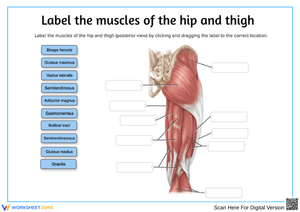
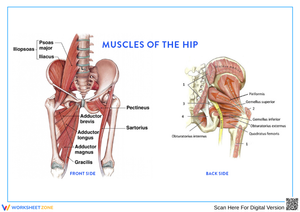
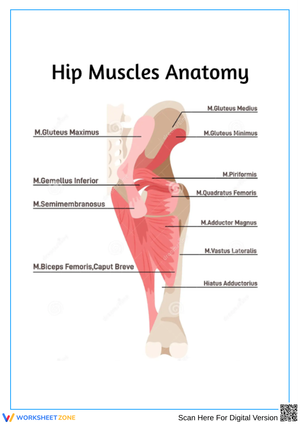
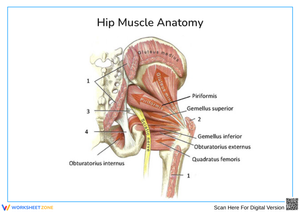
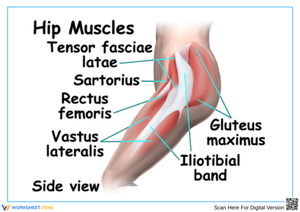
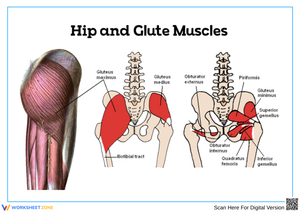
These 11th grade hip muscle worksheets resources give anatomy teachers a structured way to slow down one of the most visually dense sections of the human body unit — the hip region, where multiple overlapping muscle groups share anterior and posterior territory, and students must track names, locations, and movement vocabulary all at once. The set covers the major muscles involved in hip movement and stability, using diagram labeling, function matching, and short-answer exercises to move students from basic recognition toward applied understanding.
Muscles and Skills Covered Across the Set
The muscles at the center of these worksheets are the ones Grade 11 anatomy students consistently need to know: the three gluteal muscles, the iliopsoas, the adductor group, the tensor fasciae latae, and the hamstrings at their proximal hip attachment. Each worksheet ties those structures to the six primary actions at the hip joint — flexion, extension, abduction, adduction, medial rotation, and lateral rotation. That connection between name and movement is what keeps the anatomy from collapsing into a memorization exercise.
The different worksheets within the set vary in demand. Some use a word bank alongside a numbered anterior or posterior diagram, giving students a clear starting point. Others ask students to complete a function table — listing the primary action of each muscle group — or to identify a structure from its movement role alone, working backward from function to name. That progression moves students through increasingly demanding tasks without requiring teachers to locate separate materials for each phase of the unit.
Teaching Hip Muscles in a Sequence That Actually Sticks
The most reliable approach in practice is to introduce hip muscles by movement category before asking students to learn them by location. When students first sort muscles into flexors, extensors, abductors, and adductors, each name arrives with a functional anchor. The gluteus medius isn't just a structure on a diagram — it's the muscle that prevents the pelvis from dropping during single-leg stance. That job-based context makes the name easier to retain. When students later return to a labeling worksheet, their accuracy improves noticeably because they're working from understanding rather than re-encountering an unfamiliar term.
Drawing on a set of 11th grade hip muscle worksheets resources supports this teaching sequence directly. One worksheet handles the movement-sorting introduction, a separate diagram worksheet covers location-based labeling, and the no-prompts version serves as a pre-assessment check before a quiz or practical — the same core muscle set across every worksheet, at different levels of support and demand.
Errors Students Make That These Worksheets Help Expose
The confusion between the iliopsoas and the rectus femoris shows up more often than expected. Both muscles occupy the anterior-superior region of the thigh on a diagram, and students who can correctly name the iliopsoas on a labeled chart will still draw their arrow to the wrong structure on a blank diagram — usually because they're navigating by general position rather than the muscle's actual path. Asking students to trace the iliopsoas from its origin on the ilium and lumbar vertebrae down to the lesser trochanter, rather than just pointing to a spot, catches that error before it gets reinforced.
Abduction and adduction stay mixed up through the first week of the unit for a surprising number of students. They write the definitions correctly on vocabulary checks but reverse them on application questions, especially when the diagram shows the leg in a non-neutral position. A single lateral leg-raise demonstration before the labeling task reduces this error noticeably. The worksheets that include movement prompts alongside diagrams help reinforce the distinction, but teachers should plan to address it explicitly regardless.
A third pattern involves the deep external rotators. Students routinely leave the piriformis and obturators off any unlabeled diagram — not because they don't know the names, but because those muscles weren't prominent during initial instruction. Introducing them as a named group rather than as individual structures gives students a category to anchor them to, and they appear on worksheets much more reliably afterward.
Fitting These Worksheets Into Your Anatomy Unit Plans
The labeled-diagram worksheet works well as a Monday warm-up after an introductory lesson. Students arrive having looked over their notes, and a 10-minute labeling task tells you quickly who retained the basic structures and who still has gaps — no setup, no projection, immediate diagnostic information without a formal quiz.
- Introductory lesson: Use the word-bank labeling worksheet during the first exposure to hip muscles. Students identify structures with support while you review locations aloud as a class.
- Mid-unit practice: The function-matching worksheet fits after students can identify structures but before they're ready for assessment-level recall. Partner work here is productive — students compare answers and flag disagreements before checking the key.
- Day before a quiz or lab practical: Run the no-prompts version independently. Students complete it, then compare with a partner using the included answer key. The gaps they surface in that five-minute exchange are exactly what needs reteaching.
- Station rotations: A labeling station, a function-matching station, and an answer-key self-check station give students three distinct tasks with no extra materials. The consistent muscle set across every worksheet means whole-class discussion afterward doesn't need to reconcile different content strands.
- Substitute plans: Each worksheet includes complete directions and a full answer key, so a sub can run the lesson without any anatomy knowledge. That reliability matters when the teacher's schedule compresses near unit assessments.
Adapting the Worksheets Across Different Readiness Levels
For students who are new to anatomical vocabulary or who freeze when confronted with a dense, unlabeled diagram, printing the word-bank version alongside a labeled reference image provides enough support to engage with the content rather than shutting down. That combination is not a lower-rigor task — it removes the retrieval barrier while keeping the core thinking requirement intact. Students still match structures to names and names to actions; they just aren't expected to hold twelve new terms in working memory simultaneously on their first exposure.
For students who already know the muscle names and need a more demanding task, the blank assessment version — no word bank, no numbered diagram — requires them to work entirely from memory and to explain movement rather than match it. A short written response asking why gluteus medius activity matters during walking produces qualitatively different thinking than a fill-in-the-blank format, and it surfaces real gaps that multiple-choice items often miss.
In mixed-readiness classes, these two versions run simultaneously without restructuring the lesson. Both groups work with the same muscles, the same vocabulary, and the same movement categories. The 11th grade hip muscle worksheets format accommodates this kind of parallel-track delivery because each worksheet is a standalone task — there's no shared document or sequential packet that forces every student into the same entry point.
Frequently Asked Questions
Which hip muscles should Grade 11 anatomy students know by name?
Most Grade 11 anatomy courses focus on the muscles most directly involved in hip movement and postural stability: the gluteus maximus, medius, and minimus; the iliopsoas; the major adductors including adductor longus, brevis, and magnus; the tensor fasciae latae; and the hamstrings at their proximal hip attachment. Some courses add the piriformis and obturators when the unit extends into rotation. A focused list of ten to twelve muscles, each consistently tied to a primary action, gives students a workable foundation without overloading the unit.
Do these worksheets require prior anatomy coursework?
The word-bank and labeled-reference versions work well for students with little prior anatomy background. The labeling exercises introduce both structure names and movement vocabulary — flexion, extension, abduction, adduction, rotation — so students can build from each worksheet rather than needing extensive pre-teaching. Running the word-bank version as a class activity on the first day of the hip unit, rather than sending it home immediately, removes most of the startup friction for students who don't have a strong prior foundation.
Are these worksheets better suited for homework or in-class practice?
Both settings work, and the 11th grade hip muscle worksheets set is practical for homework because the diagrams and directions are fully self-contained — students don't need additional explanation to begin. That said, the blank no-prompts version produces more honest data when completed in class under independent conditions. When assigned as homework, students often cross-reference the labeled version directly, which eliminates its diagnostic value. Using the supported versions for at-home review and reserving the blank version for in-class independent work gets the most out of both formats.
What does the answer key cover?
Each worksheet in the set includes a complete answer key covering both the labeled diagrams and the function-matching sections. In practice, that detail matters more than it might sound: teachers can run partner peer-check at stations without pausing to grade a full set, students can self-assess during test-prep sessions, and substitutes can manage the lesson without anatomy expertise. Having the key immediately available also lets teachers use the labeling practice as a formative check during class — quick, low-stakes, and immediately actionable before the unit moves forward.