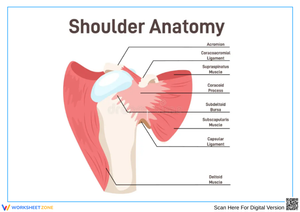
These 11th grade shoulder muscle worksheets give anatomy and physiology teachers a concrete way to move students past muscle-name memorization toward a working understanding of how the glenohumeral joint actually functions. Each worksheet in the set targets a specific layer — structure, muscle action, origin and insertion, or clinical reasoning — so complexity builds across the unit rather than arriving all at once.
What the Set Covers
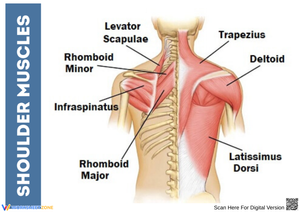
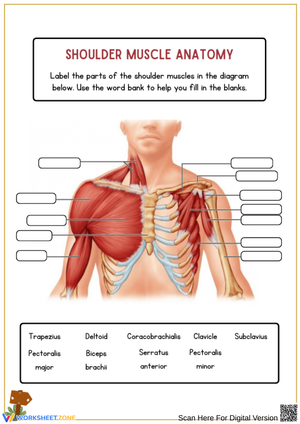
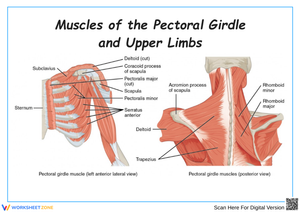
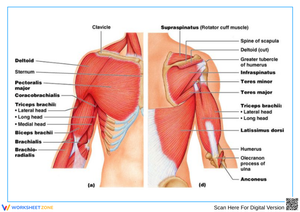
The worksheets address the full range of shoulder musculature taught in Grade 11 anatomy: the four rotator cuff muscles of the SITS group (supraspinatus, infraspinatus, teres minor, subscapularis), the three fiber divisions of the deltoid, and the scapular stabilizers — serratus anterior, trapezius, and levator scapulae. Tasks range from labeling anterior and posterior anatomical views to predicting muscle action from fiber direction to analyzing origin-insertion pairs.
- Identifying each SITS muscle by location, origin, insertion, and primary action
- Comparing anterior and posterior shoulder views on the same task
- Mapping deltoid fiber direction to predict function across all three fiber sets
- Analyzing scapulohumeral rhythm by tracking degrees of movement from each joint component
- Applying muscle function knowledge to short clinical scenarios involving common shoulder injuries
The scapulohumeral rhythm tasks deserve particular attention. When the arm reaches overhead, the scapula must rotate upward to keep the glenoid fossa aligned under the humeral head — roughly two degrees of glenohumeral motion for every one degree of scapulothoracic motion. Tracking that coordination in numerical terms distinguishes a Grade 11 anatomy unit from a middle-school body-systems survey and directly prepares students for introductory college kinesiology work.
Frequent Student Errors Worth Catching Before the Test
The most reliable confusion in this unit is teres minor versus teres major. Both originate near the lateral border of the scapula, and students consistently mix up their insertion points and actions — especially on diagram-labeling tasks where the two muscles appear in close proximity. Teres minor inserts on the greater tubercle of the humerus and assists external rotation; teres major inserts on the lesser tubercle and internally rotates. A side-by-side comparison on a blank diagram, done before any quiz, closes that gap faster than re-reading the chapter.
Subscapularis placement creates a different problem. Because it sits on the anterior surface of the scapula, students who have only encountered posterior-view diagrams simply cannot locate it when a full anterior illustration appears on an exam. The 11th grade shoulder muscle worksheets that pair anterior and posterior views within a single task help here — students see the subscapularis in its actual spatial relationship to the other three SITS muscles rather than meeting it as an isolated exception memorized from a note card.
A third pattern surfaces reliably: students learn that the deltoid abducts the arm, then apply that to all three fiber divisions. When asked about the anterior deltoid specifically, many students write "abduction" instead of "flexion and internal rotation." Asking students to annotate fiber direction before answering any action question catches this before it becomes a test-day reflex. That sequence — annotate first, then predict — takes roughly 90 seconds and prevents a mistake that otherwise reappears on every assessment.
How to Work These Worksheets Into Your Anatomy Unit
The most effective sequence starts with fully labeled diagrams for initial exposure, then moves to unlabeled versions for retrieval practice. The temptation is to show students the labeled version again when they get stuck — but the productive struggle of retrieving an unfamiliar name unprompted is exactly the mechanism that builds durable recall. Returning to the same unlabeled worksheet two days later, before re-reading notes, outperforms repeated review of labeled diagrams by a wide margin. Each worksheet is discrete enough to drop into a morning warm-up, a 15-minute lab activity, or a post-lecture check.
The clinical scenario worksheets work best near the end of the unit. A scenario — a swimmer with progressive supraspinatus tendinopathy, a student presenting with a winged scapula from serratus anterior weakness — asks students to work backward from a clinical situation into their anatomical knowledge. That reversal is harder than a labeling task but far more diagnostic of actual understanding, and teachers running dual-enrollment or pre-health electives find these tasks hold up well as summative measures.
The empty-can and full-can shoulder movements pair directly with the supraspinatus worksheet. Students perform the motion while pressing two fingers lightly over the supraspinous fossa of their own shoulder, feeling the muscle activate as the arm reaches roughly 30 degrees in the scapular plane. That tactile moment makes the 11th grade shoulder muscle worksheets content stick in a way that re-reading a diagram does not — the proprioceptive feedback gives students a physical reference for the abstract function described on the worksheet.
Standard Alignment
The worksheets align with NGSS HS-LS1-2, which asks students to develop and use models to illustrate the hierarchical organization of interacting biological systems — here, how individual muscles operate as part of the shoulder girdle system. At the state level, most Grade 11 anatomy and physiology courses map this content to standards covering the skeletal-muscular interface, muscle classification by action, and the role of connective tissue in joint stability. The origin-insertion tasks address the common state-level expectation that students identify structures by name and describe their functional contribution. In states with Health Science CTSA pathway exams, shoulder musculature appears as tested content, making this set directly relevant to pathway assessment preparation.
Adjusting These Worksheets for a Mixed-Ability Class
For students still building confidence with anatomical vocabulary, beginning each labeling worksheet with the word bank visible removes vocabulary retrieval as a barrier so the student can focus on spatial reasoning — placing the right name in the right location. Removing the word bank on a second attempt, one or two days later, shifts the cognitive demand without requiring a separate worksheet. That two-pass approach lets the same material serve both the student who needs structured support and the one who is ready for independent recall.
Students who move through identification work quickly benefit most from the biomechanical analysis and clinical scenario tasks. Asking them to calculate the mechanical advantage of the supraspinatus versus the deltoid at 15 degrees versus 90 degrees of abduction, or to design a basic rehabilitation sequence for a specific rotator cuff injury, keeps the ceiling high without requiring entirely different materials. The 11th grade shoulder muscle worksheets set carries enough analytical depth at the upper end to hold the attention of students who are already comfortable with identification and need a harder question to work through.
Frequently Asked Questions
Do the worksheets include both anterior and posterior anatomical views?
Yes. Several worksheets require students to work from both orientations because the subscapularis only appears on anterior views while the infraspinatus and teres minor are only clearly visible posteriorly. Limiting students to one view is precisely why subscapularis identification breaks down on exams — when the muscle appears from an unfamiliar angle, students who only practiced one orientation tend to go blank.
Are these worksheets appropriate for dual-enrollment anatomy courses?
The set works well in dual-enrollment settings. The scapulohumeral rhythm analysis, the fiber-direction prediction tasks, and the clinical scenario worksheets go beyond standard high school identification requirements and align with introductory college anatomy expectations. Teachers can use the labeling worksheets for standard Grade 11 sections and reserve the biomechanical analysis tasks for sections running at a college-level pace.
How are the rotator cuff muscles addressed in depth?
Several worksheets focus specifically on the SITS group, including tasks that ask students to distinguish all four muscles by origin, insertion, and action; identify each on an unlabeled posterior diagram; and explain why the supraspinatus is injured more frequently than the other three. That last question requires students to connect the muscle's anatomy — its passage through the subacromial space — to its clinical vulnerability, which separates genuine understanding from surface-level recall.
Can the unlabeled diagram worksheets serve as formal assessments?
The unlabeled diagram and clinical scenario worksheets function as solid formative assessments without modification. The labeled versions with a word bank work better as guided practice. Using both within the same unit gives teachers a clearer read on what students actually know versus what they can reproduce with support — and that distinction matters when deciding how to address a gap before the unit moves forward.