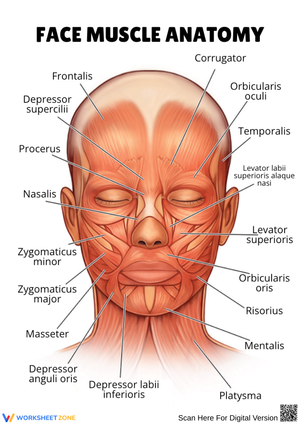
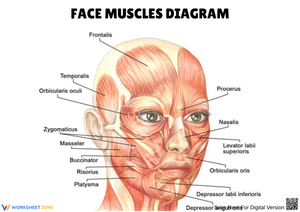
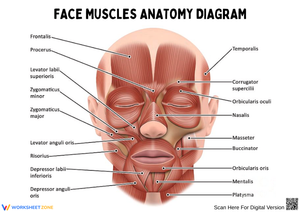
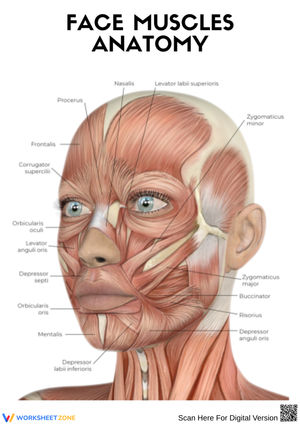
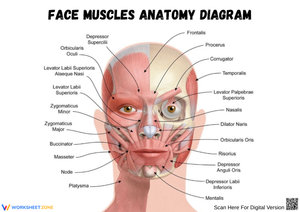
11th Grade Face Muscle worksheets
11th grade face muscle worksheets resources give anatomy teachers a structured tool for moving students past rote memorization into functional understanding of one of the body's most specialized muscle groups. The set covers both the muscles of facial expression and the muscles of mastication — two distinct groups with different innervation, different attachment patterns, and meaningfully different clinical implications. Students label, identify, and analyze; teachers get a formative tool that maps directly onto a standard muscle physiology unit.
The Two Groups Students Have to Keep Straight
The central organizing principle of facial musculature is the split between muscles that move skin and muscles that move the jaw. Muscles of expression — the orbicularis oculi, zygomaticus major, frontalis, corrugator supercilii, buccinator, and orbicularis oris, among others — do something anatomically unusual: they insert into the skin or into adjacent muscles rather than attaching exclusively to bone. That arrangement is what allows the skin to wrinkle, pucker, and pull into expressions. Muscles of mastication — primarily the masseter, temporalis, and medial and lateral pterygoids — follow the more familiar bone-to-bone model and generate the mechanical force needed for chewing.
The distinction carries real clinical weight. Expression muscles are innervated by Cranial Nerve VII (the facial nerve); mastication muscles answer to the mandibular branch of Cranial Nerve V (the trigeminal nerve). A patient with Bell's Palsy loses motor control of the expression muscles on one side of the face — but the masseter continues to function, because a different nerve supplies it entirely. Exercises that ask students to sort muscles by nerve supply make this distinction concrete rather than abstract.
Skills These Worksheets Build
- Labeling the major muscles of the upper and lower face on unlabeled diagrams
- Identifying origin, insertion, and primary action for muscles including the masseter, temporalis, orbicularis oculi, and zygomaticus major
- Sorting muscles by cranial nerve innervation — CN VII versus CN V — and explaining why the distinction matters
- Connecting muscle function to visible surface anatomy: what the corrugator supercilii actually does when it contracts, and why that is relevant to reading a patient's presentation
- Applying anatomical knowledge to a clinical scenario, including unilateral facial palsy and TMJ dysfunction cases
- Recognizing the medial and lateral pterygoids and their role in the lateral grinding motion of the jaw
The clinical case prompts in 11th grade face muscle worksheets sets push students to do more than name structures. Asking students to identify which muscles stop responding when a patient cannot close one eye forces them to trace the nerve pathway back to its source — and that reasoning process is where the anatomy actually sticks.
Smart Ways to Integrate These Worksheets Into Your Unit Plan
The most reliable sequence is to establish the two functional groups as a conceptual frame before any labeling begins. Students who try to memorize muscle names without the expression-versus-mastication organizing principle end up with a list of Latin words that don't cohere. A short direct-instruction segment on the skin-insertion principle — with students making exaggerated expressions while looking in small mirrors — gives the labeling exercises on each worksheet an organizing logic to attach to.
The mirror activity is worth building into the lesson deliberately, not just mentioning as an option. When students reach the corrugator supercilii on a worksheet, ask them to furrow their brow and hold it, then describe in writing what the skin between the eyebrows did and which direction the tissue moved. That written observation connects the Latin name to a physical event the student has just produced in their own face. The first worksheet in the set works well as a guided class activity on that basis; the mastication worksheet holds up better as independent or paired work once students have the conceptual grounding.
Lab stations offer another strong structure for a 50-minute period. One station pairs an anatomical skull model with the mastication worksheet: students palpate the masseter on their own jaw while recording its origin on the zygomatic arch and insertion on the ramus of the mandible. A second station uses the expression diagram worksheet alongside a laminated branching chart of CN VII, asking students to trace which nerve branch reaches each target muscle in their quadrant of the face. The movement between stations keeps the class active during what is, by necessity, a heavy vocabulary lesson.
Mistakes Students Make That These Worksheets Help You Catch
The most persistent error is assigning the facial nerve to every muscle on the face, including the masseter. Students encounter "facial nerve" early in the unit and overgeneralize — when asked to write the innervation of the masseter, a significant share write CN VII without hesitation. The nerve-sorting exercises on each worksheet surface this error before it becomes a test-day problem, because students have to commit to a specific nerve for every muscle in the set. There is no way to gloss over the distinction the way students can on a simple fill-in labeling task.
A second common swap: orbicularis oculi for orbicularis oris. Both are circular sphincter muscles, both start with "orbicularis," and students who haven't anchored the names to clear visual references will reverse them in written assessments even after scoring well on diagram labeling. Worksheets that require students to write each muscle's function — not just its name — catch this reversal immediately, because a student who writes "closes the eyelids" next to orbicularis oris has made an error that is visible the moment a teacher reads the paper.
Third, the pterygoids get underlearned. The masseter and temporalis are memorable and anatomically accessible; the medial and lateral pterygoids, which drive the lateral grinding motion of the jaw, appear in more complex diagrams and tend to disappear from student studying. Each worksheet in the set includes them explicitly, which removes the option of treating them as optional content.
Standard Alignment
These worksheets align with NGSS performance expectation HS-LS1-2, which requires students to develop and use models to illustrate the hierarchical organization of interacting systems — from cells and tissues through organs and organ systems. Facial musculature is a strong anchor for this standard because it asks students to articulate how the structural organization of striated muscle tissue connects to organ-level function (expression or mastication) and then to cross-system interaction (muscular and nervous systems coordinating through specific cranial nerves). State anatomy and physiology courses following an HOSA-aligned curriculum will find the content consistent with Grade 11 musculoskeletal module expectations.
Differentiating These Worksheets Across Student Levels
Students who are working below grade level on anatomical terminology do better when the word bank on a labeling worksheet includes both the muscle name and a brief function clue — "zygomaticus major (draws mouth corners upward)" rather than just the Latin name. This reduces the retrieval burden that gets in the way of learning the actual anatomy without reducing the conceptual demand of the identification task. For students who are ready to work without those cues, remove the function clues from the word bank before printing.
For students ready to go deeper, 11th grade face muscle worksheets exercises extend naturally into neuroanatomy: ask students to diagram the motor pathway from the facial motor cortex through the internal capsule and brainstem, out the stylomastoid foramen, and to a specific target muscle. The Bell's Palsy case questions also extend well for advanced learners — rather than simply identifying which muscles are affected, students predict which specific branch of CN VII is compromised based on the described pattern of weakness. That level of reasoning approaches what students encounter in dual-enrollment or pre-health coursework.
Frequently Asked Questions
Can these worksheets work in both standard and honors-level Grade 11 anatomy?
Yes. The core labeling and function tasks serve standard-level courses; the cranial nerve sorting and clinical application questions push into honors-level reasoning. 11th grade face muscle worksheets resources in this set move from basic identification in early exercises to applied analysis in later ones, so the same worksheet surfaces different levels of understanding depending on how far students work through it — which makes the resources useful in mixed-level classes without requiring two entirely separate versions.
How much class time does each worksheet require?
A labeling worksheet on the muscles of expression takes most Grade 11 students between 20 and 30 minutes when working independently. The mastication worksheet, which includes pterygoid identification and a nerve-sorting task, runs closer to 35 minutes for most classes. Both fit within a standard 50-minute period, leaving room at the end for brief discussion — which is worth planning for, because students reliably have questions about the pterygoids specifically.
What background knowledge do students need before starting?
Students should have a working understanding of origin, insertion, and action as anatomical concepts. Some familiarity with cranial nerve numbering helps but is not strictly required; the worksheets introduce the relevant nerve numbers in context. The one concept that needs direct instruction beforehand is the skin-insertion principle: students who haven't had that explained will find the expression muscle diagrams confusing, because the standard bone-to-bone mental model for skeletal muscle simply does not apply here.
Clear All