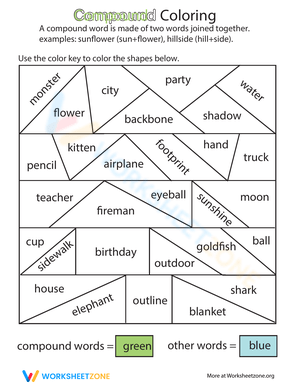
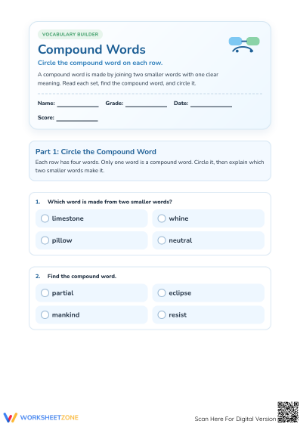
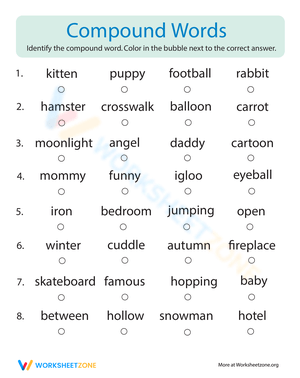
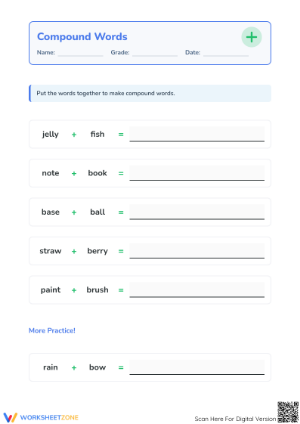
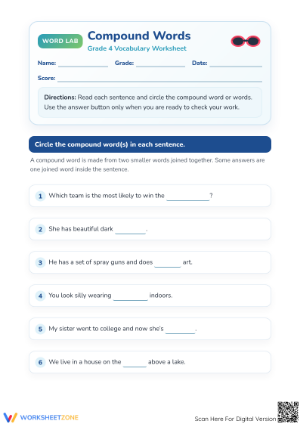
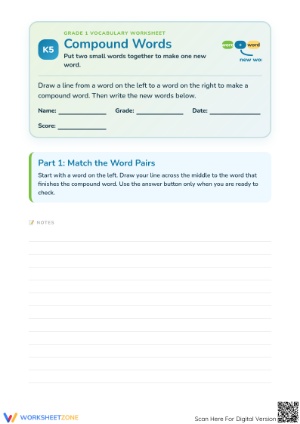
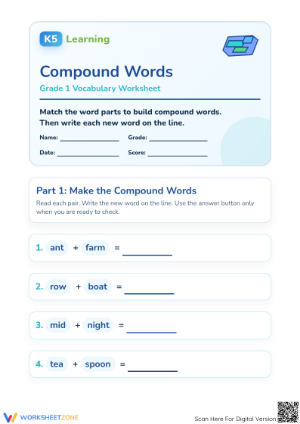
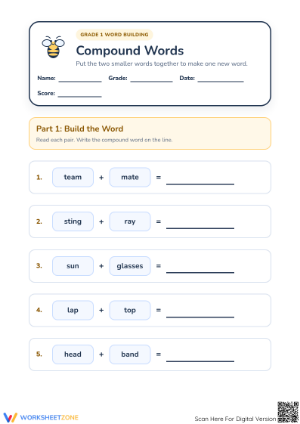
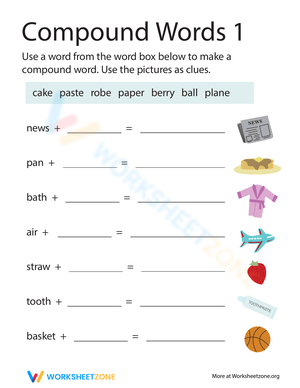
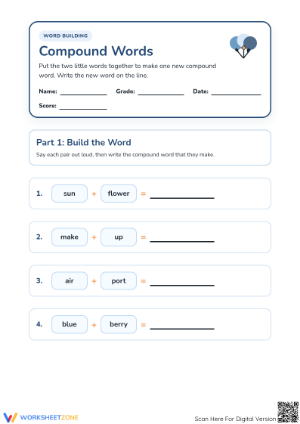
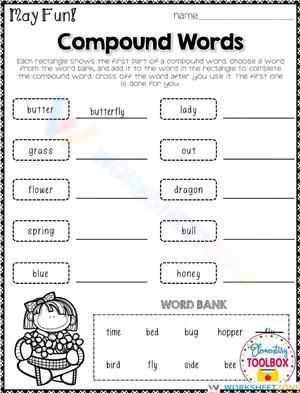
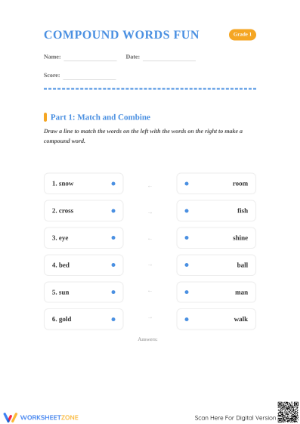
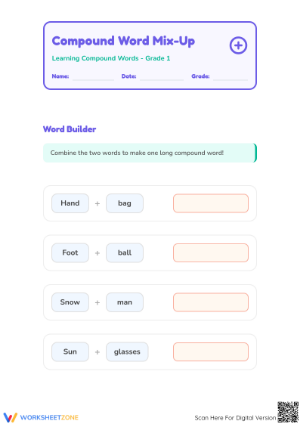
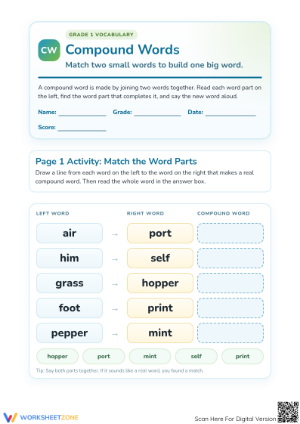
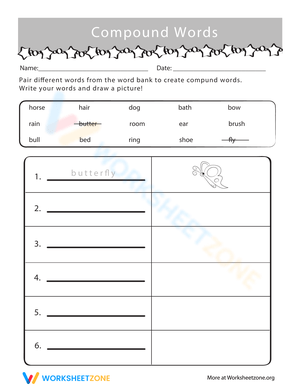
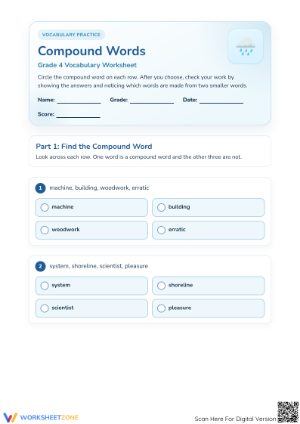
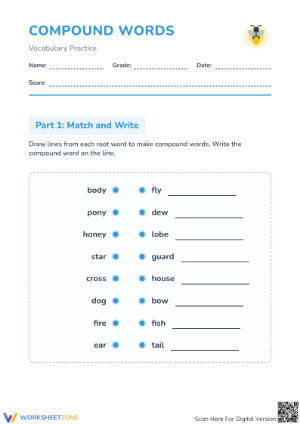
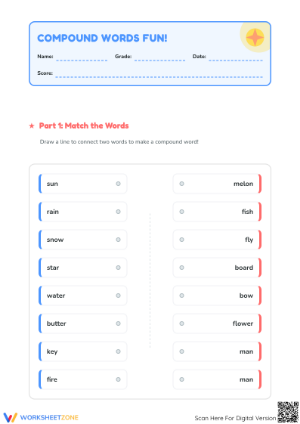
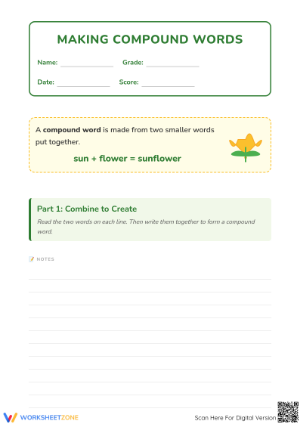
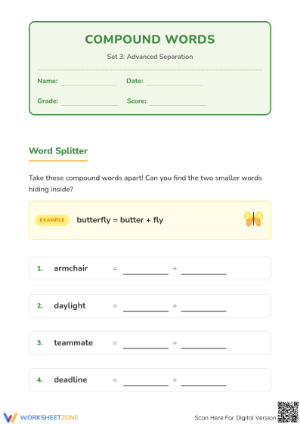
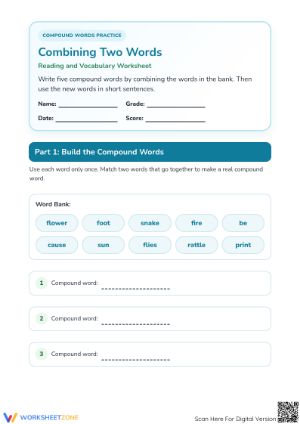
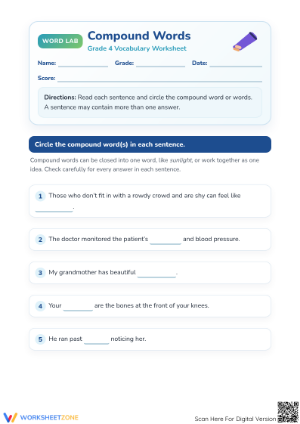
These compound words worksheets for 1st grade give teachers a print-ready set that moves students through four distinct task types — from picture-supported matching all the way to independent writing — within a single skill. The words featured across each worksheet are drawn from spoken vocabulary first graders already own: raincoat, mailbox, sunflower, cupcake, playground. Familiar base words let students focus on how meaning compounds rather than spending cognitive effort decoding unfamiliar parts.
What These Worksheets Ask Students to Do
Each worksheet targets a specific mode of practice rather than mixing every task type together. That separation matters because first graders consolidate new concepts best when they work one skill at a time before combining them. Across the set, students:
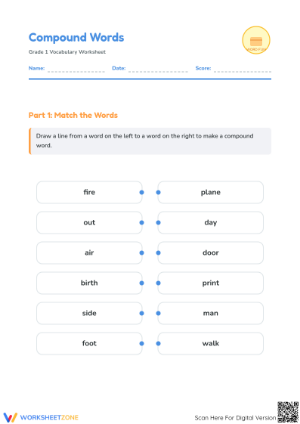
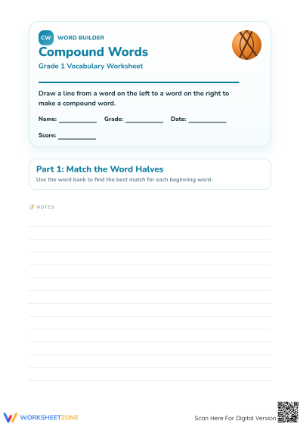
- Match pictures to compound words: Students draw a line connecting two images whose names combine — a sun and a flower joining into sunflower. The visual anchor confirms meaning before any writing begins.
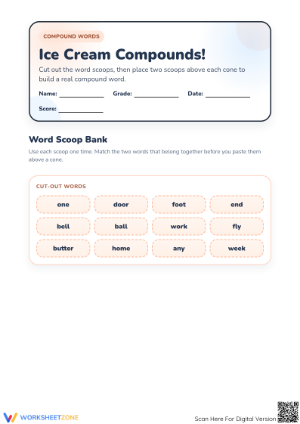
- Build words with cut-apart cards: Students arrange printed word pairs and glue them in order. The physical step slows impulsive guessing and makes the two-part structure visible in a way that simply looking at a printed word does not.
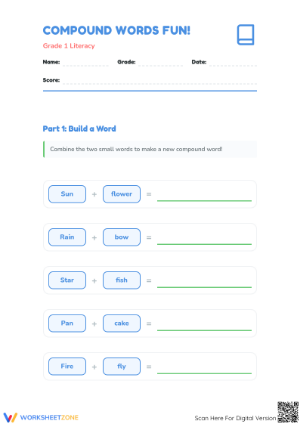
- Complete fill-in-the-blank equations: Students supply the missing half of a compound word — rain + ____ = raincoat. This format reveals whether a child knows both components, not just the finished word.
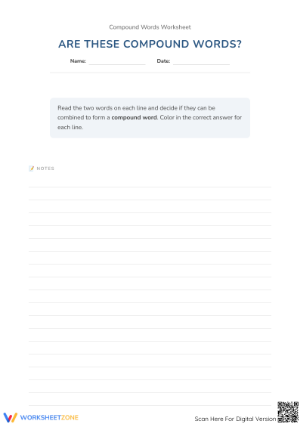
- Sort words and non-words: Students decide whether a given pair — cup + cake versus door + cloud — produces a real compound word. Sorting forces deliberate thinking rather than pattern-matching off a single recognizable part.
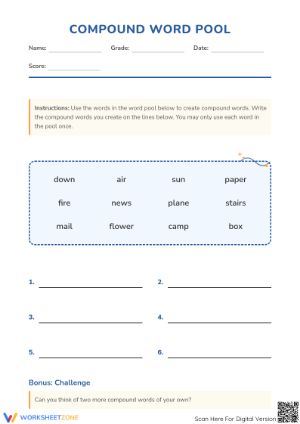
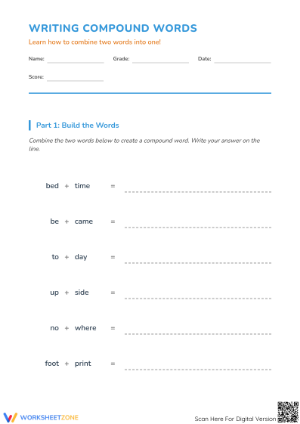
- Read and write independently: Students identify the two base words inside a compound word, then write the full word on their own. This is the production stage — recognition is already established.
Mistakes Students Make That These Worksheets Help You Catch
Working through compound words worksheets for 1st grade exposes specific misconceptions that oral instruction alone does not surface. The most persistent is part-word fixation: a student spots sun inside sunflower and confidently writes sunshine because that word lives higher in their mental lexicon. The worksheet formats here surface this error immediately. When a student physically pairs sun and flower cards and then writes sunshine anyway, you have a clear teaching moment — the word flower is right in front of them, but a more familiar compound is overriding the answer. Reteaching with the picture card of a flower rather than a ray of light resolves it faster than re-explaining the rule.
A second pattern that appears consistently: students who correctly identify both parts during oral practice then split the compound word in writing — rain coat instead of raincoat, mail box instead of mailbox. This is not a conceptual failure; it is a spelling convention gap. These students understand the morphology. They have not yet internalized that most compound words run together as one written unit. A short reference strip of the ten most common compound words, taped to the desk or posted near the writing area, handles this without turning it into a separate lesson.
Why Compound Words Belong in First-Grade Word Study
By mid-first grade, most students have enough basic decoding fluency to recognize CVC and CVCe words without laboring over each letter. Compound words arrive at exactly the right developmental moment: students draw on what they already know about two separate words to decode a third, longer word they may never have seen in print. That process — using existing knowledge to read new text — is the foundation of morphological awareness, and it transfers well beyond compound words. Students who learn to look inside long words for familiar parts become more flexible decoders in second and third grade, where multi-syllabic vocabulary dominates.
Concrete compound words also offer one of the few places in first-grade vocabulary instruction where meaning is genuinely transparent. Cupcake is a cake in a cup. Raincoat is a coat for rain. That semantic clarity gives teachers a natural entry into discussing how words carry meaning — a conversation first graders can participate in rather than receive passively.
Recommended Strategies for Getting the Most From These Worksheets
The most effective sequence runs across four or five days rather than a single sitting. On day one, introduce the concept orally before any paper comes out. Hold up two pictures — a cup and a cake — say each word, push them together physically, and say cupcake. Work through six to eight examples this way as a group before distributing the first matching worksheet. That five-minute oral warm-up cuts down sharply on the number of students sitting confused when the page arrives.
On days two and three, use the word-card building and sorting worksheets during small-group rotations. These are the formats where misconceptions surface, so proximity matters — being at the table lets you catch the sunshine error in real time rather than after the pages are collected. Reserve the fill-in and read-and-write pages for days four and five, when students have enough exposure to work with less support. Many teachers find these compound words worksheets for 1st grade work well in dry-erase sleeves during center rotation: students complete, erase, and repeat a matching or sorting page across multiple days before moving to written production.
One technique worth trying during the first round of instruction: print the two base words in different colors so students see rain and coat as distinct units inside raincoat. In week two, switch to standard black print. Students who relied on the color separation to process the parts will reveal themselves quickly, giving you a clear small-group pull for reteaching.
Adjusting the Worksheets Across Ability Levels
The picture-matching and word-card worksheets are accessible to most first graders without modification. For students still consolidating basic sight words, pare each worksheet to four items instead of eight and add a picture bank at the top so they choose from a closed set rather than retrieving from memory. Students who stall at writing can circle the correct base word from two printed choices rather than filling in the blank — the cognitive demand stays the same while removing the motor barrier.
For students who clear the standard worksheets quickly, the extension is not more compound words — it is deeper engagement with meaning. Ask them to draw a small picture showing how the two base words connect, or write a sentence where swapping one base word changes the whole image entirely (What if it were a "rainjacket"? Does that work? Why not?). That kind of reasoning builds morphological awareness that pays off on later reading comprehension measures, and it requires nothing more than a blank line at the bottom of the existing worksheet.
Standard Alignment
These worksheets align most directly with CCSS L.1.4b, which asks first graders to use knowledge of how two words combine to determine the meaning of a compound word. In instructional terms, L.1.4b positions compound word study as a meaning-making strategy rather than a spelling exercise — a distinction that matters when deciding where this practice lives in the week. It belongs alongside vocabulary and reading comprehension routines, not only inside phonics blocks. The worksheets also support RF.1.3 broadly, since reading each base word and then blending the full compound reinforces the decoding habit of processing familiar chunks within longer words.
Frequently Asked Questions
Do these worksheets address open and hyphenated compound words, or only closed forms?
Compound words worksheets for 1st grade address closed compound words almost exclusively — forms like cupcake, mailbox, and playground where both parts run together as one written unit. Open compounds such as ice cream and hyphenated forms appear in later grades when students have the spelling convention knowledge to handle the distinctions. Introducing all three forms in first grade routinely produces confusion and exceeds what the standards require at this level.
How many items should each worksheet include for first graders?
Six to eight items is the practical ceiling for most first graders working independently. More than eight often produces fatigue-driven guessing in the second half of the page — students rush to finish rather than thinking through each pair. For small-group reteach, four to six items gives you enough information to identify gaps without exhausting the lesson window.
Can these worksheets serve as a quick formative check?
The fill-in-the-blank and read-and-write pages work well as brief formative measures. A student who consistently supplies the wrong base word — or writes two separate words instead of one — has given you actionable information in about three minutes of review. The sorting worksheet doubles as a formative tool when you ask students to explain one sorting decision aloud before collecting the page: that 30-second verbal check reveals the reasoning behind the written answer in ways the paper alone does not show.












 Interactive Worksheet Maker
 Quiz Maker
 Word Search Maker
 Crossword Puzzle Maker
 Word Scramble Generator
 Sentence Scramble Generator
 Handwriting Worksheet Generator
 Name Tracing Generator
 Fill In The Blank Generator