


























Views
Downloads
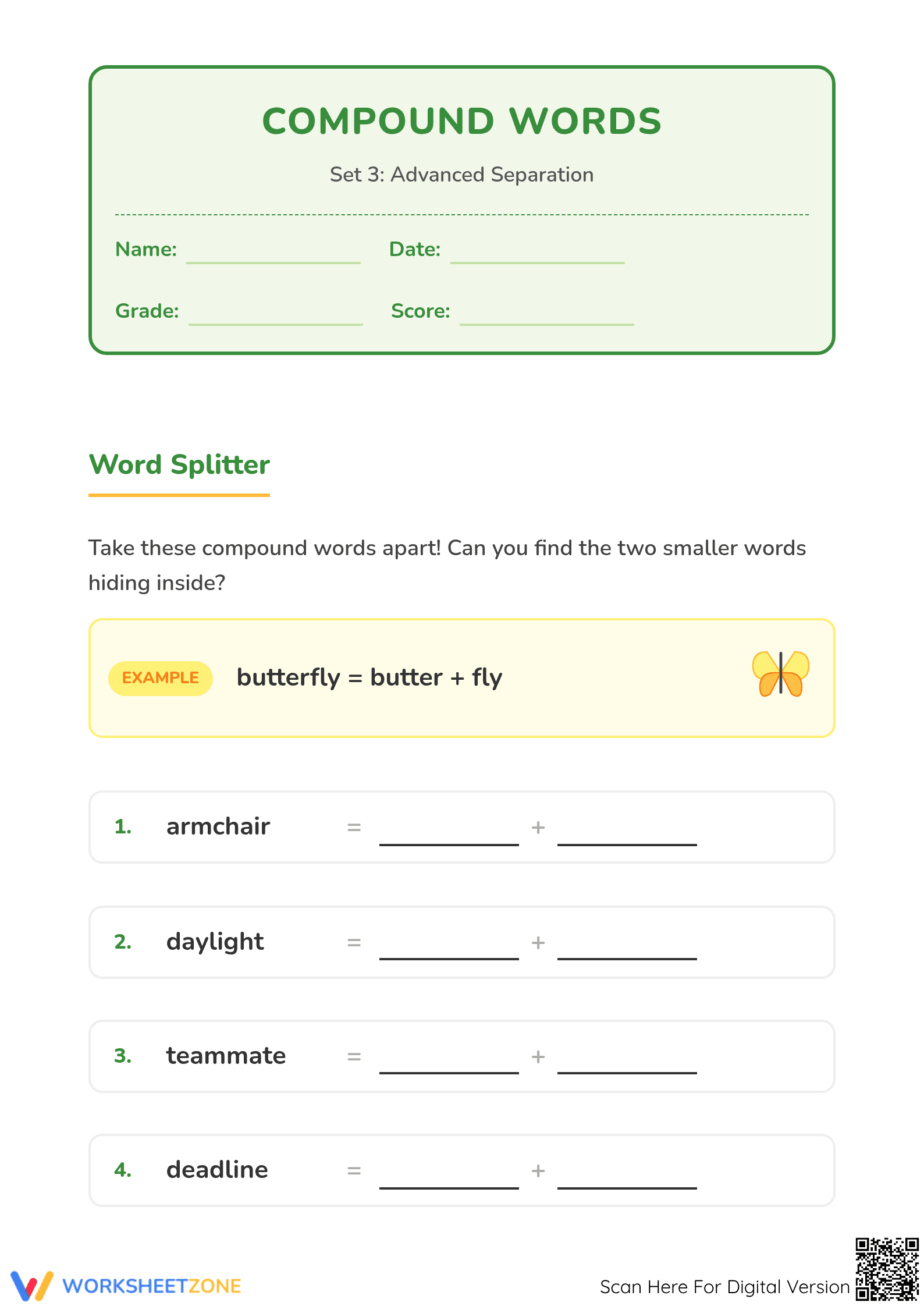


Grade 1 Compound Words Worksheet — Essential Printable
Paste this activity's link or code into your existing LMS (Google Classroom, Canvas, Teams, Schoology, Moodle, etc.).
Students can open and work on the activity right away, with no student login required.
You'll still be able to track student progress and results from your teacher account.
This Grade 1 ELA worksheet focuses on the structural analysis of compound words. Students decompose complex lexical units into constituent base words, identifying smaller words hidden inside larger ones. This systematic practice develops critical decoding skills and semantic awareness, ensuring learners understand how word meanings are constructed through morphological composition.
At a Glance
- Grade: 1 · Subject: English Language Arts (ELA)
- Standard:
CCSS.ELA-LITERACY.L.1.4— Identify word parts to determine the meaning of unknown or multiple-meaning words- Skill Focus: Compound word decomposition and root word identification
- Format: 3 pages · 20 problems · Answer key included · PDF
- Best For: Early literacy centers and independent grammar practice
- Time: 15–25 minutes
The resource consists of three pages containing twenty targeted separation tasks. Students encounter high-frequency words like "keyboard" and "teammate" in a clear visual equation format. A modeled example establishes expectations, while the layout provides ample writing space. A complete answer key is included to facilitate rapid grading or student self-correction during independent work periods.
Teachers can implement this resource with zero technical setup. First, print the PDF and answer key (30 seconds). Second, distribute the worksheets during a literacy block or as morning work (1 minute). Finally, use the answer key for immediate feedback or whole-class review (under 2 minutes). Total teacher preparation time is under two minutes, making this an excellent choice for emergency sub plans or last-minute filler activities.
Standards Alignment
The primary alignment is CCSS.ELA-LITERACY.L.1.4, focusing on determining the meaning of unknown words using word-level components. This worksheet provides foundational scaffolding for morphological mastery, preparing students for more complex Grade 2 standards. Both standard codes can be copied directly into lesson plans, IEP goals, or district curriculum mapping tools to track student progress toward literacy benchmarks.
How to Use It
Deploy this as a formative assessment after direct instruction on word families. Circulate to observe if students accurately distinguish between base words. Alternatively, use individual pages as exit tickets to gauge mastery of word structure before introducing prefixes. Most Grade 1 students will complete the full twenty-problem set within twenty minutes of focused work.
Who It's For
This resource is designed for first-grade students transitioning from phonemic awareness to morphological decoding. It supports English Language Learners by illustrating how familiar vocabulary combines to create new concepts. The worksheet pairs naturally with a compound word anchor chart or a reading passage containing target vocabulary like "seashell" to reinforce contextual application.
Research provided by RAND AIRS 2024 emphasizes that morphological awareness, specifically the ability to identify constituent parts of compound words, is a significant predictor of reading comprehension success in the early primary grades. This worksheet facilitates explicit instruction in word structure, a practice that the National Assessment of Educational Progress (NAEP) identifies as a core component of effective literacy instruction. By requiring students to physically write the base words, the resource reinforces the orthographic mapping of high-frequency roots. This focused practice on standard CCSS.ELA-LITERACY.L.1.4 ensures that Grade 1 learners develop the systematic decoding habits necessary for fluent reading. The inclusion of twenty distinct tasks provides the repetition required for neural consolidation of these lexical patterns, moving students toward independent mastery of complex word forms. This evidence-based approach to grammar instruction supports long-term vocabulary growth and linguistic confidence in developing readers.


