


























Views
Downloads
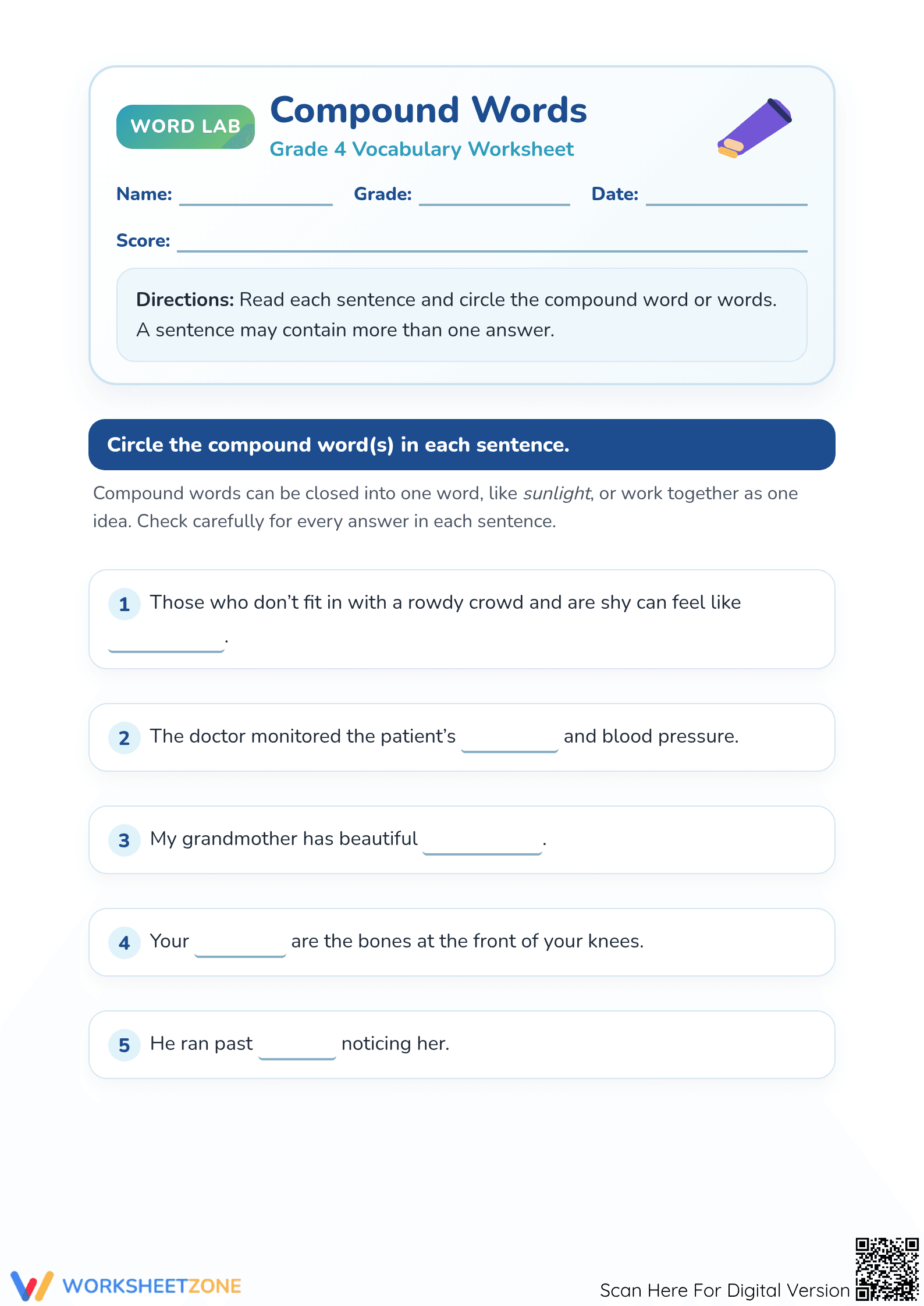


Printable Compound Words Worksheet | Grade 4 Essential
Paste this activity's link or code into your existing LMS (Google Classroom, Canvas, Teams, Schoology, Moodle, etc.).
Students can open and work on the activity right away, with no student login required.
You'll still be able to track student progress and results from your teacher account.
Strengthen your students' vocabulary and morphological awareness with this comprehensive Grade 4 compound words worksheet. Designed to build mastery in identifying closed and open compound words, this printable resource challenges learners to analyze sentences and extract meaningful lexical units. By isolating root words, students enhance their ability to decode complex language, leading to improved reading fluency and literacy success.
At a Glance
At a Glance
- Grade: 4 · Subject: English Language Arts
- Standard:
CCSS.ELA-LITERACY.L.4.4— Use strategies to determine the meaning of grade-level vocabulary and compound words.- Skill Focus: Identifying closed and open compound words
- Format: 2 pages · 8 problems · Answer key included · PDF
- Best For: Independent vocabulary practice and lexical review
- Time: 15–20 minutes
What's Inside
This two-page PDF resource provides a structured environment for lexical exploration. It features eight carefully crafted sentences that incorporate a variety of compound word types, including closed forms like "sunlight" and open forms like "blood pressure." The worksheet includes clear instructional headers, dedicated space for student identification, and a comprehensive answer key for immediate feedback. Its clean layout ensures students remain focused on the linguistic tasks without visual distractions.
Skill Progression
- Guided practice: Review definitions and examples of closed and open compound words to establish a conceptual baseline for structural identification.
- Supported practice: Work through the first four sentences, identifying word pairs that combine to create new meanings while referencing the header.
- Independent practice: Locate and circle compound words within complex sentences, applying morphological strategies independently to demonstrate mastery.
This gradual-release approach ensures students move confidently toward independent application of word-analysis skills.
Standards Alignment
This worksheet is primarily aligned to CCSS.ELA-LITERACY.L.4.4, which focuses on using various strategies to determine the meaning of unknown and multiple-meaning words and phrases. By dissecting compound words into their component roots, students fulfill the requirement to analyze word structure as a means of lexical discovery. Both standard codes can be copied directly into lesson plans, IEP goals, or district curriculum mapping tools.
How to Use It
Use this worksheet during the "You Do" phase of a morphology lesson. After teaching compound word types, distribute the printable to assess mastery. For a formative observation, check if students identify multiple words in sentence 7, noting those who need scaffolding. Completion typically takes 15 to 20 minutes, fitting easily into any ELA block or vocabulary center rotation.
Who It's For
This resource is ideal for Grade 4 students, but works well for Grade 3 enrichment or Grade 5 review. It helps English Language Learners (ELLs) developing structural analysis skills and lexical confidence. Pair it with an anchor chart or informational passage to reinforce morphological awareness, ensuring all students gain mastery over these essential linguistic building blocks.
The study of compound words in the fourth-grade curriculum is a critical component of morphological awareness, which directly correlates with reading comprehension and lexical acquisition. According to Fisher & Frey (2014), the ability to dissect and assemble multi-morphemic units allows students to decode unfamiliar text with greater efficiency. This worksheet targets CCSS.ELA-LITERACY.L.4.4 by requiring learners to identify both closed and open compound words within contextually rich sentences. By engaging with these eight structured tasks, students practice the strategy of looking for known root words to determine the meaning of a larger lexical unit. This focused practice bridges the gap between basic phonics and advanced academic vocabulary, ensuring that Grade 4 students develop the structural analysis skills necessary for complex informational texts. Educators can utilize this printable resource to provide rigorous, evidence-based practice that aligns with the Science of Reading's emphasis on morphology as a pillar of literacy development.


