


























Views
Downloads


Compound Words Worksheet: Grade 1-4 — Printable No-Prep
Paste this activity's link or code into your existing LMS (Google Classroom, Canvas, Teams, Schoology, Moodle, etc.).
Students can open and work on the activity right away, with no student login required.
You'll still be able to track student progress and results from your teacher account.
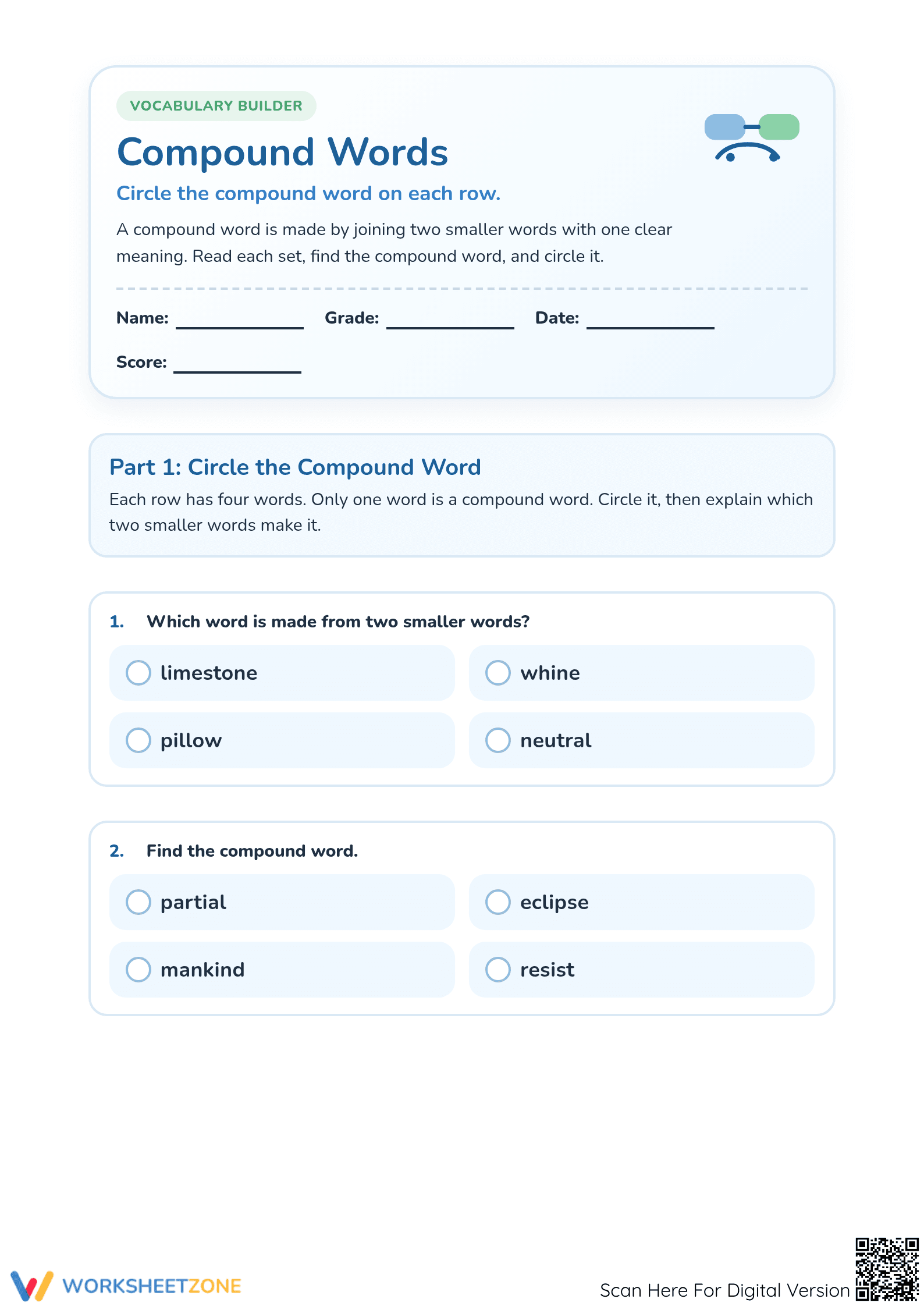
Mastering compound words is essential for elementary vocabulary growth and morphological awareness. This four-page worksheet focuses on identifying compound words and understanding how two words merge to form new meanings. Students strengthen their linguistic skills through eleven structured exercises, paving the way for advanced reading comprehension and greater precision in their written English Language Arts work.
At a Glance
- Grade: 1–4 · Subject: ELA
- Standard:
CCSS.ELA-LITERACY.L.2.4.D— Use individual word meanings to predict the meaning of a compound word- Skill Focus: Compound Word Identification
- Format: 4 pages · 11 problems · Answer key included · PDF
- Best For: Literacy centers and independent vocabulary practice
- Time: 15–25 minutes
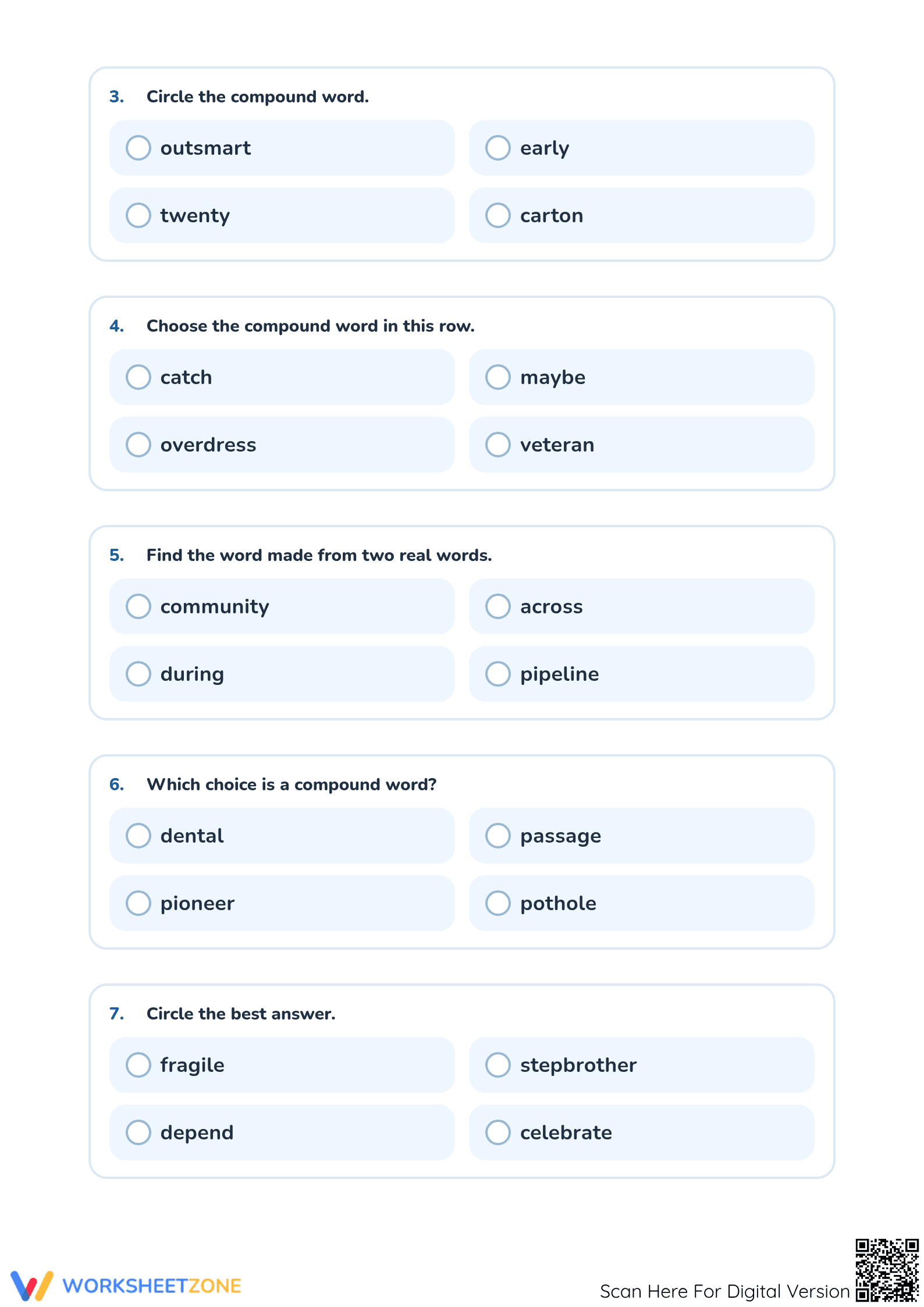
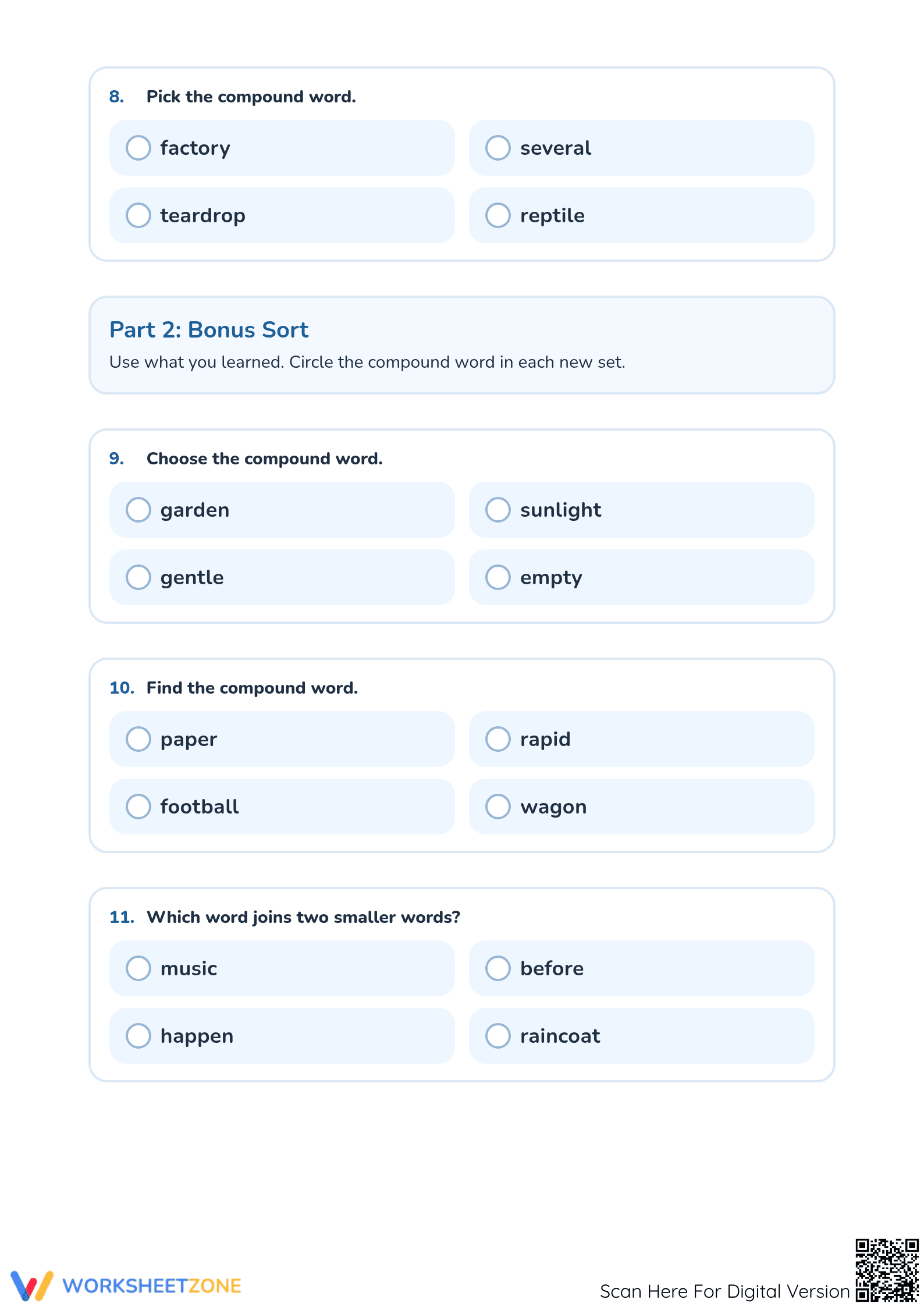
This resource contains four pages designed to build confidence in word analysis. Part 1 features eight rows of identification tasks where students must select the correct compound word from four options. Part 2, "Bonus Sort," offers three additional challenges to reinforce learning. The packet includes a student-friendly "Word Clue" box, a score tracking section, and a full answer key for efficient grading.
Teachers can move to implementation in three steps. First, print the four-page PDF for your class (30 seconds). Second, distribute the packets during your ELA block or literacy centers (1 minute). Third, use the included answer key for immediate review or student self-correction (1 minute). This structure requires less than three minutes of total preparation, making it a reliable solution for substitute teacher plans.
This worksheet is primarily aligned with CCSS.ELA-LITERACY.L.2.4.D: "Use knowledge of the meaning of individual words to predict the meaning of a compound word." It also supports CCSS.ELA-LITERACY.L.3.4.B by helping students identify the relationship between base words and their merged forms. Both standard codes can be copied directly into lesson plans, IEP goals, or district curriculum mapping tools.
Use this packet during the independent practice phase of a lesson on morphology to assess student mastery. It serves as an excellent formative assessment tool; teachers should observe whether students can explain why words like "sunlight" or "raincoat" are compound while others are not. Expected completion time ranges from 15 to 25 minutes depending on the student grade level.
This resource is tailored for Grade 1 through Grade 4 students who are developing their lexical skills. It is particularly beneficial for English Language Learners (ELLs) who need explicit practice with English word construction. The worksheet pairs naturally with a compound word anchor chart or a short informational passage where students can highlight merged words in a real-world context.
Effective vocabulary instruction requires students to move beyond simple memorization toward a structural understanding of language. According to a RAND AIRS 2024 analysis of elementary literacy strategies, explicit practice in word-building and decomposition—such as the identification of compound words—significantly improves a student's ability to decode unfamiliar text. This worksheet directly addresses the CCSS.ELA-LITERACY.L.2.4.D standard by requiring students to recognize that a compound word is made by joining two smaller words with one clear meaning. By engaging with eleven distinct problems across four pages, learners build the morphological awareness necessary for reading fluency. This research-based approach ensures that students do not just see words as isolated units but as logical constructions. The inclusion of an answer key allows for immediate feedback, which NAEP studies indicate is crucial for reinforcing newly acquired linguistic patterns in the primary grades.


