


























Views
Downloads


Compound Words Worksheet | Grade 1 Essential Printable
Paste this activity's link or code into your existing LMS (Google Classroom, Canvas, Teams, Schoology, Moodle, etc.).
Students can open and work on the activity right away, with no student login required.
You'll still be able to track student progress and results from your teacher account.
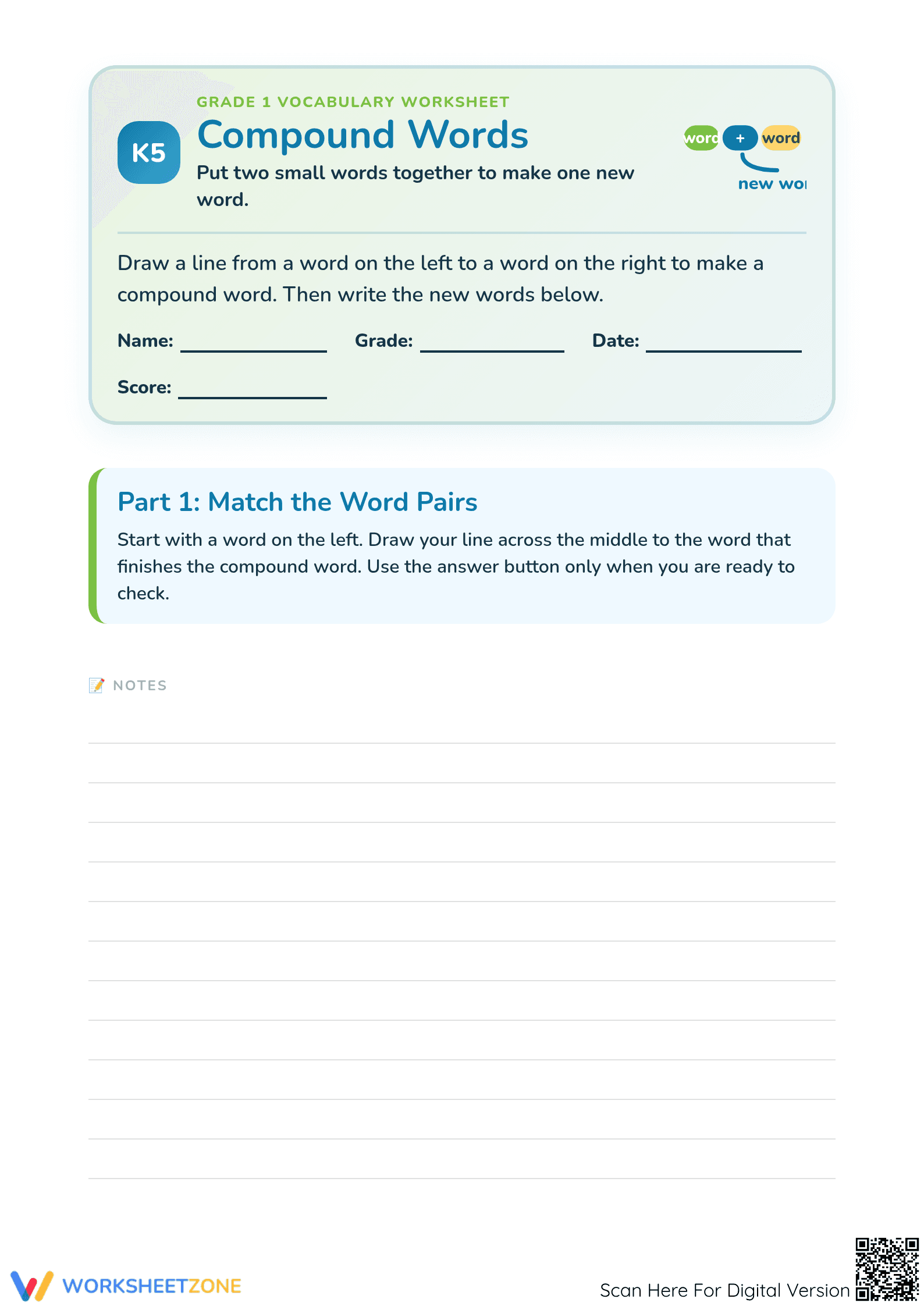
This Grade 1 compound words worksheet provides essential practice in identifying and constructing new words from root pairs. Students engage in 14 targeted tasks that build foundational lexical skills through matching and writing. By completing these exercises, learners will demonstrate how separate meanings merge into singular, complex terms.
At a Glance
- Grade: 1 · Subject: English Language Arts (ELA)
- Standard:
CCSS.ELA-LITERACY.L.1.4— Determine the meaning of unknown words using context and word parts- Skill Focus: Compound Word Construction
- Format: 4 pages · 14 problems · Answer key included · PDF
- Best For: Literacy centers and independent morning work
- Time: 15–20 minutes
What's Inside
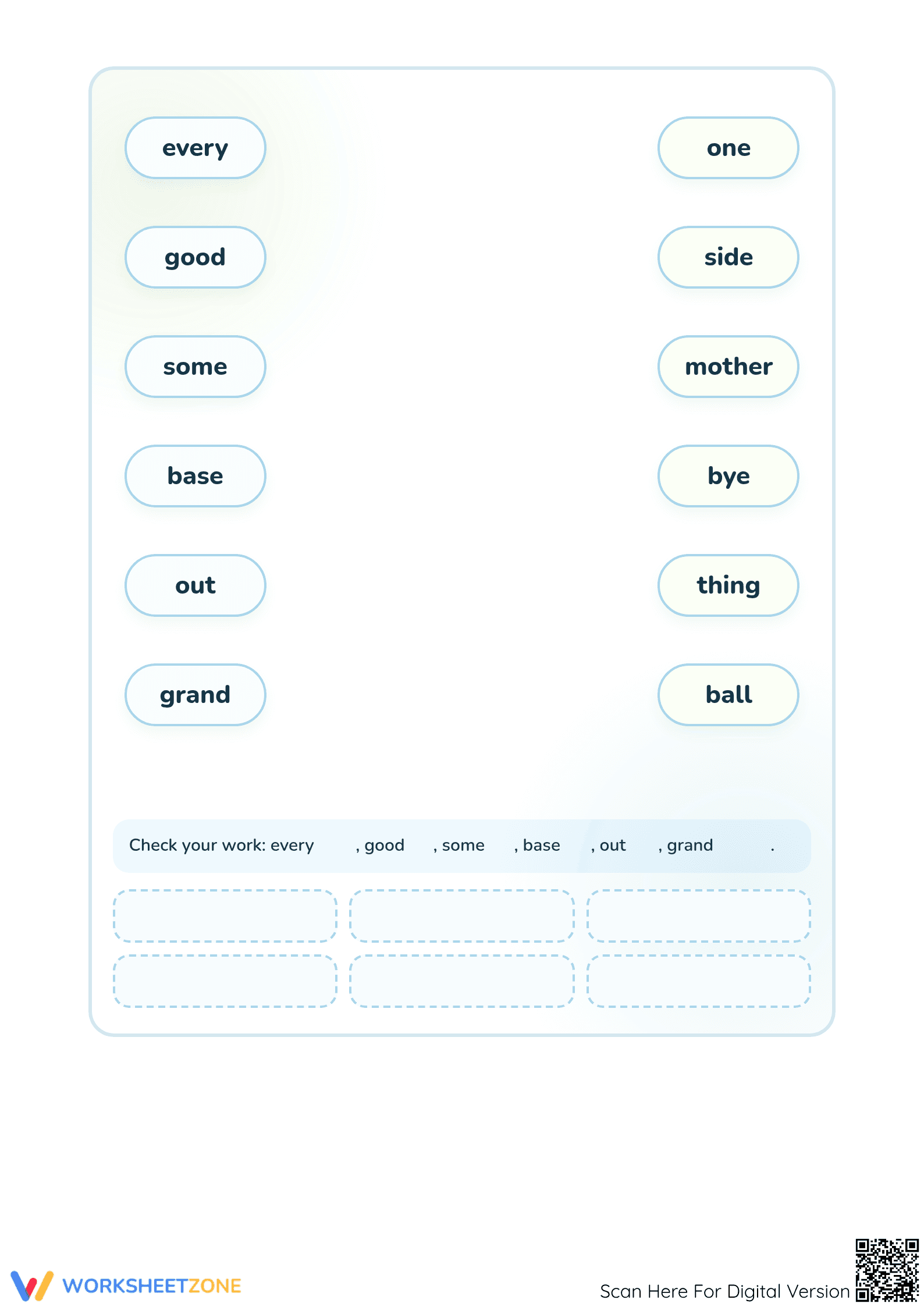
The resource spans 4 pages for maximum clarity and engagement. Part 1 features a matching bank where students connect six root pairs. Part 2 provides addition-style prompts with handwriting lines for the new words. Part 3 uses context clues to test application across the entire set. A full answer key is included for teacher review or student self-checking.
Zero-Prep Workflow
This resource follows a zero-prep workflow designed for busy educators. To implement, follow these simple steps: First, print the 4-page PDF. Second, distribute the sets to your students. Third, review the answers using the included key. Total preparation time is under 2 minutes, making this an excellent choice for substitute folders or independent morning work rotations.
Standards Alignment
Alignment centers on CCSS.ELA-LITERACY.L.1.4, targeting vocabulary acquisition and use. It also supports CCSS.ELA-LITERACY.L.2.4.D by encouraging students to use root words to predict meanings of compound terms. Both standard codes can be copied directly into lesson plans, IEP goals, or district curriculum mapping tools to track student mastery.
How to Use It
Use this during the independent practice phase of a lesson or as a quick formative assessment. Observe students as they join words; if they struggle, prompt them to say the root words separately first to hear the individual meanings. Expected completion time for the entire set is roughly 15 to 20 minutes.
Who It's For
This activity is built for Grade 1 students exploring word structure beyond CVC patterns. It also serves Grade 2 students needing review or ELL learners mastering common compound terms. Pair this with a vocabulary anchor chart or a picture book to reinforce how these words function in real-world reading scenarios.
According to the RAND AIRS 2024 report on primary literacy development, explicit instruction in morphological awareness serves as a critical bridge between phonics and advanced reading comprehension. This CCSS.ELA-LITERACY.L.1.4 aligned worksheet facilitates this transition by requiring students to perform three cognitive operations: recognition through matching, synthesis through writing, and application through context riddles. By isolating 14 specific word pairs, the resource allows Grade 1 students to explore how meaning is generated when lexical units are joined. This "part-to-whole" processing is essential for decoding multisyllabic words in complex texts. Research suggests that students who engage with structured, multi-modal vocabulary tasks show a higher rate of retention than those using passive methods. Educators can use this capsule as a summary for curriculum alignment or parent-teacher communication regarding student progress in foundational English Language Arts skills and lexical development.


