


























Views
Downloads

Essential Compound Words Matching Worksheet | Grade 1 ELA
Paste this activity's link or code into your existing LMS (Google Classroom, Canvas, Teams, Schoology, Moodle, etc.).
Students can open and work on the activity right away, with no student login required.
You'll still be able to track student progress and results from your teacher account.
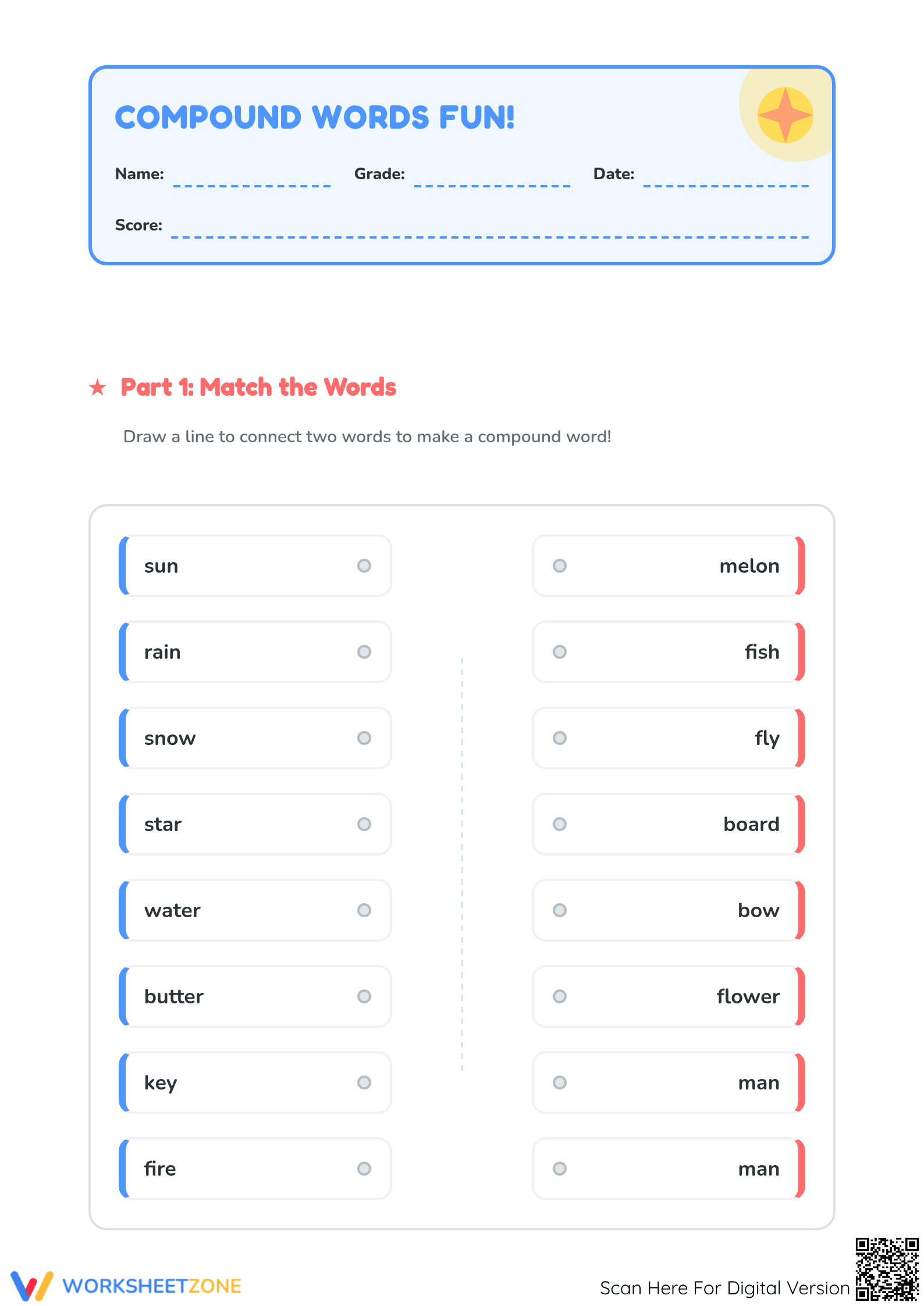
Strengthen your Grade 1 students' vocabulary and morphological awareness with this comprehensive compound words practice set. This worksheet guides learners through the process of combining two independent root words to create a single word with a new, distinct meaning. By completing these engaging tasks, students develop the foundational skills necessary for predicting word meanings and improving reading fluency.
At a Glance
- Grade: 1 · Subject: ELA
- Standard:
CCSS.ELA-LITERACY.L.2.4.D— Predict meanings of compound words using individual root word meanings- Skill Focus: Compound Word Construction
- Format: 3 pages · 24 problems · Answer key included · PDF
- Best For: Literacy centers and independent skill reinforcement
- Time: 20–30 minutes
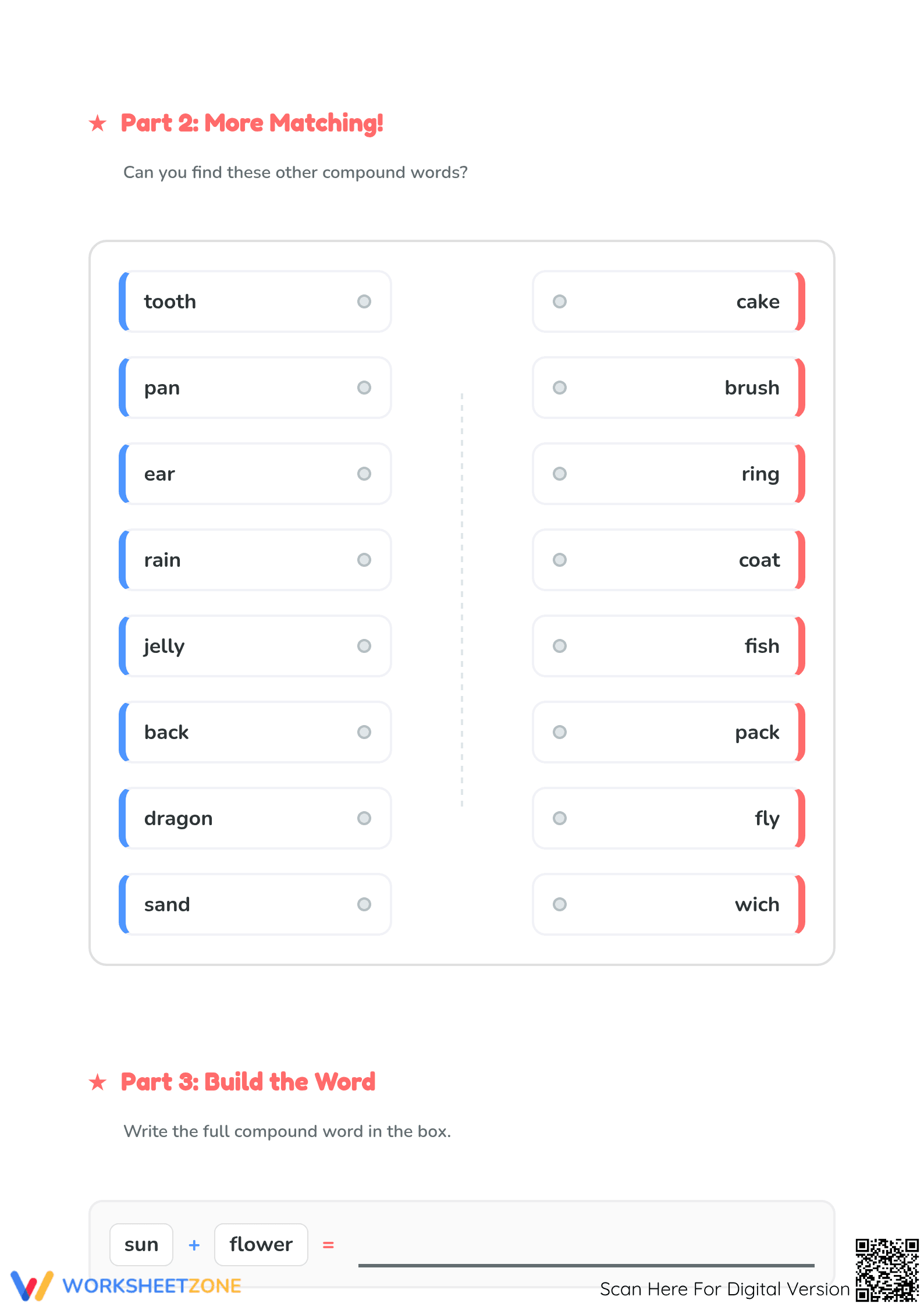
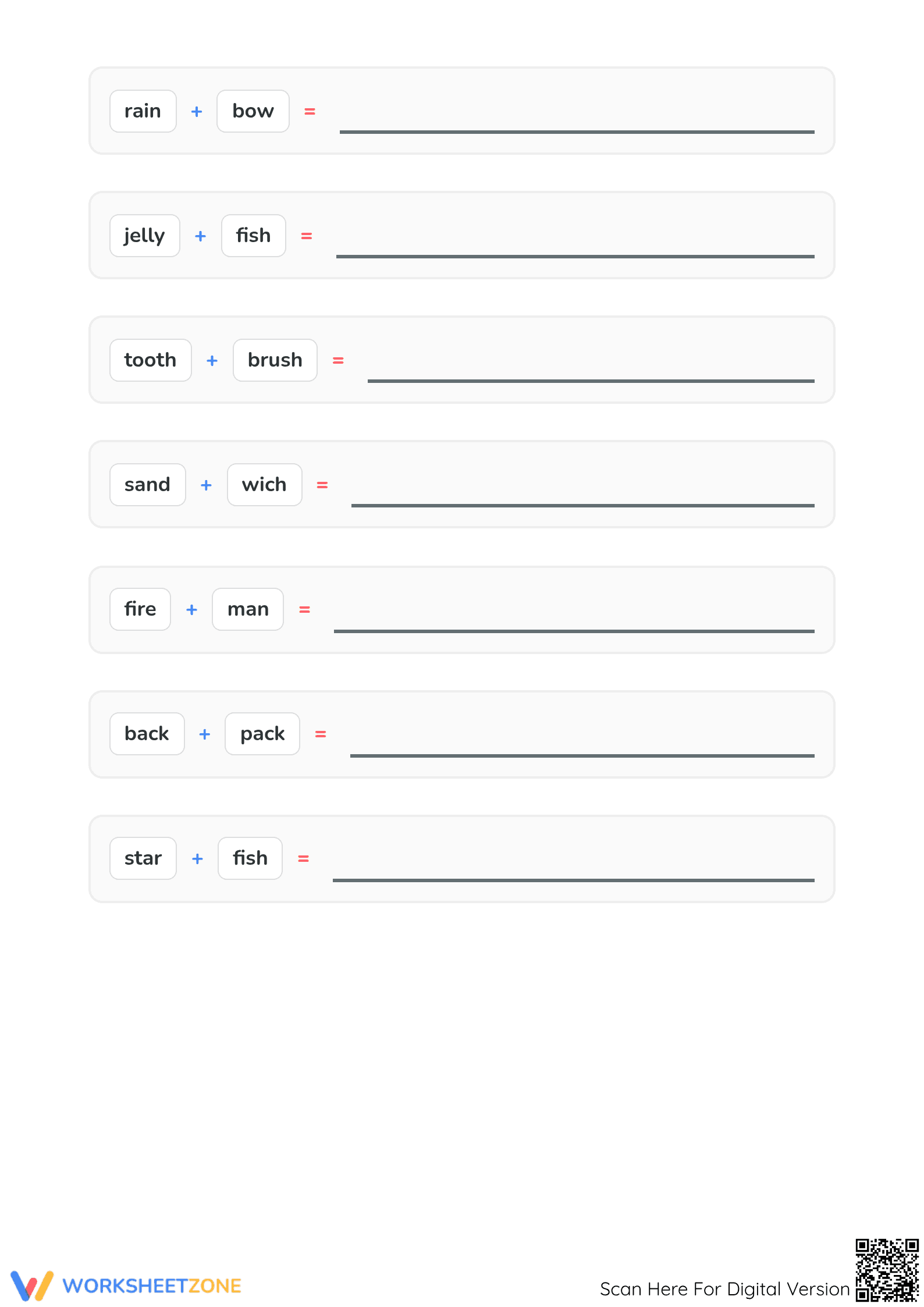
This three-page instructional resource features 24 structured tasks designed to reinforce lexical patterns. Students interact with familiar root words through two "Match the Words" sections containing 16 total pairing exercises. The final page features a "Build the Word" section where students synthesize eight new compound words from given components. A complete answer key is provided to facilitate rapid grading and student self-correction.
Skill Progression
- Guided Practice: The worksheet begins with 8 matching pairs where students connect simple root words like "sun" and "flower" using visual lines, establishing the basic concept of word synthesis.
- Supported Practice: Students progress to a second set of 8 matching tasks with slightly more complex word combinations, requiring deeper recognition of word relationships.
- Independent Practice: In the final 8 tasks, students move from matching to construction, writing out the full compound word to demonstrate mastery of spelling and structural integration.
This sequence follows a gradual-release model, moving from visual identification to independent lexical production.
Standards Alignment
This resource aligns primarily with `CCSS.ELA-LITERACY.L.2.4.D`, which focuses on using the meaning of individual words to predict the meaning of a compound word. While often introduced in Grade 1, this skill is a critical bridge to Grade 2 linguistic standards and supports overall vocabulary acquisition. Both standard codes can be copied directly into lesson plans, IEP goals, or district curriculum mapping tools.
How to Use It
Integrate this worksheet into your literacy block after an initial anchor chart lesson on compound words. It serves as an excellent formative assessment tool; observe whether students can identify the transition point between root words. Expect a completion time of 20 to 30 minutes depending on the student's familiarity with the vocabulary.
Who It's For
This resource is ideal for first-grade students and English language learners who need concrete practice with word morphology. It pairs naturally with a "Compound Word Mystery Box" activity or a direct instruction lesson using high-frequency word cards to build decoding confidence.
Research by Fisher & Frey (2014) emphasizes the importance of morphology in early literacy development, noting that understanding how words are constructed directly correlates with reading comprehension. This worksheet targets the CCSS.ELA-LITERACY.L.2.4.D standard by requiring students to synthesize root words into functional compound words, a process that internalizes lexical logic. By engaging in 24 distinct tasks, students move beyond rote memorization toward a conceptual understanding of word formation. This approach aligns with NAEP recommendations for increasing vocabulary breadth through structural analysis. Educational data suggests that early exposure to compound word patterns reduces cognitive load when students encounter multisyllabic words in more complex texts. This worksheet provides the repetitive, focused practice necessary to turn these linguistic observations into automatic reading skills. As a standalone PDF with a clear answer key, it ensures that instructional time is spent on student engagement rather than administrative preparation.


