


























Views
Downloads


Compound Words Printable Worksheet | Grade 1 ELA
Paste this activity's link or code into your existing LMS (Google Classroom, Canvas, Teams, Schoology, Moodle, etc.).
Students can open and work on the activity right away, with no student login required.
You'll still be able to track student progress and results from your teacher account.
This Grade 1 ELA worksheet helps students master compound words by evaluating whether two distinct words can be combined to form a new word. By analyzing word pairs and determining their validity, young learners build essential vocabulary and word analysis skills necessary for reading fluency and comprehension.
At a Glance
- Grade: 1 · Subject: ELA
- Standard:
CCSS.ELA-LITERACY.RF.1.3— Apply phonics and word analysis skills to decode words.- Skill Focus: Identifying compound words
- Format: 3 pages · 11 problems · Answer key included · PDF
- Best For: Independent practice and vocabulary building
- Time: 10–15 minutes
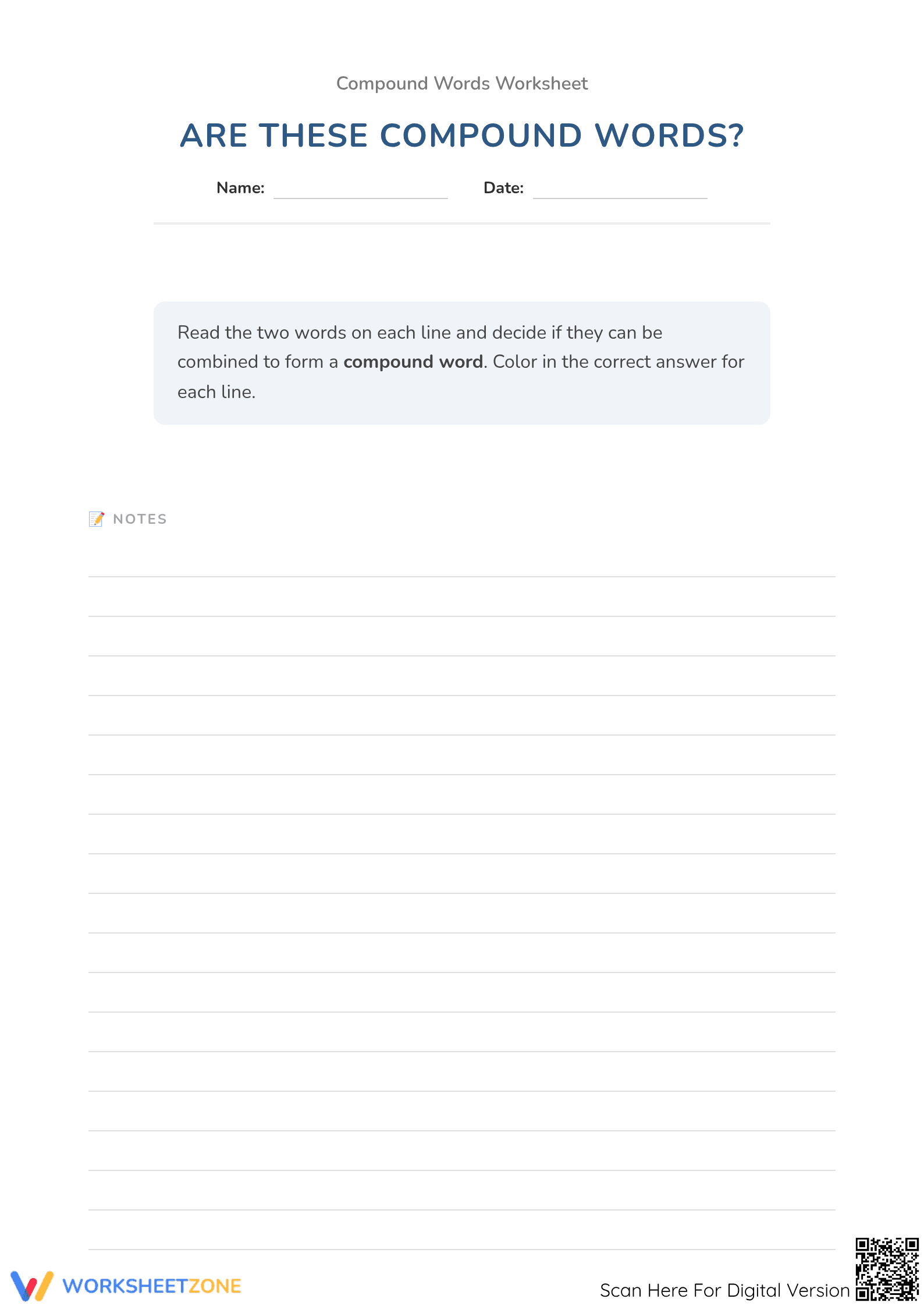
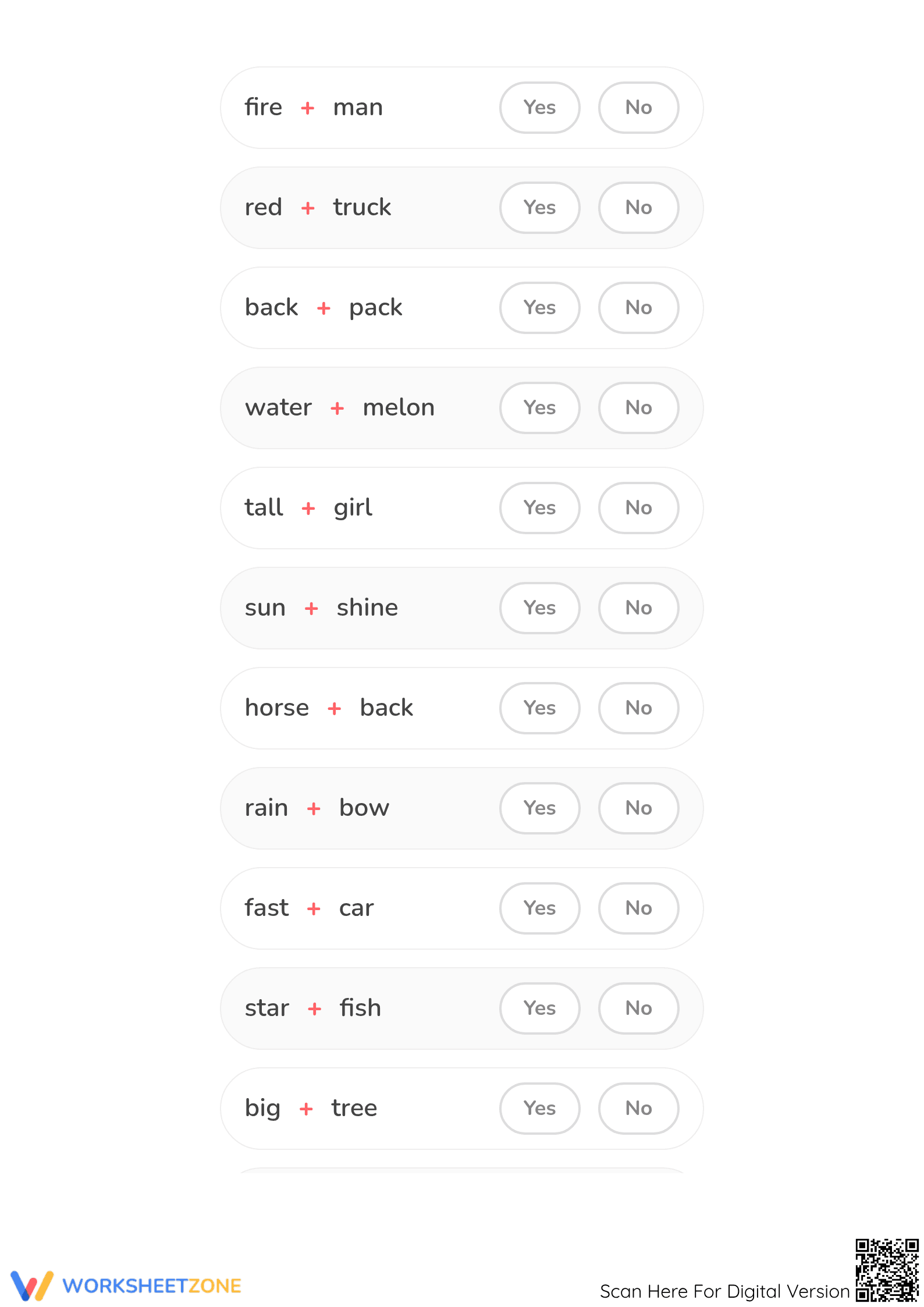
This resource features three pages of focused practice, including a dedicated notes section for teacher instruction or student brainstorming. The main activity presents ten clear "Yes or No" multiple-choice questions where students evaluate word pairs like "fire + man" or "red + truck." A bonus section challenges students to write their own compound word equation. A complete answer key is provided to ensure quick and accurate grading.
Skill Progression
- Guided practice: Teachers use the initial notes page to introduce compound words, providing examples of how two smaller words create a new meaning.
- Supported practice: The first few problems feature highly familiar word pairs, allowing students to build confidence as they evaluate the combinations.
- Independent practice: Students complete the remaining word pairs and tackle the bonus challenge of generating their own compound word independently.
This structure follows a proven gradual-release model, moving smoothly from "I Do" to "We Do" to "You Do."
Standards Alignment
This worksheet is aligned to CCSS.ELA-LITERACY.RF.1.3, requiring students to know and apply grade-level phonics and word analysis skills in decoding words. By evaluating whether two words form a valid compound word, students demonstrate an understanding of word structures and vocabulary acquisition. Both standard codes can be copied directly into lesson plans, IEP goals, or district curriculum mapping tools.
How to Use It
This activity is perfect for independent seatwork after a whole-class mini-lesson on compound words. Teachers can distribute the worksheet and have students complete the ten evaluation problems to reinforce the day's instruction. As a formative assessment tip, observe whether students are sounding out both words individually before deciding if they make sense together; this reveals their decoding strategies. The entire activity should take approximately 10 to 15 minutes to complete.
Who It's For
This resource is designed for first-grade students developing their foundational reading and vocabulary skills. It is highly effective for early finishers, morning work, or targeted intervention groups needing extra practice with word analysis. For differentiation, teachers can read the word pairs aloud to students who struggle with decoding. This worksheet pairs perfectly with a classroom anchor chart displaying common compound words and their visual representations.
Mastering word analysis skills, such as identifying compound words, is a critical step in early literacy development. Aligned with CCSS.ELA-LITERACY.RF.1.3, this resource requires students to apply phonics and word analysis skills to decode words. According to Fisher & Frey (2014), providing students with structured, focused practice on specific vocabulary components significantly improves their ability to decode unfamiliar text and comprehend complex sentences. When young learners actively evaluate word combinations, they strengthen their morphological awareness, which directly correlates with reading fluency. This targeted practice ensures that students do not just memorize vocabulary but deeply understand the structural rules governing word formation. By integrating these foundational exercises into daily instruction, educators can build a more robust literacy framework that supports long-term academic success and reading comprehension.


