


























Views
Downloads


Printable Compound Words Worksheet Packet | Grades 1-4
Paste this activity's link or code into your existing LMS (Google Classroom, Canvas, Teams, Schoology, Moodle, etc.).
Students can open and work on the activity right away, with no student login required.
You'll still be able to track student progress and results from your teacher account.
Mastering compound words is a critical milestone in early literacy, helping students decode complex vocabulary by recognizing familiar root words. This three-page worksheet packet provides structured practice for students to identify, combine, and write 19 different compound words. By completing these exercises, learners develop a stronger grasp of how language builds meaning through combination.
At a Glance
- Grade: 1-4 · Subject: ELA
- Standard:
L.2.4.D— Use knowledge of individual word meanings to predict the meaning of compound words- Skill Focus: Compound Word Formation
- Format: 3 pages · 19 problems · Answer key included · PDF
- Best For: Vocabulary centers and independent morning work
- Time: 15–20 minutes
What's Inside
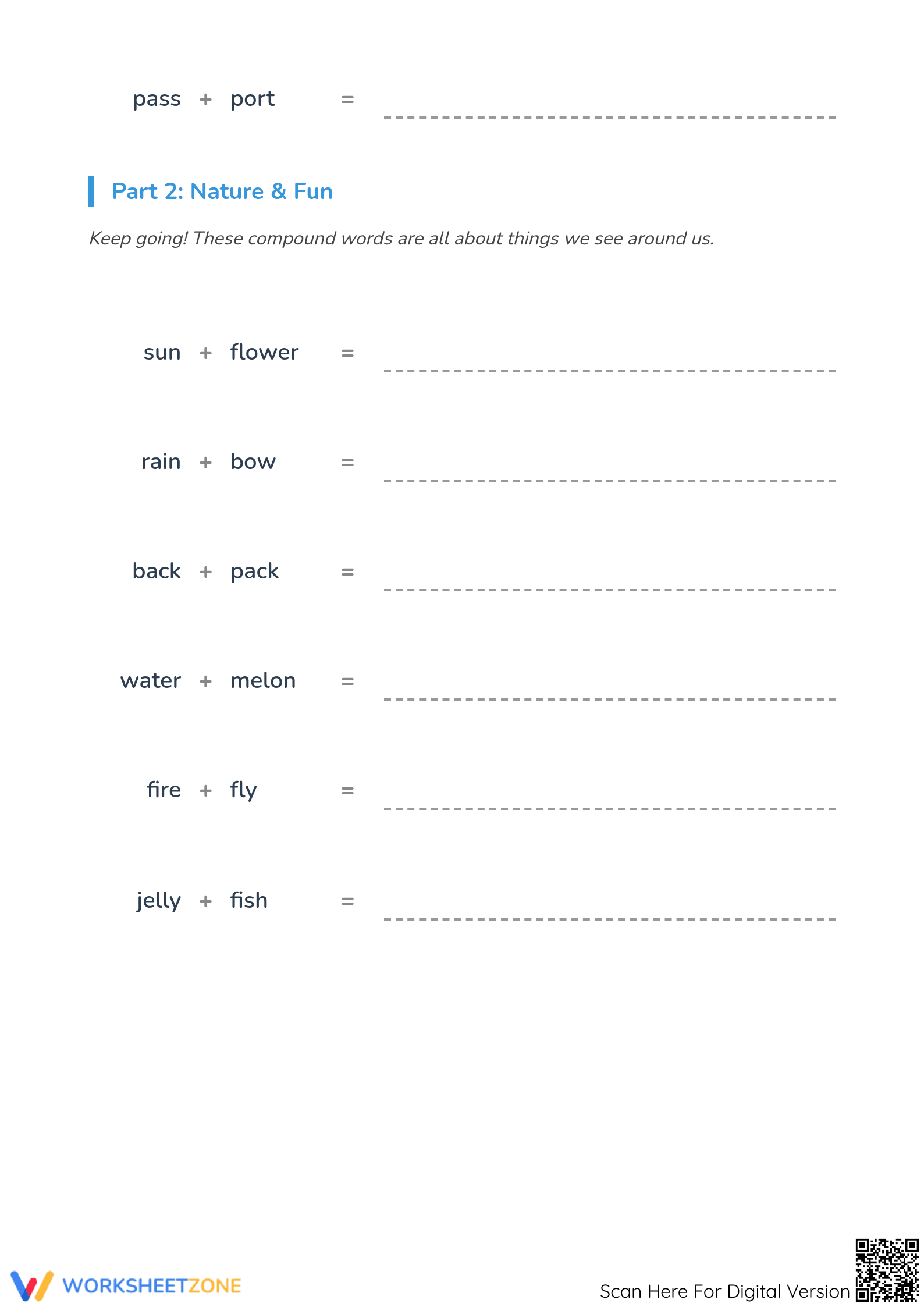
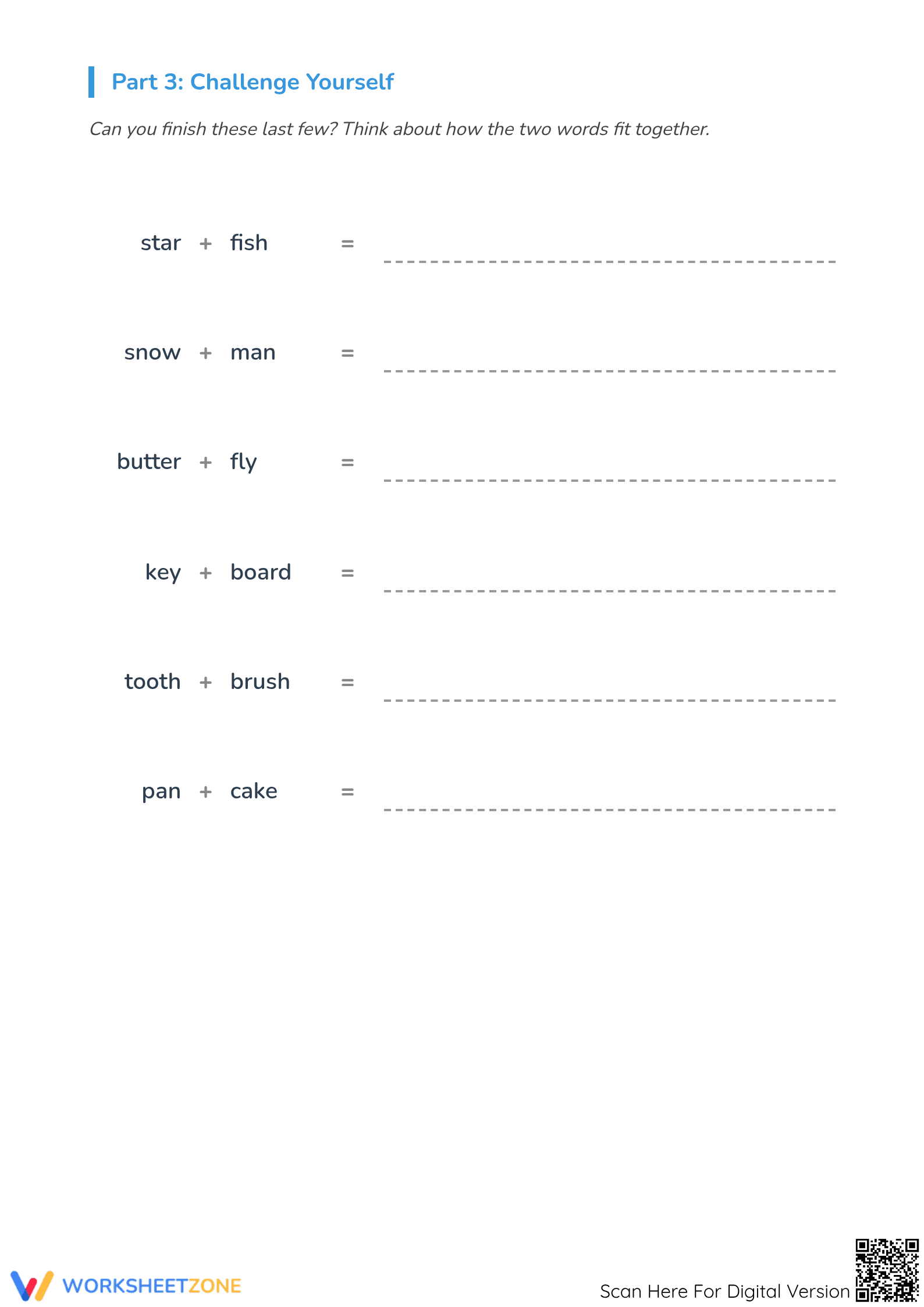
This comprehensive printable set features three distinct parts designed to build student confidence. Page one focuses on high-frequency compound words like "bedtime" and "upside." Page two introduces a "Nature & Fun" theme, including words like "sunflower" and "jellyfish." The final page offers a "Challenge Yourself" section with more complex pairings. The clear, vertical equation layout (word + word = result) provides a visual scaffold that simplifies the morphological process for young writers. Each page includes space for name, grade, date, and score for easy grading.
Zero-Prep Workflow
- Print: Select the pages you need and print enough copies for your class. This takes less than 60 seconds at the copier.
- Distribute: Hand out the worksheets as a packet or individual sheets. The clear instructions mean students can begin working immediately with zero teacher setup.
- Review: Use the provided full-page answer key to check student work in under 2 minutes. This workflow is ideal for substitute plans or busy Friday afternoons.
Standards Alignment
This resource aligns directly with `CCSS.ELA-LITERACY.L.2.4.D`, which requires students to use their knowledge of the meaning of individual words to predict the meaning of compound words. By explicitly showing the addition of two root words, the worksheet reinforces the internal logic of the English language. This standard code can be copied directly into lesson plans, IEP goals, or district curriculum mapping tools to demonstrate compliance with rigorous literacy requirements.
How to Use It
This packet is best used during the independent practice portion of a vocabulary lesson. After a brief direct instruction on what a compound word is, distribute page one to verify student understanding. For a formative assessment observation, walk around the room and note if students are writing the combined word without spaces; this is a common error that indicates a need for further modeling. The 20-minute completion time makes it a perfect bridge between whole-group reading and literacy rotations.
Who It's For
While primarily designed for Grade 2 students meeting core standards, the clear layout makes it an excellent remedial resource for Grade 3 or 4 students who struggle with spelling and word structure. It also serves as an enrichment activity for advanced Grade 1 learners. This resource pairs naturally with an anchor chart showing visual examples of compound words (e.g., a picture of a sun next to a flower) to provide additional support for English Language Learners.
The development of morphological awareness through compound word practice is supported by NAEP research, which indicates that students who recognize word parts have significantly higher reading comprehension scores. Aligned to CCSS.ELA-LITERACY.L.2.4.D, this 19-problem worksheet ensures that students can accurately combine root words like 'star' and 'fish' to expand their lexical range. By focusing on the plain-English skill of predicting new meanings from known parts, the activity builds the foundational decoding skills necessary for middle-grade literacy success. Research from Fisher & Frey (2014) emphasizes that such structured, gradual-release practice is essential for moving students from guided instruction to independent mastery. This printable packet provides the high-repetition, low-stress environment required for students to internalize these rules without feeling overwhelmed by complex text. Teachers can rely on this verified instructional tool to provide consistent, standards-aligned evidence of student growth in word class identification and lexical application.


