


























Views
Downloads

Nordic Countries Worksheet | Grade 8-9 Essential
Paste this activity's link or code into your existing LMS (Google Classroom, Canvas, Teams, Schoology, Moodle, etc.).
Students can open and work on the activity right away, with no student login required.
You'll still be able to track student progress and results from your teacher account.
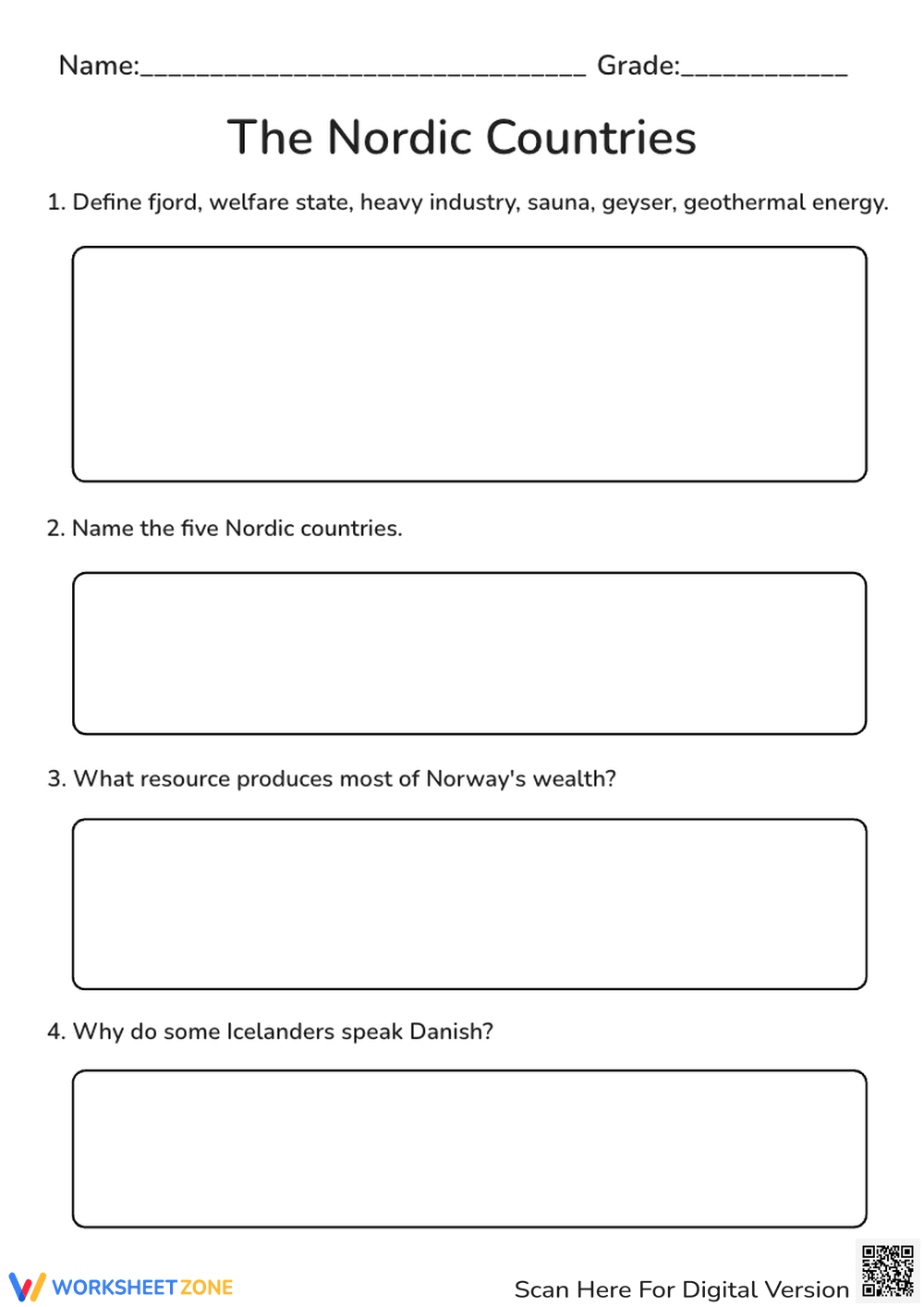
This Grade 8 and 9 Social Studies worksheet helps students identify and analyze the unique geographic and cultural characteristics of Northern Europe. By defining key regional terms and exploring economic drivers, learners develop a concrete understanding of how the Nordic region functions. It provides a structured framework for evaluating regional identity and resource management.
At a Glance
- Grade: 8-9 · Subject: Social Studies
- Standard:
CCSS.ELA-LITERACY.RH.6-8.4— Determine the meaning of domain-specific words related to history and social studies- Skill Focus: Nordic Geography & Cultural History
- Format: 1 page · 4 tasks · Answer key included · PDF
- Best For: Independent practice or quick regional assessment
- Time: 15–20 minutes
The worksheet features four distinct sections designed to build regional literacy. It begins with a vocabulary block requiring definitions for terms like fjord, geothermal energy, and welfare state. Subsequent tasks require students to name the five specific countries, identify Norway's primary wealth-producing resource, and explain the historical linguistic connection between Iceland and Denmark. The layout provides ample writing space for detailed responses.
This resource is designed for immediate classroom implementation with a total teacher prep time of under 2 minutes. Simply print the single-page PDF and distribute it to students. Because the questions are self-contained and clearly phrased, it functions perfectly as a high-quality sub plan or a quiet transition activity. Reviewing the 4 tasks as a whole class takes approximately 5 minutes, making it an efficient addition to any geography unit.
This resource aligns with `CCSS.ELA-LITERACY.RH.6-8.4`, focusing on the acquisition of domain-specific vocabulary necessary for understanding complex social systems. It also supports `CCSS.ELA-LITERACY.RH.9-10.4` by challenging students to interpret how specific terms shape the description of a region's economy and culture. Both standard codes can be copied directly into lesson plans, IEP goals, or district curriculum mapping tools.
Use this worksheet as a formative assessment after an introductory lecture on European regions. It works well during the independent practice phase of a lesson to verify that students can distinguish between different Northern European nations. Teachers should observe if students can link geothermal energy specifically to Iceland's volcanic activity. Completion typically takes 15 to 20 minutes depending on the depth of definitions provided.
This material is tailored for middle and early high school students studying world geography or human systems. It is particularly effective for students who benefit from structured, open-ended prompts rather than multiple-choice questions. Pair this with a physical map of Europe or a short reading passage about the Scandinavian Peninsula to provide additional context for the vocabulary definitions and historical questions.
Research from EdReports (2024) emphasizes that domain-specific vocabulary acquisition is a primary predictor of reading comprehension in the social studies classroom. This worksheet targets that need by requiring students to define six high-leverage terms, including welfare state and geothermal energy, which are central to understanding the Nordic model. By aligning with CCSS.ELA-LITERACY.RH.6-8.4, the resource ensures that students are not just memorizing names but are engaging with the technical language of geography. Fisher & Frey (2014) note that structured writing prompts in content areas help solidify the instructional cycle, moving students toward independent mastery of regional concepts. This 1-page tool provides the necessary scaffolding for Grade 8 and 9 learners to synthesize historical facts with modern economic realities, such as Norway's resource wealth. It serves as a reliable instrument for measuring student progress in regional literacy and critical thinking.


