


























1 / 2
0
Views
0
Downloads

0.0
0
Save
0 Likes
Share
Ohm's Law Practice Problems
0 Views
0 Downloads
Paste this activity's link or code into your existing LMS (Google Classroom, Canvas, Teams, Schoology, Moodle, etc.).
Students can open and work on the activity right away, with no student login required.
You'll still be able to track student progress and results from your teacher account.
Information
Description
What It Is:
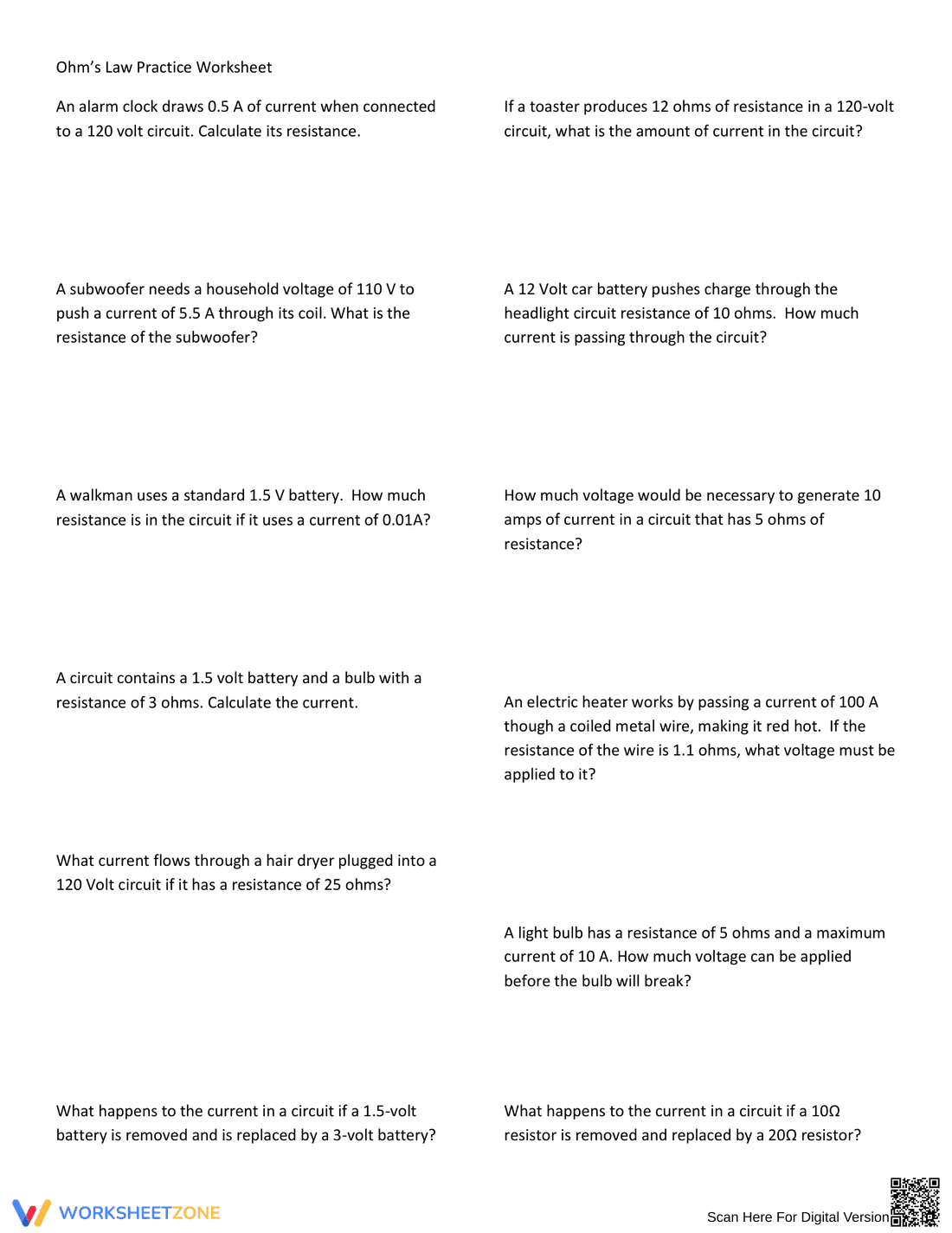
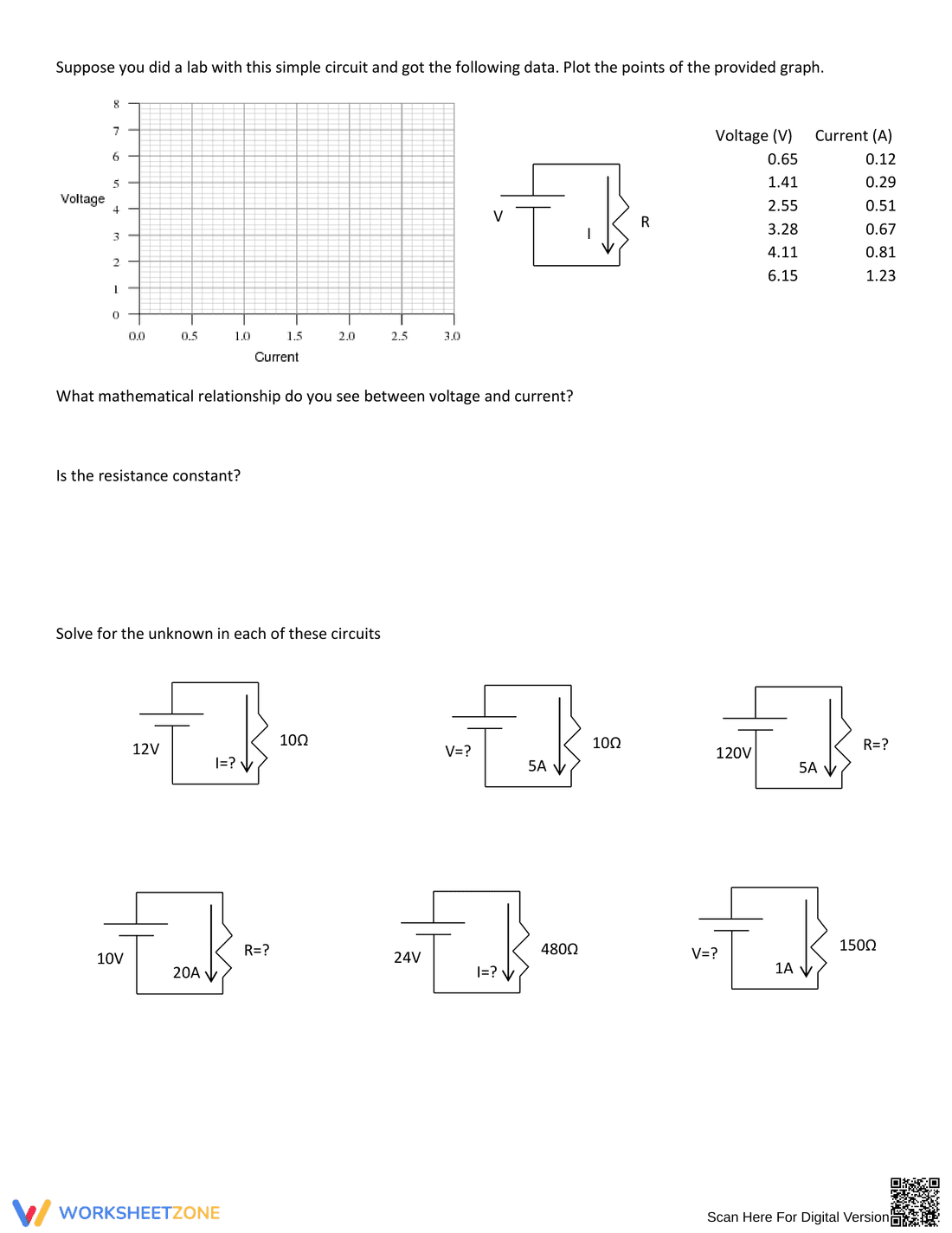
This is an Ohm's Law practice worksheet containing word problems related to voltage, current, and resistance. The problems involve calculating resistance, current, or voltage in various electrical circuits and devices like alarm clocks, toasters, subwoofers, car batteries, walkmans, electric heaters, and light bulbs. Some questions also explore the effect of changing voltage or resistance on the current in a circuit.
Grade Level Suitability:
This worksheet is most suitable for high school physics students (Grades 9-12) or introductory college physics courses. It requires an understanding of basic algebra and the ability to apply Ohm's Law (V=IR) to solve for unknown variables.
Why Use It:
This worksheet provides practice in applying Ohm's Law to real-world scenarios, reinforcing understanding of the relationship between voltage, current, and resistance. It helps students develop problem-solving skills in the context of electrical circuits and familiar devices. It also encourages critical thinking about how changes in voltage or resistance affect current.
How to Use It:
Students should read each word problem carefully, identify the given values (voltage, current, resistance), and determine what needs to be calculated. They should then apply Ohm's Law (V=IR) to solve for the unknown variable. It may be helpful to rearrange the formula to solve for the desired variable before plugging in the known values. Show all work and include appropriate units in the answers.
Target Users:
The target users are students learning about Ohm's Law in physics or electronics courses, teachers looking for practice problems to reinforce the concept, and tutors who want to help students master the application of Ohm's Law.
This is an Ohm's Law practice worksheet containing word problems related to voltage, current, and resistance. The problems involve calculating resistance, current, or voltage in various electrical circuits and devices like alarm clocks, toasters, subwoofers, car batteries, walkmans, electric heaters, and light bulbs. Some questions also explore the effect of changing voltage or resistance on the current in a circuit.
Grade Level Suitability:
This worksheet is most suitable for high school physics students (Grades 9-12) or introductory college physics courses. It requires an understanding of basic algebra and the ability to apply Ohm's Law (V=IR) to solve for unknown variables.
Why Use It:
This worksheet provides practice in applying Ohm's Law to real-world scenarios, reinforcing understanding of the relationship between voltage, current, and resistance. It helps students develop problem-solving skills in the context of electrical circuits and familiar devices. It also encourages critical thinking about how changes in voltage or resistance affect current.
How to Use It:
Students should read each word problem carefully, identify the given values (voltage, current, resistance), and determine what needs to be calculated. They should then apply Ohm's Law (V=IR) to solve for the unknown variable. It may be helpful to rearrange the formula to solve for the desired variable before plugging in the known values. Show all work and include appropriate units in the answers.
Target Users:
The target users are students learning about Ohm's Law in physics or electronics courses, teachers looking for practice problems to reinforce the concept, and tutors who want to help students master the application of Ohm's Law.


