


























Views
Downloads


Essential Ideal Gas Model Worksheet | Grade 11 Chemistry
Paste this activity's link or code into your existing LMS (Google Classroom, Canvas, Teams, Schoology, Moodle, etc.).
Students can open and work on the activity right away, with no student login required.
You'll still be able to track student progress and results from your teacher account.
This Grade 11 chemistry worksheet equips students to compare ideal-gas mathematical predictions against real-gas physical behavior. Learners solve quantitative gas law equations, evaluate the molecular impact of particle volume and intermolecular attractions, and analyze empirical compressibility datasets to determine when ideal models fail. This resource prepares high school chemists for advanced thermodynamics and kinetic molecular theory.
At a Glance
- Grade: 11 · Subject: Chemistry
- Standard: High School Physical Sciences — Evaluate predictive models of gas behavior under varying conditions
- Skill Focus: Compare Ideal-Gas Model Predictions
- Format: 5 pages · 10 problems · Answer key included · PDF
- Best For: Post-lecture practice and data analysis
- Time: 45–60 minutes
What's Inside
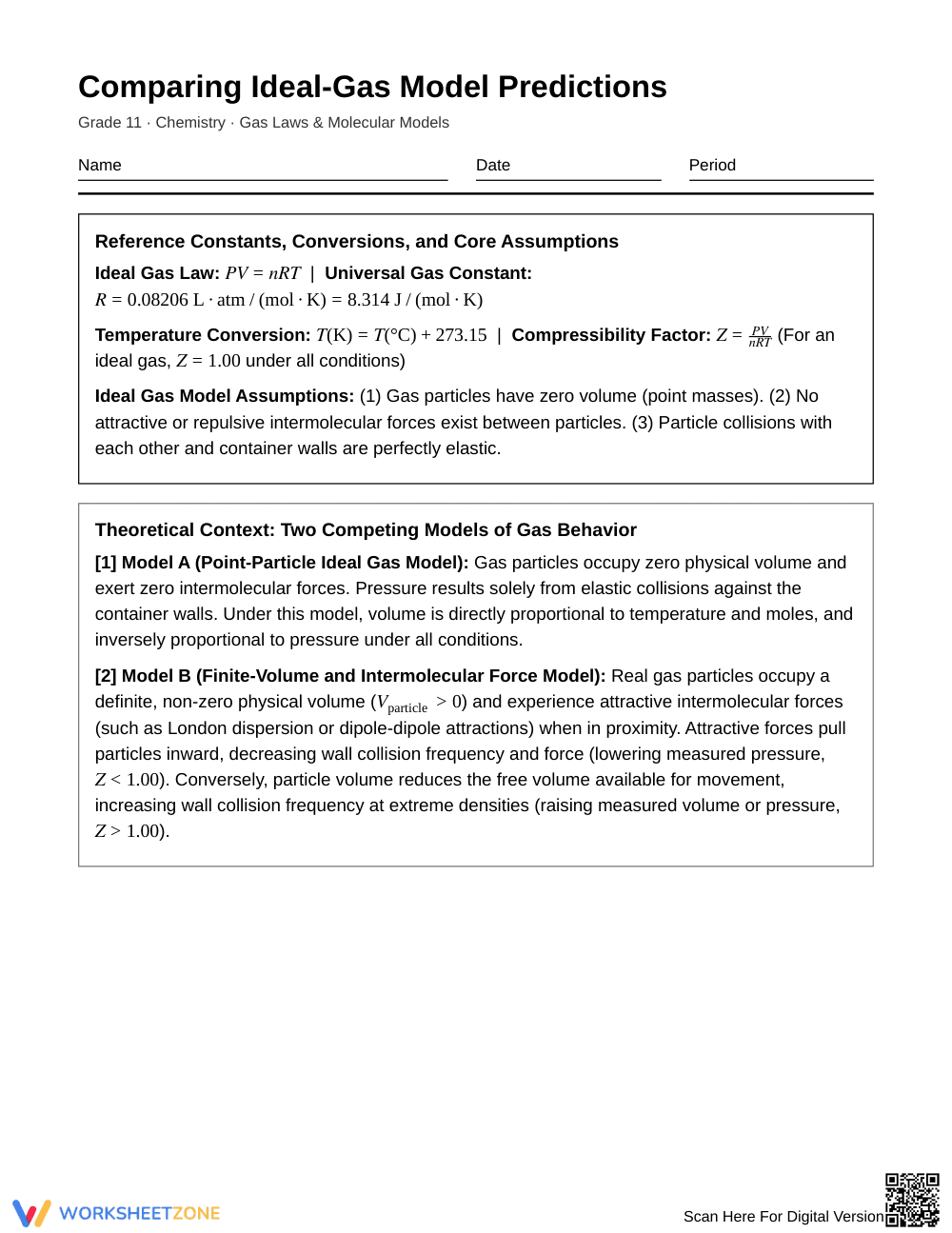
The 5-page PDF includes a structured reference block containing fundamental gas constants, temperature conversions, compressibility factor formulas, and core model postulates. Students complete 10 problems spanning numeric gas law calculations, conceptual variable-control scenarios, condition rankings, and multi-gas compressibility data interpretation across pressure ranges up to 600 atmospheres. A complete 3-page answer key provides step-by-step mathematical solutions and scientific explanations.
Skill Progression
- Guided Practice (Part A, Problems 1–2): Students apply the ideal gas law to calculate volume and pressure changes using explicit formula prompts and conversion constants.
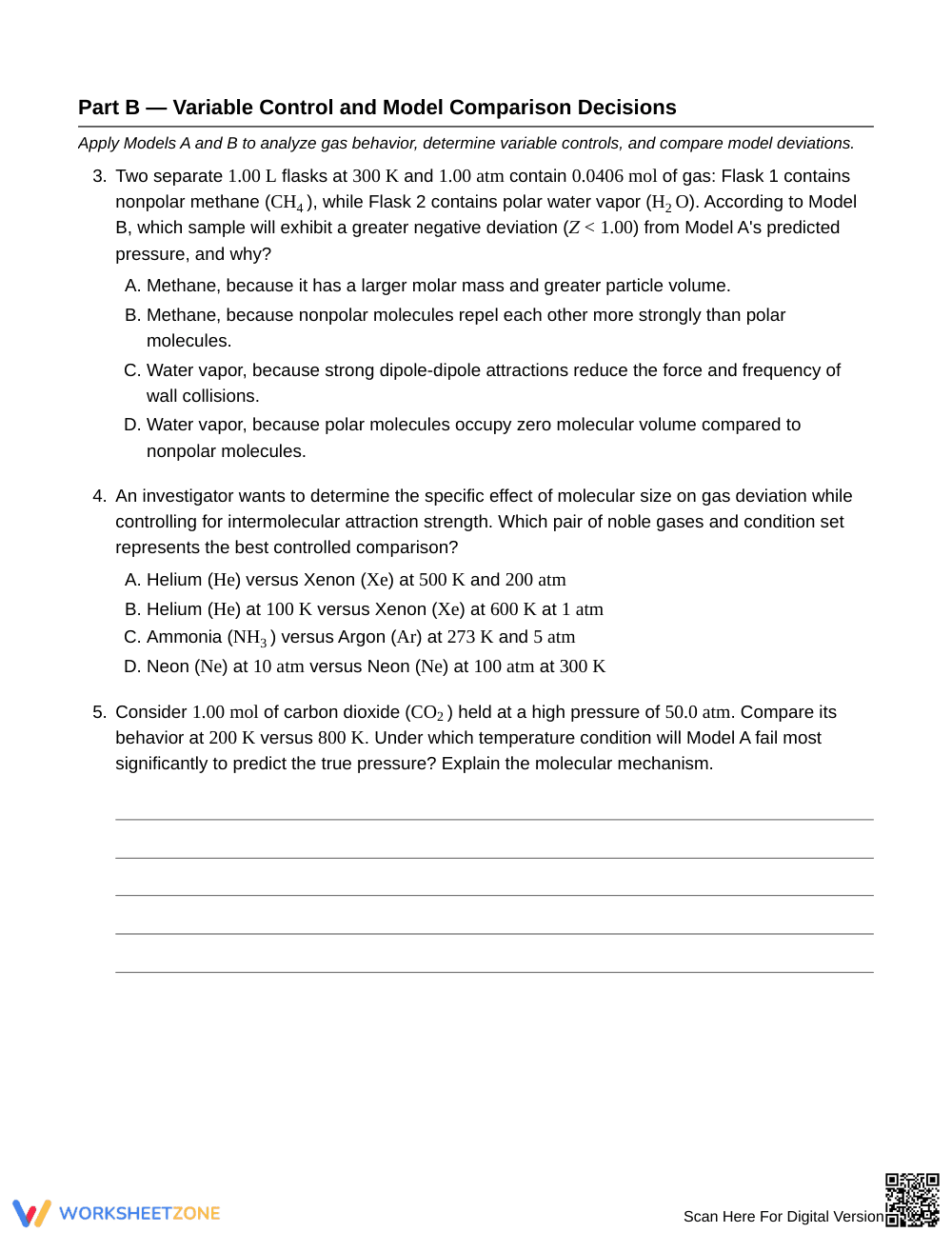
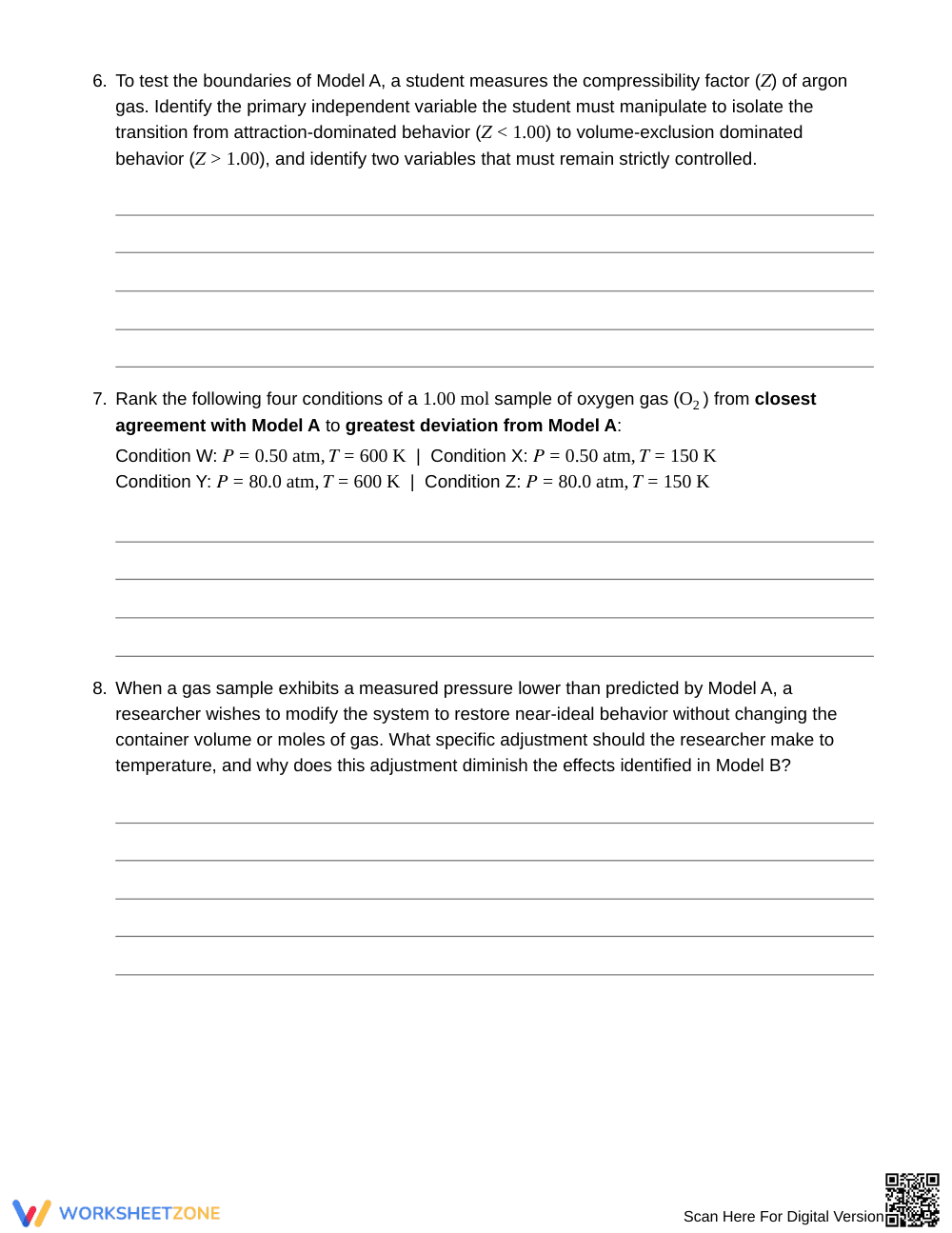
- Supported Practice (Part B, Problems 3–8): Learners evaluate molecular polarity, particle size, and temperature effects across 6 conceptual and experimental design questions.
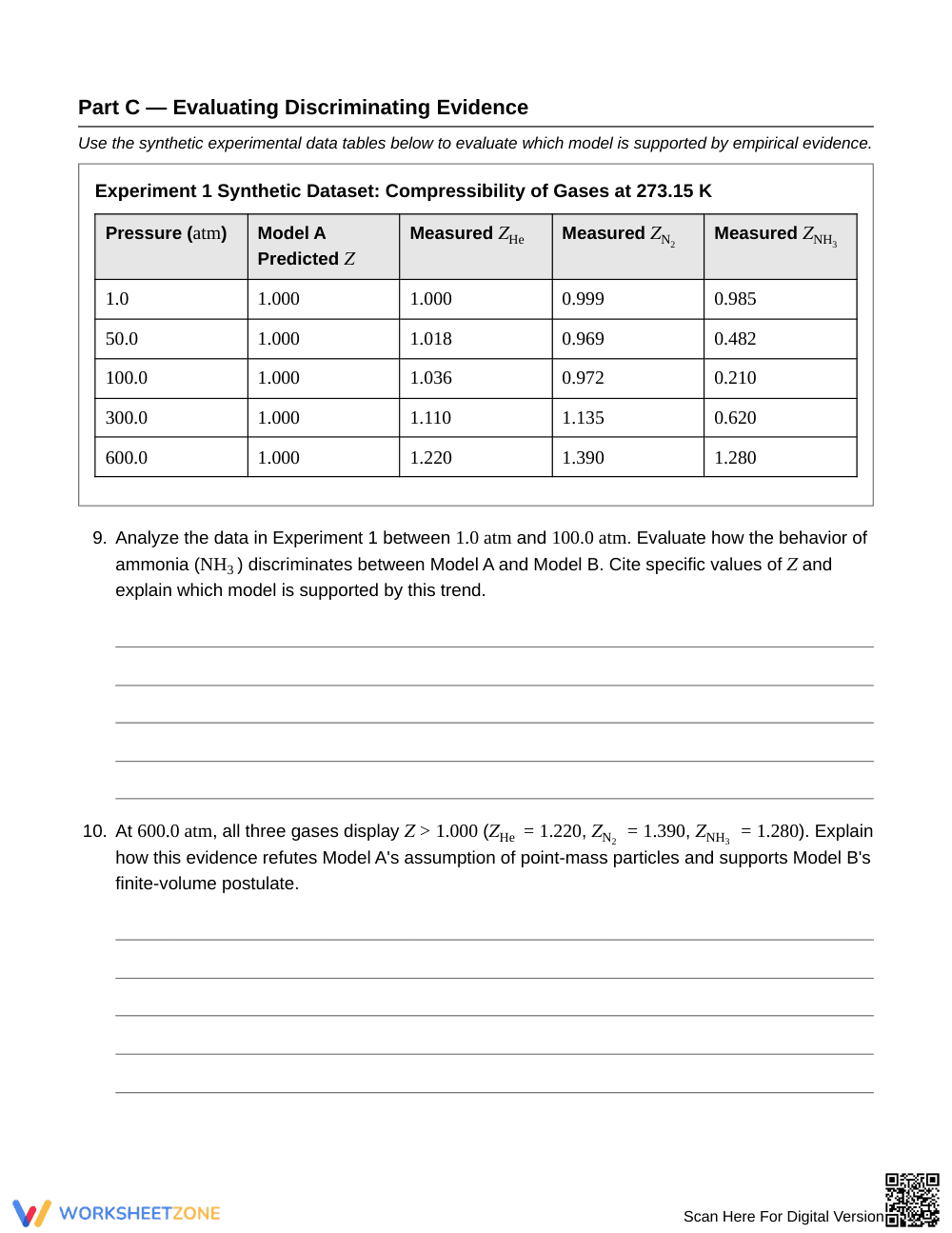
- Independent Practice (Part C, Problems 9–10): Students synthesize multi-pressure compressibility data to explain real-gas deviations from ideal assumptions.
This structured progression utilizes the gradual-release framework to move students from computational fluency to rigorous model evaluation.
Standards Alignment
This worksheet aligns with high school chemistry expectations for developing and using models to predict macroscopic properties of matter. Students investigate how molecular-scale attractions and finite particle volumes cause deviations from ideal gas predictions at extreme temperatures and pressures. These alignment details support standards-based curriculum mapping and targeted instructional planning.
How to Use It
Implement this resource following direct instruction on the ideal gas law and kinetic molecular theory. For collaborative learning, assign Parts A and B during mid-unit classwork (25 minutes), then transition students to Part C data interpretation in pairs (20 minutes). During practice, formatively check whether students recognize that low temperatures amplify intermolecular attractions while high pressures amplify finite particle volume effects. Total completion time is 45 to 60 minutes.
Who It's For
This activity is designed for Grade 11 chemistry and honors chemistry students mastering gas laws. For students requiring remediation, the included reference equations and definitions provide essential cognitive scaffolding. Pair this worksheet with an interactive kinetic molecular theory simulation to visualize particle collisions prior to data analysis.
According to Fisher & Frey (2014), structured progression through gradual release of responsibility significantly enhances student conceptual mastery in complex scientific inquiry. This Grade 11 gas laws resource embodies that instructional design by guiding learners from baseline mathematical computation with the ideal gas law to high-level evaluation of competing theoretical models. Students examine empirical compressibility data across helium, nitrogen, and ammonia to determine how non-zero particle volume and intermolecular forces cause measurable deviations from point-mass assumptions. By isolating specific thermodynamic variables such as temperature, pressure, and polarity across 10 structured tasks, the worksheet bridges theoretical formulas and empirical evidence. High school chemistry educators can utilize this 5-page worksheet to reinforce quantitative problem solving, diagnostic data analysis, and scientific reasoning, ensuring students achieve deep conceptual mastery of real versus ideal gas behavior.


