


























Views
Downloads



Essential Gas Law Unit Errors Worksheet | Grade 11 Chemistry
Paste this activity's link or code into your existing LMS (Google Classroom, Canvas, Teams, Schoology, Moodle, etc.).
Students can open and work on the activity right away, with no student login required.
You'll still be able to track student progress and results from your teacher account.
This chemistry worksheet trains Grade 11 students to audit, diagnose, and repair high-frequency mathematical and conceptual errors in gas law calculations. High school learners analyze flawed student work, articulate underlying misconceptions regarding temperature scales and gas constants, and calculate accurate numerical solutions with correct significant figures.
At a Glance
- Grade: 11 · Subject: Chemistry
- Standard: Gas Laws — Convert temperature to Kelvin and match ideal gas constants to pressure units
- Skill Focus: Error analysis in gas stoichiometry and unit conversions
- Format: 6 pages · 8 problems · Answer key included · PDF
- Best For: Formative review or post-lab error correction
- Time: 40–50 minutes
What's Inside
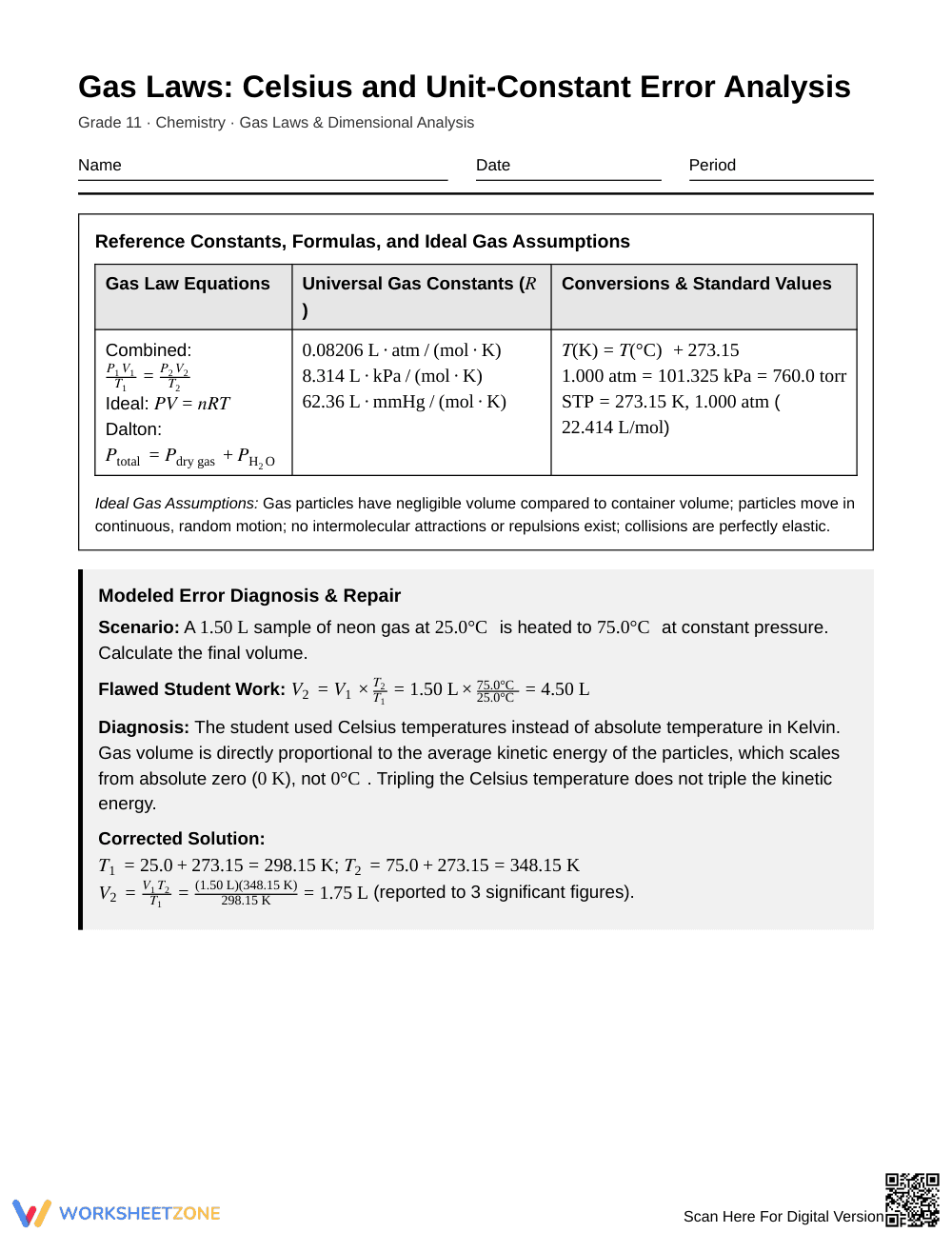
The 6-page printable activity opens with a quick-reference table of universal gas constants, unit conversion factors, and kinetic molecular theory assumptions. A complete modeled diagnosis provides an explicit benchmark before students tackle 8 flawed student scenarios spanning Charles's law, the ideal gas law, combined gas laws, STP conditions, and Dalton's law of partial pressures. A thorough 3-page answer key provides complete error explanations and stepwise mathematical solutions.
Skill Progression
- Guided practice: Students review an explicit worked example demonstrating how neglecting Kelvin conversion invalidates direct proportionality in thermal expansion.
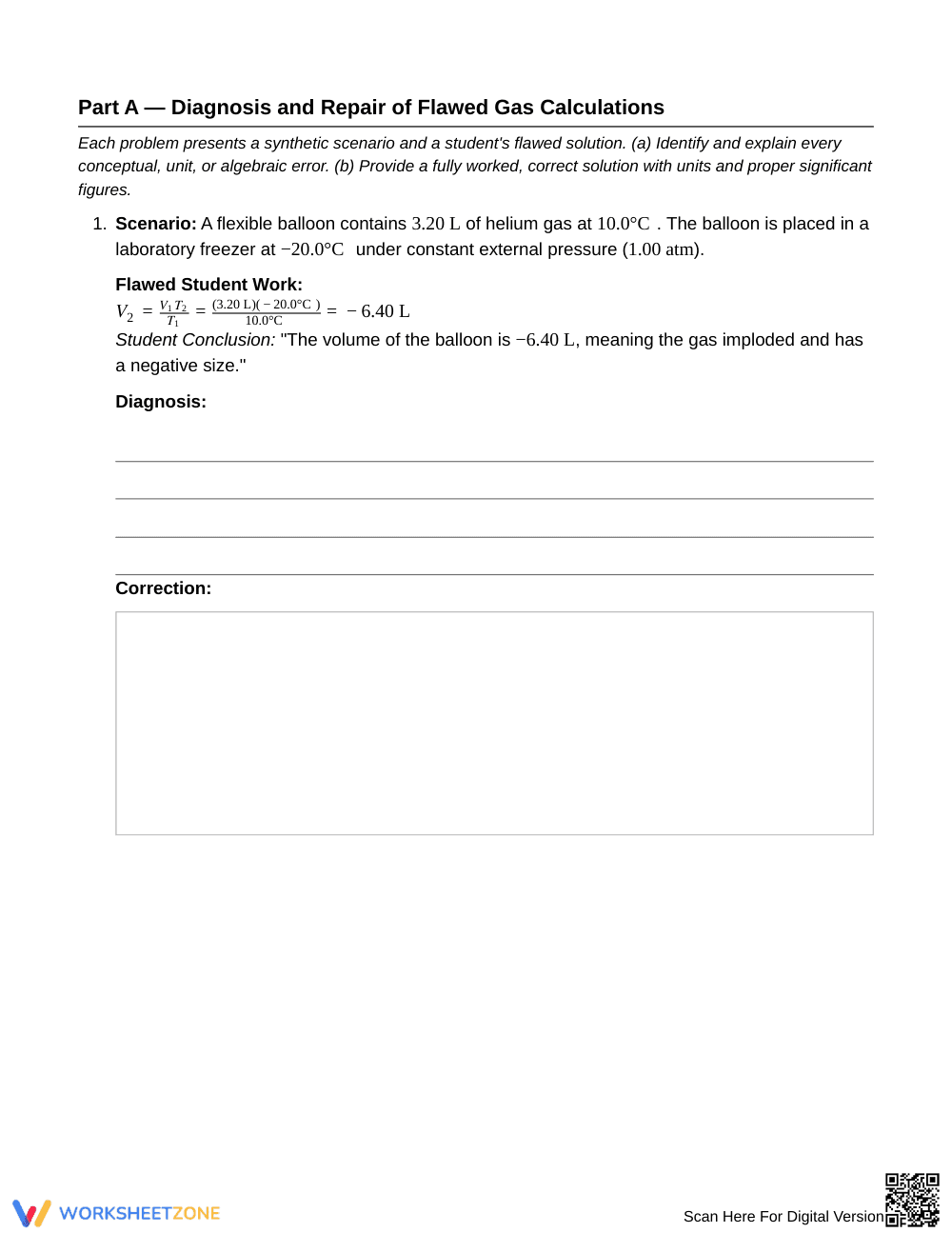
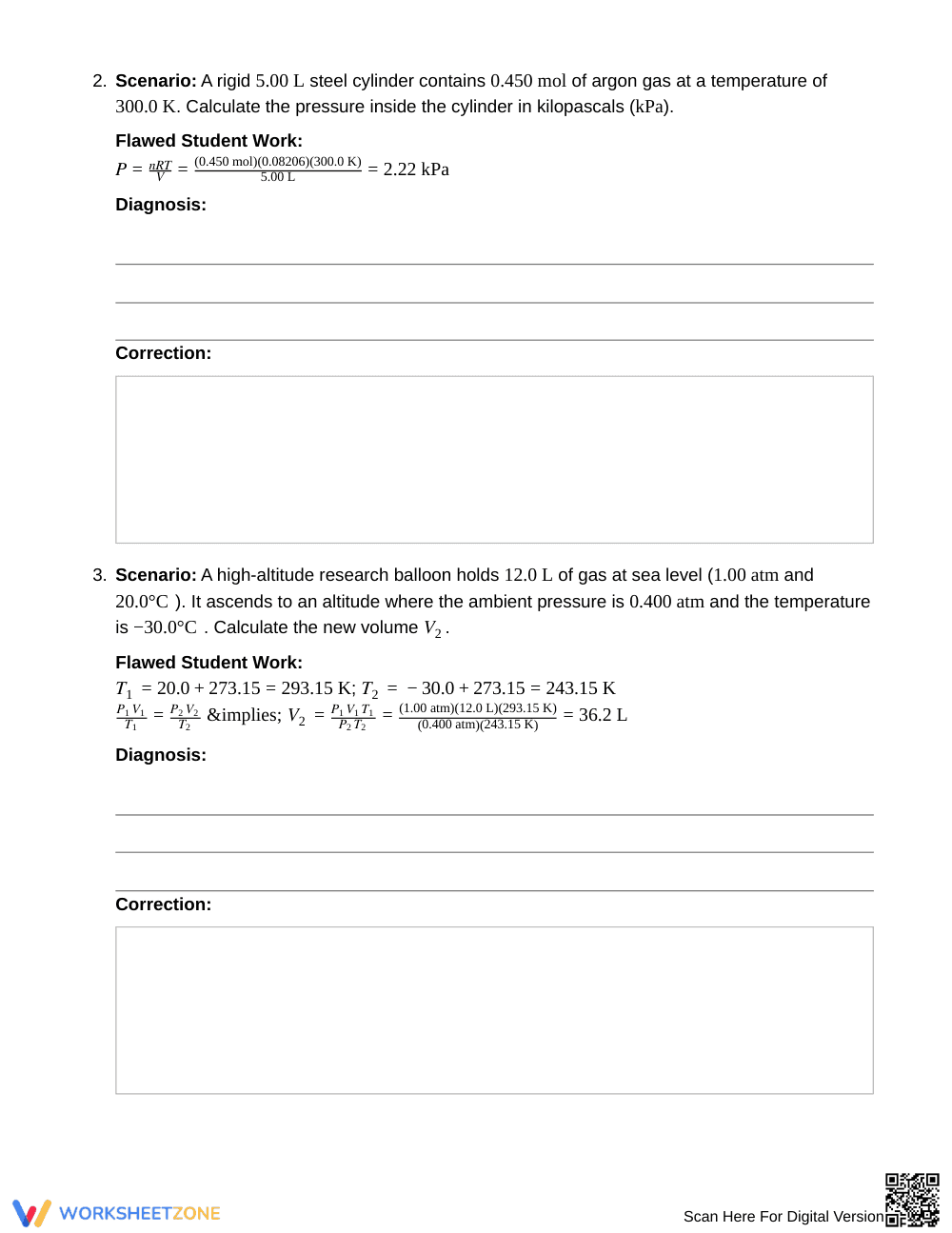
- Supported practice: Problems 1 through 4 prompt learners to target mismatched R-constants, non-absolute temperatures, and improper algebraic rearrangements in single-variable gas laws.
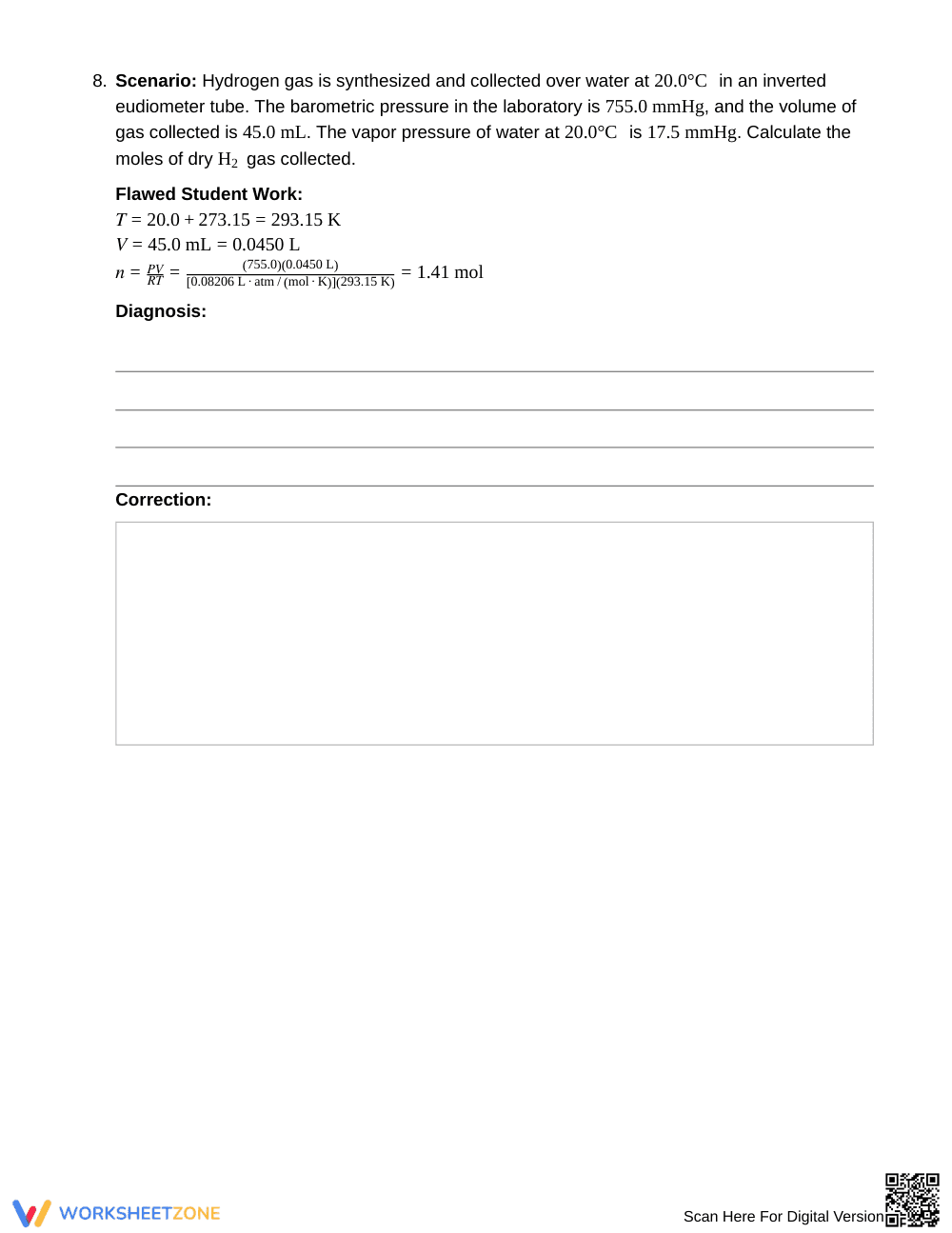
- Independent practice: Problems 5 through 8 require multi-step auditing of gram-to-mole conversions, non-STP molar volume assumptions, and wet gas vapor pressure subtractions.
This structured progression follows the gradual-release instructional model, shifting students from identifying visible calculation mistakes to deconstructing complex thermodynamic misconceptions.
Standards Alignment
This resource aligns with high school chemistry standards governing kinetic molecular theory, absolute temperature relationships, and gas stoichiometry calculations. Both chemistry unit objectives and dimensional analysis skills can be copied directly into lesson plans, IEP goals, or district curriculum mapping tools.
How to Use It
Deploy this error-analysis task immediately after direct instruction on the ideal gas law or as a targeted review before summative unit exams. During classwork, monitor student discussions to verify that learners identify why Celsius values yield physically impossible negative volumes rather than merely recalculating the answer. Expect students to complete the 8-item analysis in approximately 40 to 50 minutes.
Who It's For
This worksheet serves Grade 11 general, honors, and AP Chemistry students mastering dimensional analysis and gas behavior. It pairs naturally with gas collection laboratory investigations and kinetic molecular theory anchor charts.
According to research by Fisher & Frey (2014) on guided cognitive development, evaluating synthetic student errors strengthens metacognitive monitoring and deepens conceptual mastery far more effectively than repetitive rote computation. When high school chemistry students identify why a Celsius calculation fails to reflect thermal particle motion or why an unmatched ideal gas constant distorts pressure values, they build robust problem-solving frameworks that prevent recurring calculation traps. This 8-task chemistry worksheet directly reinforces foundational gas laws by requiring students to justify mathematical corrections through kinetic molecular theory principles. The systematic layout ensures learners connect mathematical mechanics with macroscopic gas phenomena, making it an essential diagnostic resource for high school chemistry educators.


