




























Views
Downloads


Essential Combined Gas Law Worksheet | Grade 11 Chemistry

Paste this activity's link or code into your existing LMS (Google Classroom, Canvas, Teams, Schoology, Moodle, etc.).
Students can open and work on the activity right away, with no student login required.
You'll still be able to track student progress and results from your teacher account.
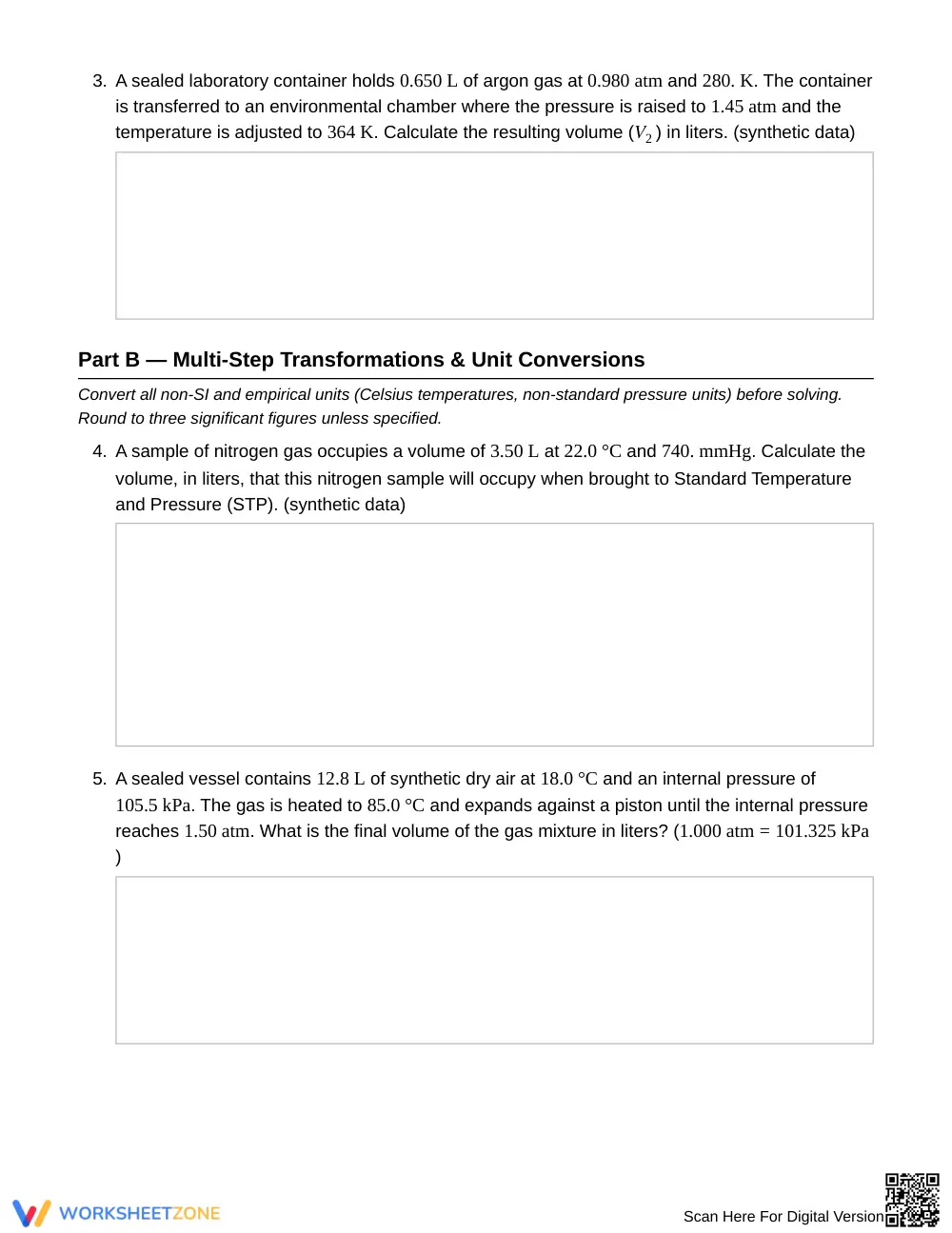
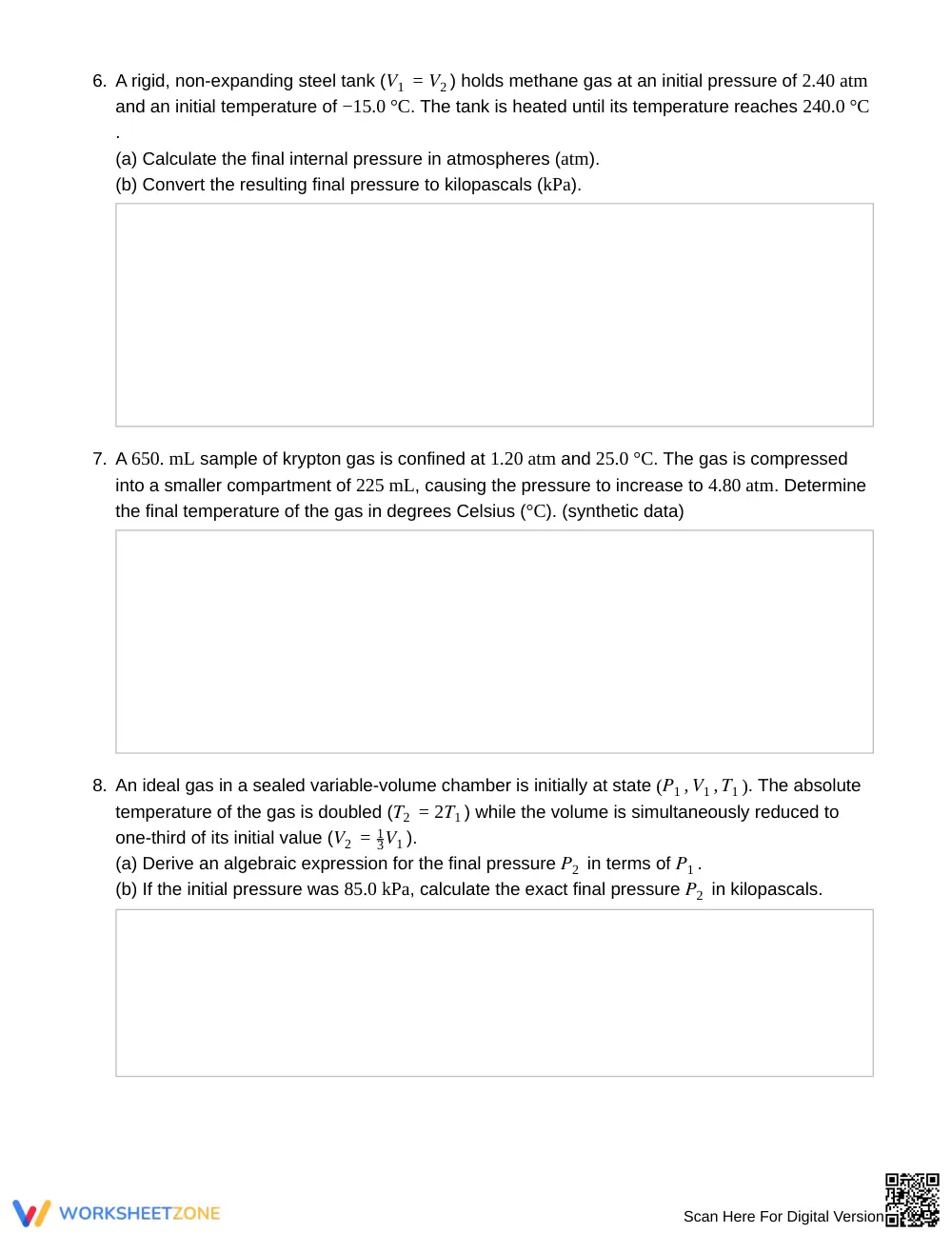
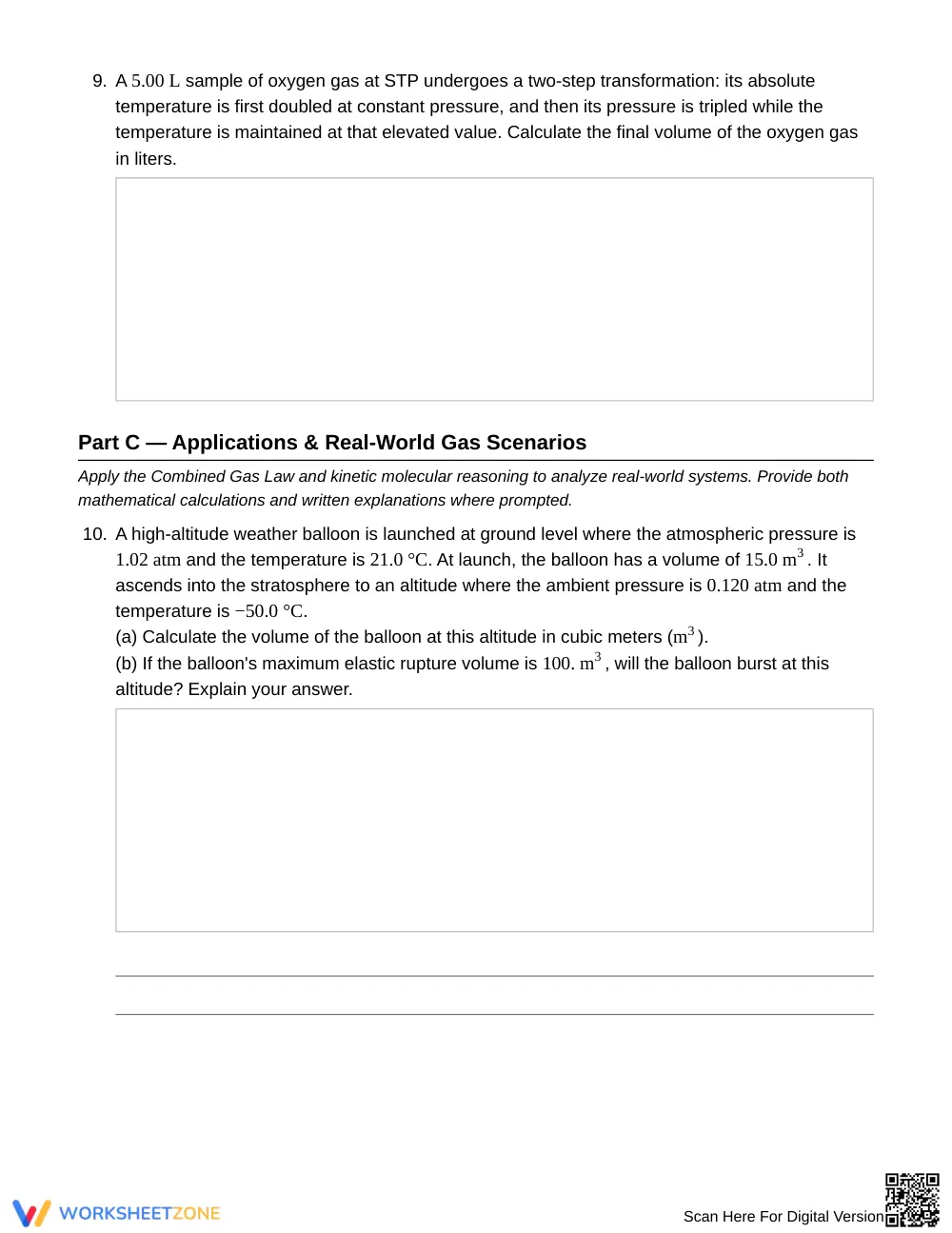
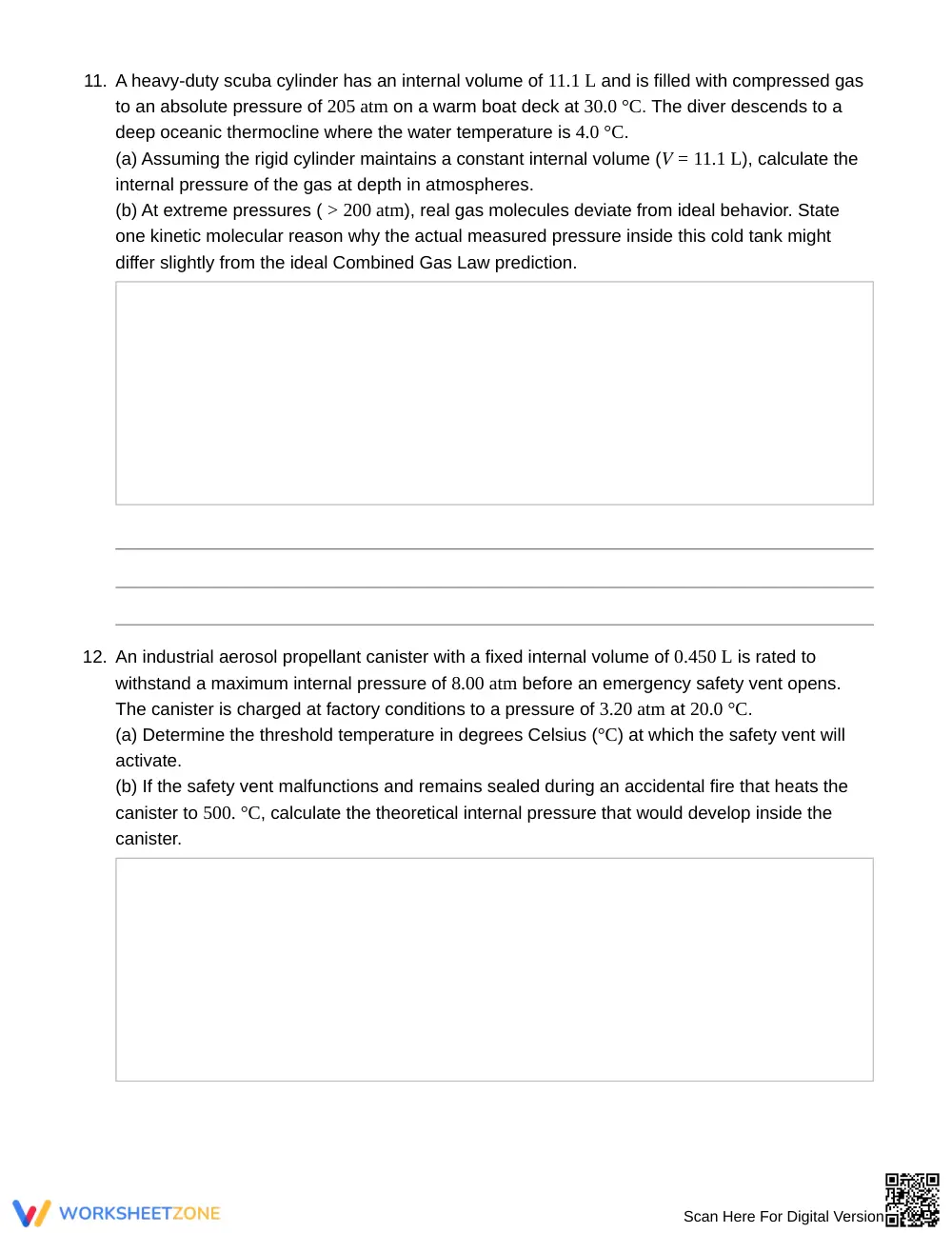
This Grade 11 chemistry worksheet builds mastery in solving combined gas law changes across changing temperature, pressure, and volume conditions. Students calculate final gas states, complete unit conversions, and apply kinetic molecular theory. Twelve structured problems build quantitative fluency and scientific reasoning.
At a Glance
- Grade: 11 · Subject: Chemistry (Physical Science)
- Standard: State Chemistry Standards — Calculate mathematical relationships between gas pressure, volume, and absolute temperature
- Skill Focus: Solve Combined-Law Changes · Gas Laws
- Format: 5 pages · 12 problems · 4-page answer key included · Printable PDF
- Best For: High school chemistry practice, homework, and exam review
- Time: 45–60 minutes
What's Inside
This 5-page resource provides 12 gas law problems organized into three sections. It features a reference box covering the combined gas law, Kelvin conversion formulas, STP values, and ideal gas assumptions. A 4-page answer key includes algebraic rearrangements, unit setups, and final answers to three significant figures.
Skill Progression
- Guided practice (Part A, 3 problems): Students solve direct three-variable equations with standard units using the reference formula box.
- Supported practice (Part B, 6 problems): Learners convert non-standard units across Celsius, kilopascals, and STP before isolating unknown variables.
- Independent practice (Part C, 3 problems): Students analyze real-world scenarios, including weather balloons and scuba tanks, using kinetic molecular reasoning.
This sequence follows the gradual-release model, moving students from formula substitution to independent thermodynamic analysis.
Standards Alignment
This resource aligns with high school physical science standards requiring mathematical models to predict relationships between gas pressure, volume, and temperature. Both standard codes can be copied directly into lesson plans, IEP goals, or district curriculum mapping tools.
How to Use It
Assign Parts A and B during direct instruction to reinforce unit conversions and equation setup. Use Part C as an independent post-instruction assessment or homework task. During practice, check whether students convert Celsius temperatures to Kelvin before rearranging variables. Completion typically takes 45 to 60 minutes.
Who It's For
This worksheet is designed for Grade 11 chemistry students learning macroscopic gas behavior. Teachers can provide formula hints for intervention or assign Part C multi-step derivations for honors extension. Pair this activity with a kinetic molecular theory anchor chart during instruction.
According to research on scaffolded science instruction by Fisher & Frey (2014), systematic progression from guided mathematical calculation to autonomous contextual analysis significantly strengthens student problem-solving transfer in high school chemistry. This Grade 11 worksheet targets the core skill of solving combined gas law changes by structuring 12 distinct multi-step tasks across pressure, volume, and temperature variables. Students practice isolating unknowns, converting non-standard measurements to Kelvin and standard atmospheres, and evaluating real-world physical scenarios through kinetic molecular theory. By incorporating an explicit reference equation box and moving from direct calculations to real-world applications such as stratospheric weather balloons and scuba tanks, this resource enables learners to internalize proportional relationships and ideal gas assumptions. Chemistry educators can deploy this 5-page printable resource during gas law units to verify quantitative calculation mastery and diagnostic scientific reasoning with confidence.


