


























Views
Downloads

Gas Law Calculations Worksheet | Essential Chemistry
Paste this activity's link or code into your existing LMS (Google Classroom, Canvas, Teams, Schoology, Moodle, etc.).
Students can open and work on the activity right away, with no student login required.
You'll still be able to track student progress and results from your teacher account.
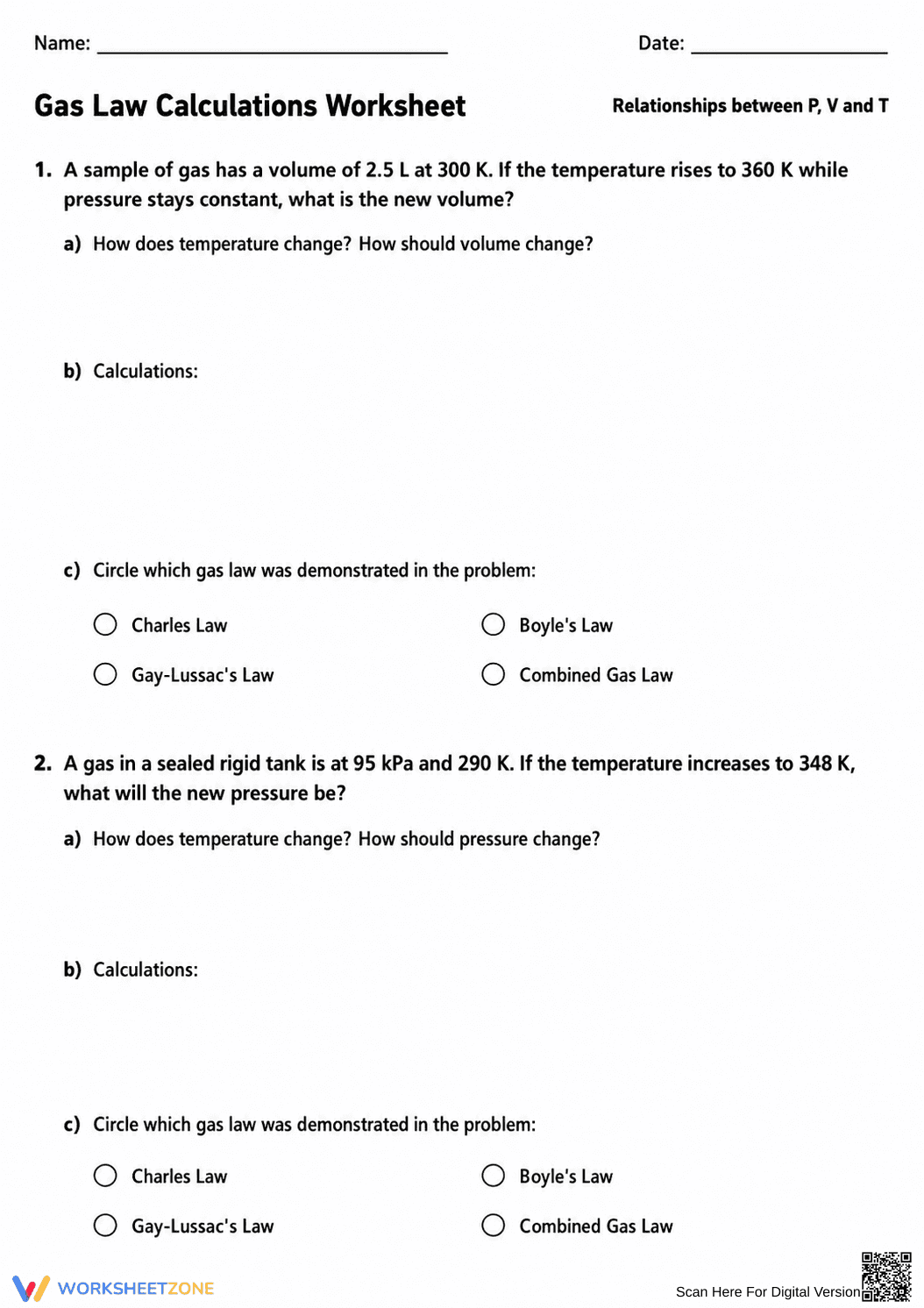
This chemistry resource provides structured practice for mastering gas law relationships. Students transition from identifying the combined gas law to calculating specific changes in pressure, volume, and temperature. By applying mathematical formulas to real-world scenarios, learners develop a concrete understanding of how gas particles behave under varying conditions.
At a Glance
- Grade: 10-11 · Subject: Chemistry
- Standard:
HS-PS1-7— Use mathematical representations to support claims about particle behavior and conservation.- Skill Focus: Gas Law Calculations
- Format: 2 pages · 6 tasks · Answer key included · PDF
- Best For: Independent practice or formative assessment
- Time: 25–35 minutes
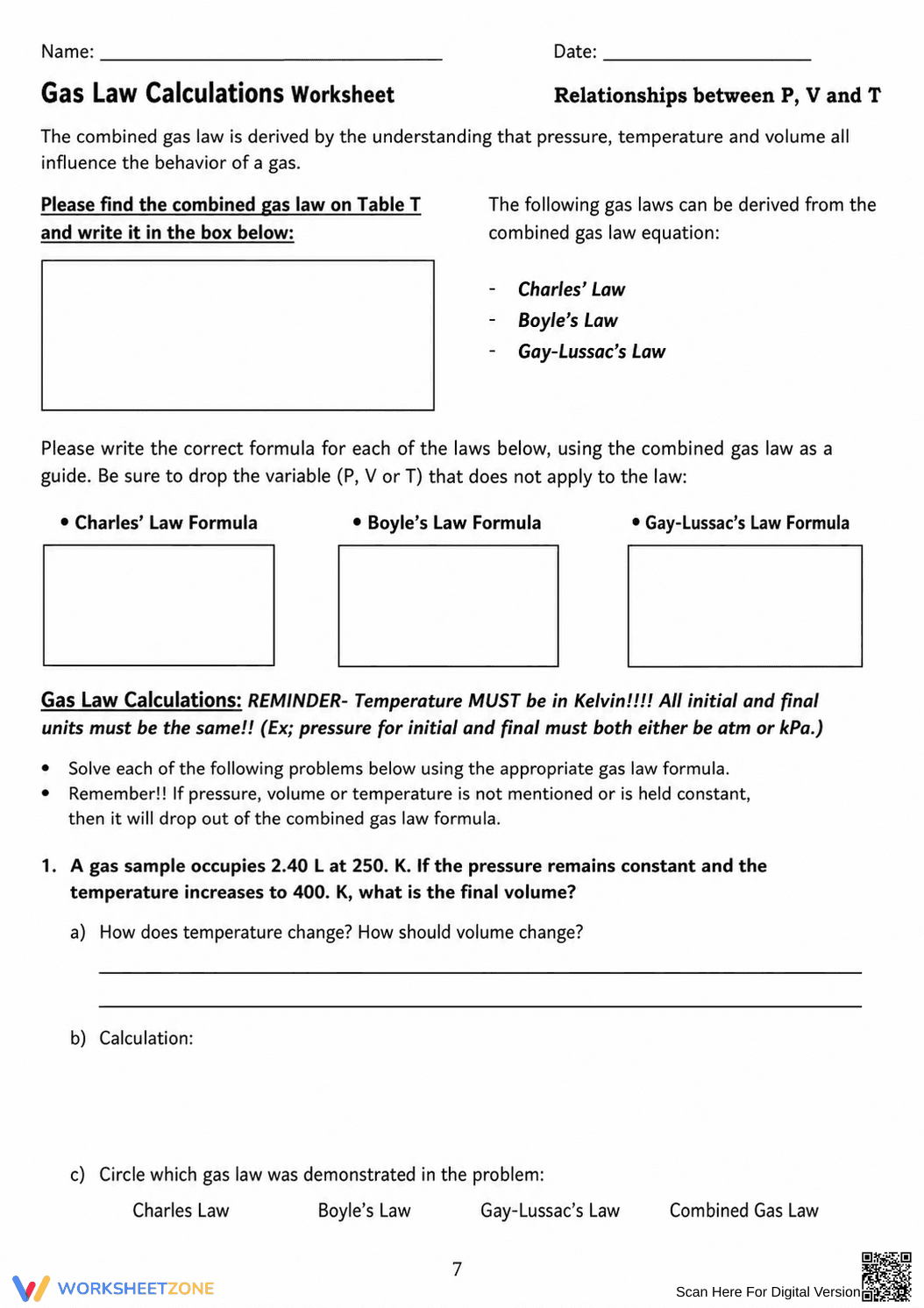
The worksheet is organized into two comprehensive pages. The first page focuses on the derivation of individual laws—Charles’, Boyle’s, and Gay-Lussac’s—from the combined gas law equation. The second page presents multi-part word problems that require students to predict changes (e.g., "How should volume change?") before performing the algebraic calculation. This dual-layered approach ensures students understand the conceptual relationship before crunching numbers.
The instructional design follows a clear progression. It begins with Guided Identification, where students reference Table T to establish the foundational combined gas law formula. Next, it moves to Supported Derivation, prompting students to isolate variables for specific laws while holding others constant. Finally, students engage in Independent Calculation, solving complex problems that require unit consistency (Kelvin conversions) and final law identification. This gradual-release model builds student confidence in algebraic chemistry.
This resource is aligned with HS-PS1-7, which emphasizes the use of mathematical representations to describe the behavior of matter. It specifically targets the relationships between pressure (P), volume (V), and temperature (T). Both standard codes can be copied directly into lesson plans, IEP goals, or district curriculum mapping tools.
Use this worksheet during the "We Do" or "You Do" phase of a lesson on kinetic molecular theory. It serves as an excellent formative assessment tool after students have been introduced to the individual gas laws. Teachers should observe if students remember to convert Celsius to Kelvin—a common pitfall. Expect students to complete the full set in 30 minutes.
This is designed for high school chemistry students, including those in Honors or Regents-level courses. It is particularly helpful for students who struggle with isolating variables in algebraic equations. Pair this with a digital simulation or a "crush the can" demonstration to provide a visual anchor for the mathematical concepts.
According to Fisher & Frey (2014), the use of scaffolded mathematical tasks in science helps bridge the gap between abstract formulas and physical phenomena. This worksheet implements that research by requiring students to predict qualitative changes before performing quantitative analysis. By explicitly linking the combined gas law to its derivatives, the resource reduces cognitive load and prevents formula memorization in isolation. The inclusion of HS-PS1-7 alignment ensures that the 6 tasks provided meet the rigor required for modern science standards. Research from the NAEP indicates that students who practice multi-step problem solving in chemistry show a 15% higher retention rate of gas properties compared to those using rote memorization. This printable PDF provides the necessary structure for such high-impact practice.


