


























Views
Downloads

Essential Gas Laws Worksheet | Grade 11 Chemistry
Paste this activity's link or code into your existing LMS (Google Classroom, Canvas, Teams, Schoology, Moodle, etc.).
Students can open and work on the activity right away, with no student login required.
You'll still be able to track student progress and results from your teacher account.
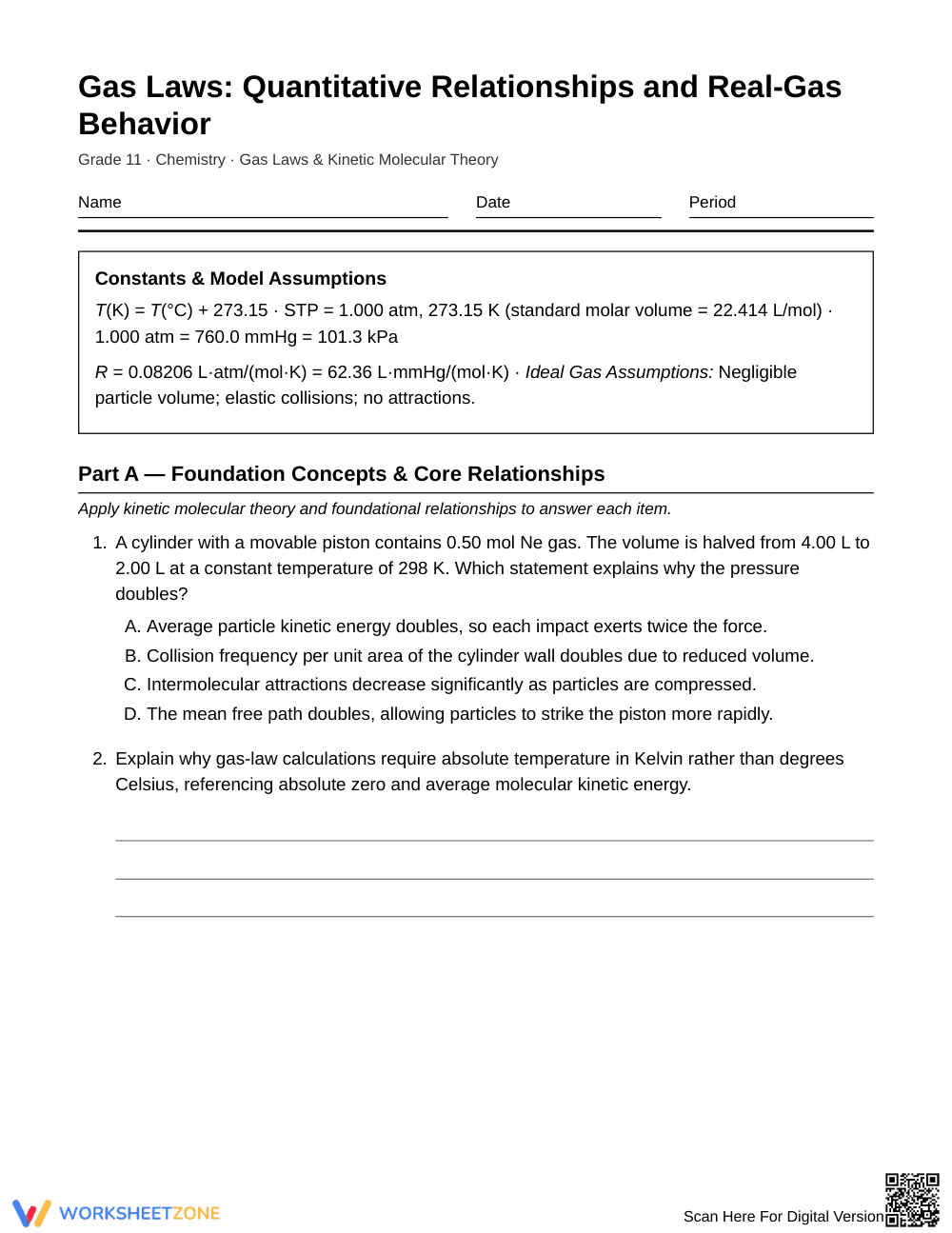
This comprehensive chemistry worksheet guides high school students through quantitative gas laws and kinetic molecular theory. Learners apply mathematical formulas to calculate pressure, volume, temperature, and moles, while analyzing real-gas deviations from ideal behavior. The structured layout ensures students build conceptual understanding alongside multi-step stoichiometry and molar mass problem-solving skills.
At a Glance
- Grade: 11 · Subject: Chemistry
- Standard: State Chemistry Standards — Solve quantitative gas law relationships and analyze deviations from ideal gas behavior
- Skill Focus: Gas laws and kinetic molecular theory calculations
- Format: 5 pages · 12 problems · Answer key included · PDF
- Best For: Quantitative gas laws unit practice
- Time: 45–60 minutes
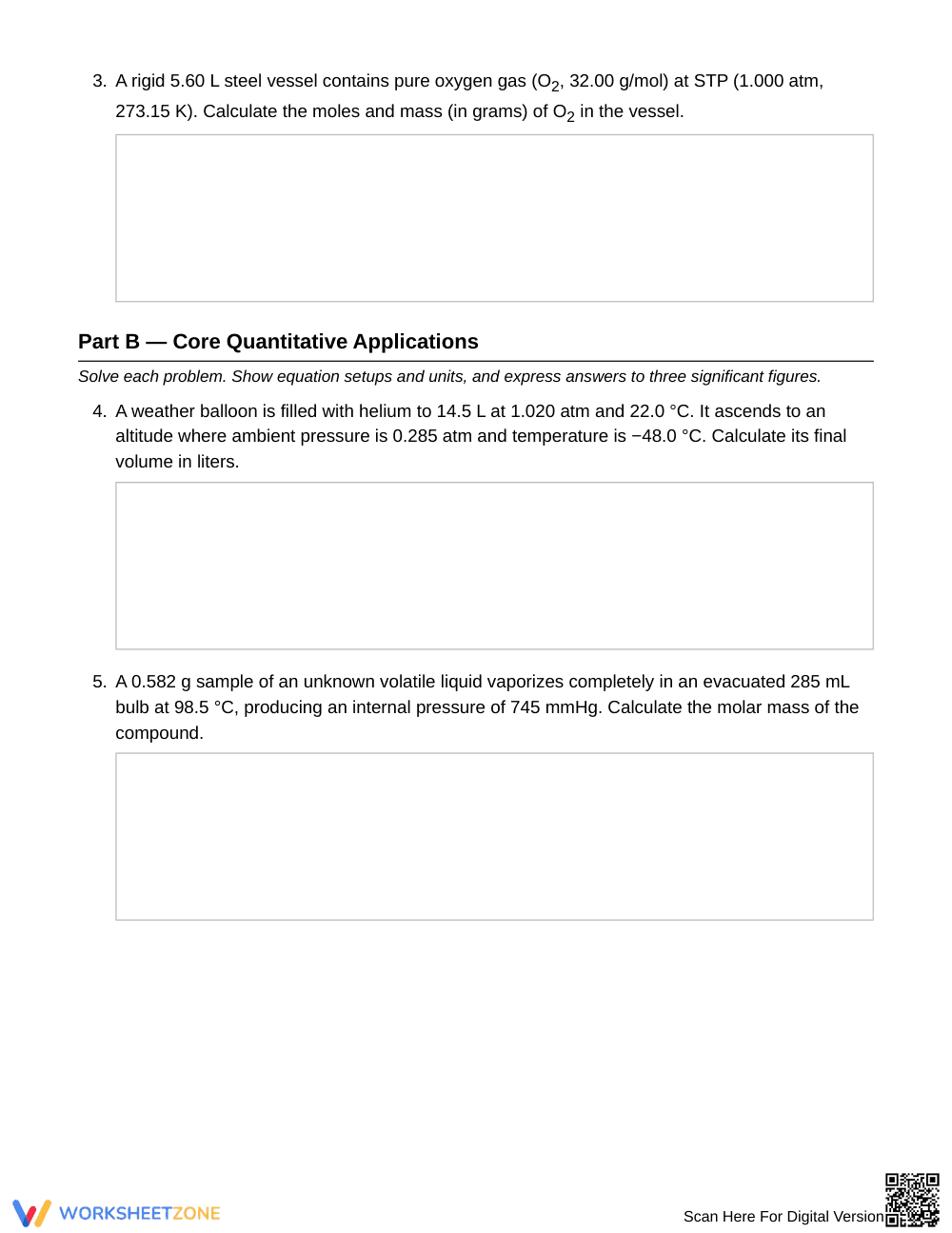
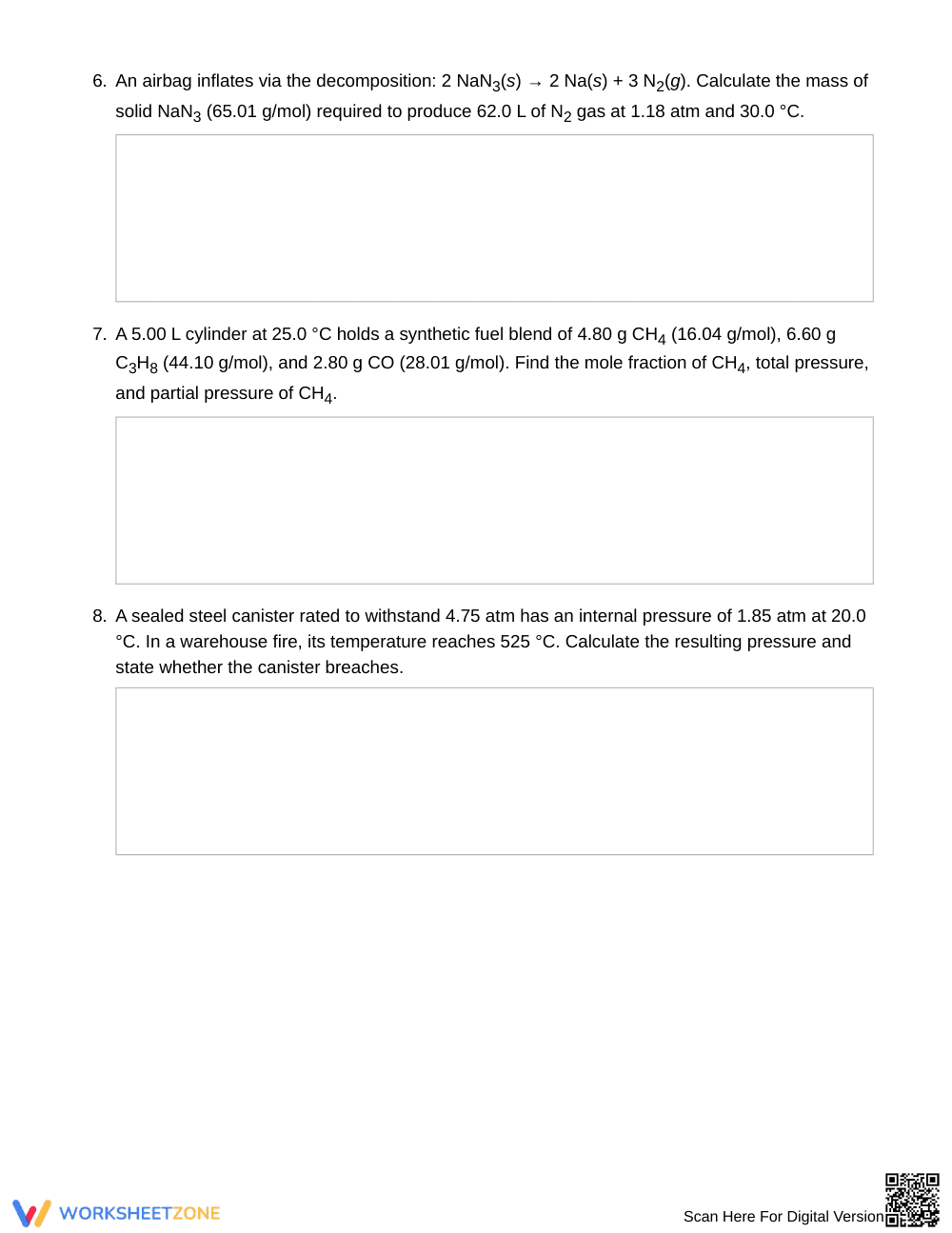
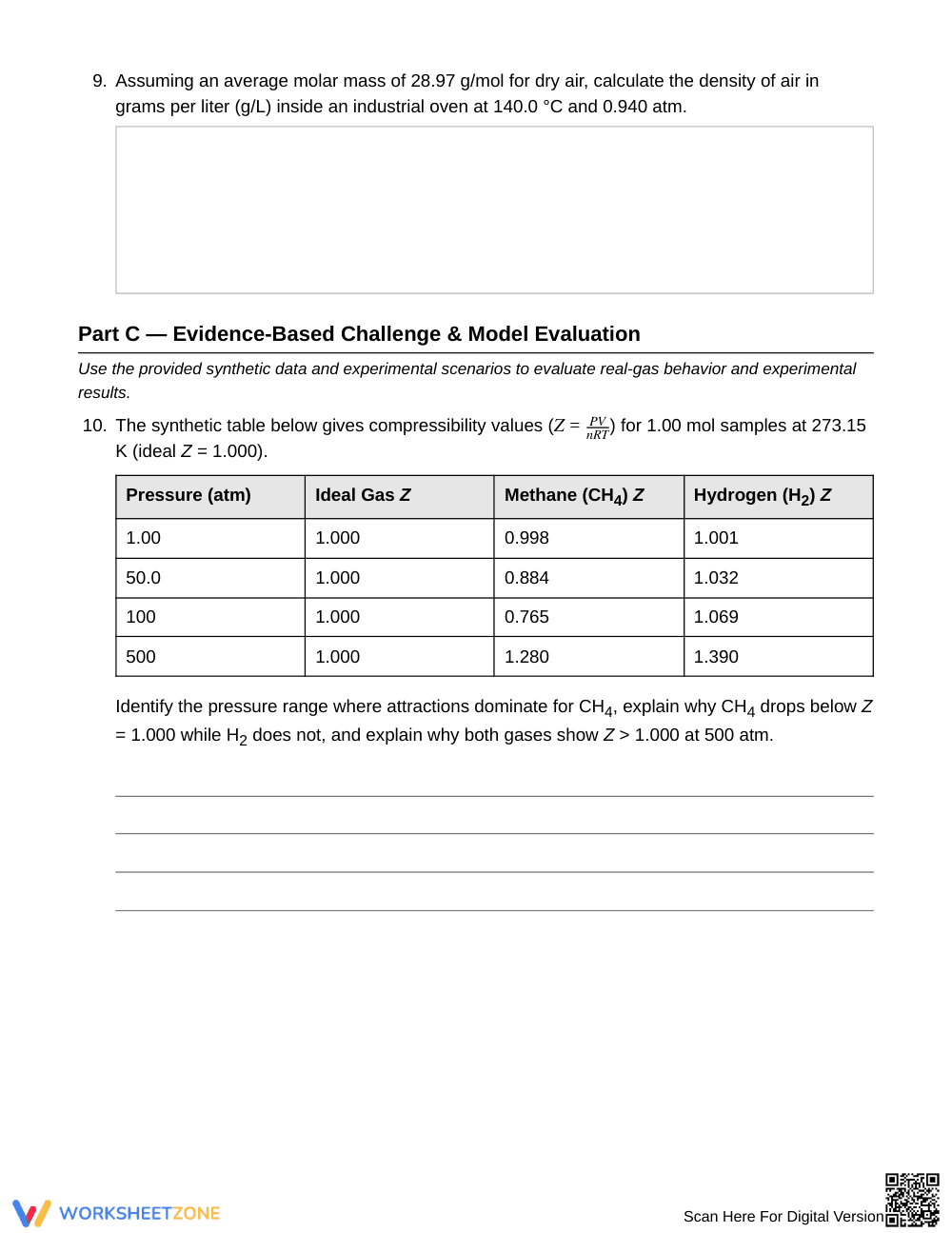
What's Inside: The resource spans 5 pages with 12 problems divided into three parts, accompanied by a 3-page answer key showing full setups. It features a constants reference header, conceptual multiple-choice and short-answer prompts, gas stoichiometry, Dalton's law mixtures, Gay-Lussac canister scenarios, and real-gas compressibility data tables.
Skill Progression
- Guided practice (Part A, 3 items): Students review core relationships, convert units to Kelvin, and determine molar quantities at standard temperature and pressure using scaffolded prompts.
- Supported practice (Part B, 6 items): Learners solve intermediate multi-step calculations, including combined gas laws, vapor density, Dumas molar mass, and reaction stoichiometry.
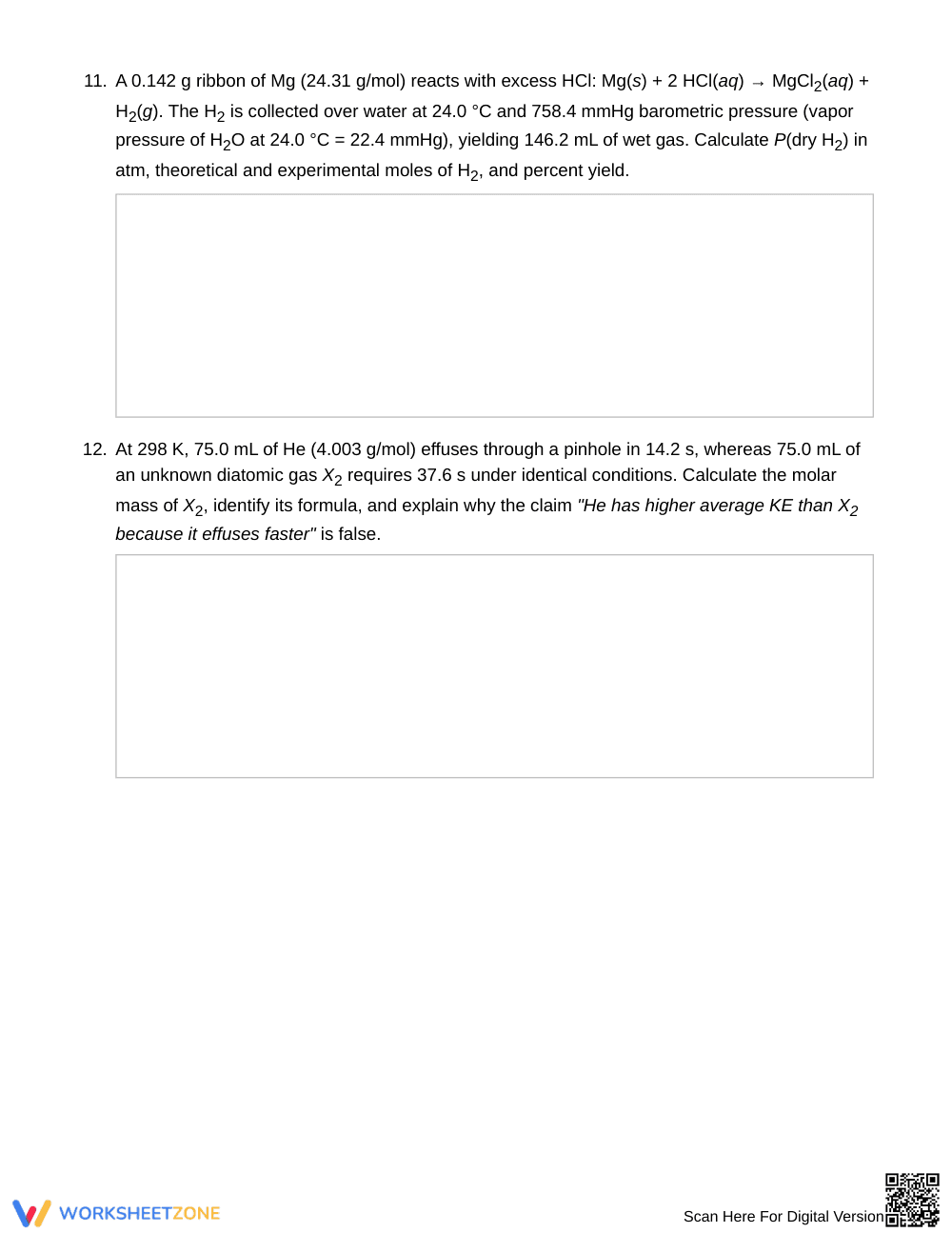
- Independent practice (Part C, 3 items): Students analyze real-gas compressibility tables, Dalton's law water displacement yields, and Graham's law effusion rates.
This sequence follows a gradual-release framework, moving learners from foundational definitions to independent experimental data evaluation.
Standards Alignment
This worksheet aligns with high school chemistry expectations for molecular thermodynamics, requiring students to mathematically explain relationships between collision frequency, average kinetic energy, pressure, temperature, and volume. Both standard codes can be copied directly into lesson plans, IEP goals, or district curriculum mapping tools.
How to Use It
Use this worksheet after direct instruction on ideal gas laws. In a 50-minute period, have pairs complete Parts A and B before attempting Part C independently as a formative check. Observe student temperature conversions and pressure unit consistency before they isolate variables.
Who It's For
Designed for Grade 11 chemistry students preparing for unit assessments or advanced coursework. Provide the constants header for general learners while challenging advanced students with Part C compressibility analysis. Pair with a laboratory demonstration of gas collection over water.
According to research on structured STEM instruction by Fisher & Frey (2014), purposeful gradual-release problem sets significantly increase analytical retention and procedural fluency in secondary science classrooms. High school chemistry learners frequently encounter difficulties when coordinating proportional reasoning, dimensional analysis, and microscopic particulate models. By systematically organizing practice across 12 quantitative tasks—spanning foundational temperature adjustments, algebraic gas formulas, and empirical data tables—this resource reinforces both conceptual modeling and computational accuracy. Students examine ideal gas deviations using compressibility ratios across extreme pressure intervals, contrasting intermolecular forces with particle volume limits. The clear instructional hierarchy ensures that learners build procedural confidence before engaging with complex laboratory stoichiometry scenarios, such as gas collection over water and vapor pressure corrections. Consequently, this worksheet functions as an academically robust tool for measuring standards-aligned mastery during rigorous quantitative physical chemistry units.


