


























Views
Downloads




Essential Gas Laws Predictions | Grade 11 Chemistry
Paste this activity's link or code into your existing LMS (Google Classroom, Canvas, Teams, Schoology, Moodle, etc.).
Students can open and work on the activity right away, with no student login required.
You'll still be able to track student progress and results from your teacher account.
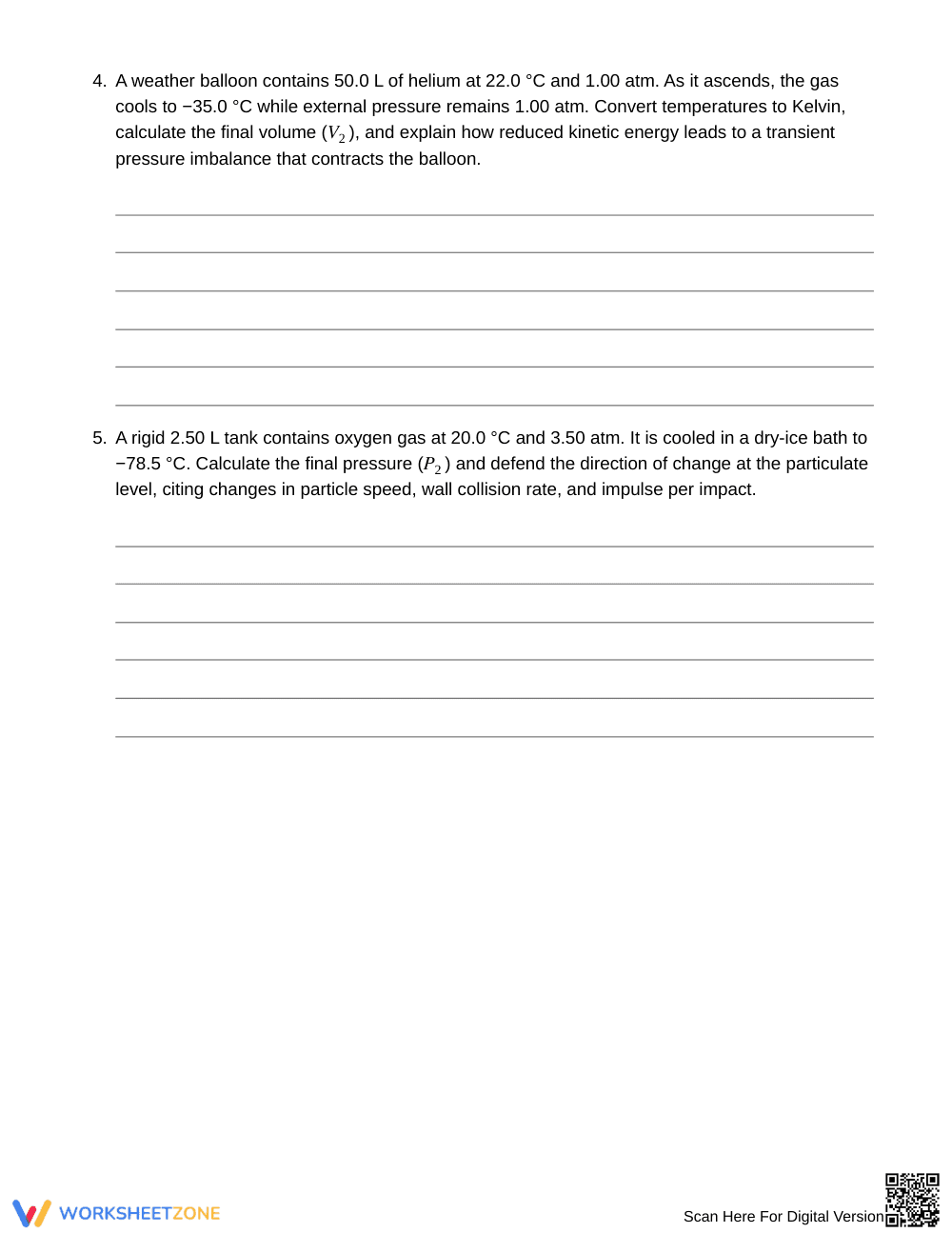
This Grade 11 chemistry worksheet equips students to calculate gas variables and defend predicted directional changes using kinetic molecular theory. Learners evaluate how shifts in pressure, volume, temperature, and molar quantity impact particle behavior across 8 rigorous problems. Students move beyond rote formula manipulation to connect mathematical derivations with particulate-level mechanistic explanations.
At a Glance
- Grade: 11 · Subject: Chemistry
- Standard: Gas Properties — Defend directional changes in gas systems using kinetic molecular theory
- Skill Focus: Defend the Direction of a Predicted Change
- Format: 5 pages · 8 problems · Answer key included · PDF
- Best For: Gas laws unit mastery practice
- Time: 35–45 minutes
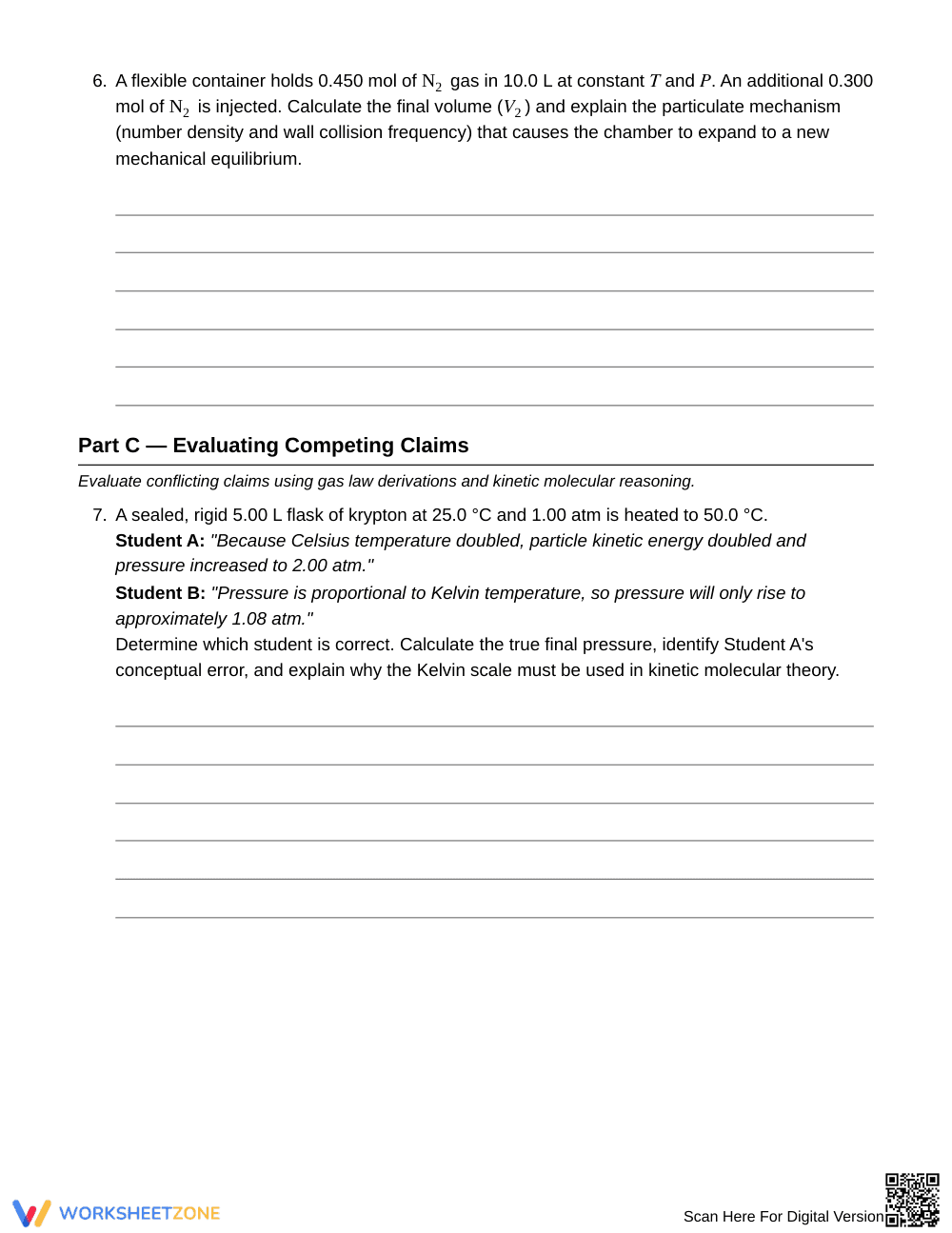
This 5-page instructional resource contains 8 multi-part problems supported by a dedicated reference header with fundamental gas constants and core kinetic assumptions. The packet includes a structured synthetic data set for controlled variable analysis, 4 qualitative-quantitative bridge calculations across Boyle's, Charles's, Gay-Lussac's, and Avogadro's laws, 2 claim-evaluation scenarios, and an exhaustive 3-page answer key with step-by-step mechanical justifications.
Skill Progression
- Guided practice (Part A, 2 tasks): Students identify controlled variables within experimental data sets and isolate necessary boundary conditions required to validate gas law relationships.
- Supported practice (Part B, 4 tasks): Students calculate numerical outcomes for expanding and contracting systems while writing particulate explanations centered on wall collision frequency, molecular velocity, and impulse.
- Independent practice (Part C, 2 tasks): Students evaluate competing student claims, correct temperature scale misconceptions, and derive density formulas directly from ideal gas relationships.
This structured progression leverages a gradual-release instructional model to transition students from identifying experimental evidence to independently evaluating complex thermodynamic arguments.
Standards Alignment
This worksheet aligns with high school physical science standards requiring students to communicate scientific ideas about how particulate kinetic energy and molecular motion govern macroscopic pressure and volume changes in closed systems. Both standard codes can be copied directly into lesson plans, IEP goals, or district curriculum mapping tools.
How to Use It
Deploy this worksheet after direct instruction on ideal gas laws and kinetic molecular theory as an in-class cooperative task or summative review. During completion (estimated at 35 to 45 minutes), formatively assess whether students reference Kelvin temperature rather than Celsius when evaluating kinetic energy, and confirm they explain pressure changes via collision rates per unit area rather than mere formula recall.
Who It's For
Designed for Grade 11 general, honors, and AP Chemistry students, this resource includes prompt scaffolding that supports developing science writers while challenging advanced learners with algebraic derivations. Pair this packet with a gas properties PhET computer simulation or a live syringe compression demonstration to reinforce particulate visualization.
Defending predicted directional changes in gas systems requires students to coordinate macroscopic measurements with submicroscopic kinetic models. According to findings highlighted in Fisher & Frey (2014), structured instructional scaffolds that demand explicit mechanistic explanations foster deeper conceptual transfer than isolated algorithmic practice. This Grade 11 chemistry resource targets that cognitive bridge across 8 scaffolded tasks, directing learners to articulate how variations in volume, temperature, and molar quantity directly alter particle speed, collision frequencies, and wall impulse. By systematically evaluating synthetic laboratory data, solving multi-step gas law equations, and refuting authentic student misconceptions regarding Celsius temperature doubling, students develop the analytical stamina needed for advanced scientific discourse. The accompanying 3-page comprehensive answer key details mathematical calculations alongside particulate-level rationales, providing educators with concrete exemplars to evaluate student reasoning and verify true conceptual mastery across core thermodynamic and kinetic molecular competencies.


