


























Views
Downloads



Proven Multi-Stage Gas Laws Worksheet | Grade 11 Chemistry
Paste this activity's link or code into your existing LMS (Google Classroom, Canvas, Teams, Schoology, Moodle, etc.).
Students can open and work on the activity right away, with no student login required.
You'll still be able to track student progress and results from your teacher account.
This advanced chemistry worksheet equips Grade 11 students to analyze sequential state changes and infer unknown conditions across complex thermodynamic processes. Through 6 multi-step analytical problems, learners track invariant quantities, evaluate competing physical models, and synthesize thermodynamic cycles to build rigorous quantitative reasoning.
At a Glance
- Grade: 11 · Subject: Chemistry
- Standard: Chemistry — Calculate unknown state variables across multi-stage gas transformations
- Skill Focus: Infer an Unknown Condition in a Multi-Stage Process
- Format: 5 pages · 6 problems · Answer key included · PDF
- Best For: Advanced gas law mastery and review
- Time: 45–60 minutes
What's Inside
This 5-page worksheet delivers 6 in-depth problems across three parts. Students analyze experimental datasets, reference constants, and thermodynamic assumptions. The resource includes model evaluations, combustion stoichiometry with condensation, and cycle tables, supported by a 4-page step-by-step answer key with complete derivations.
Skill Progression
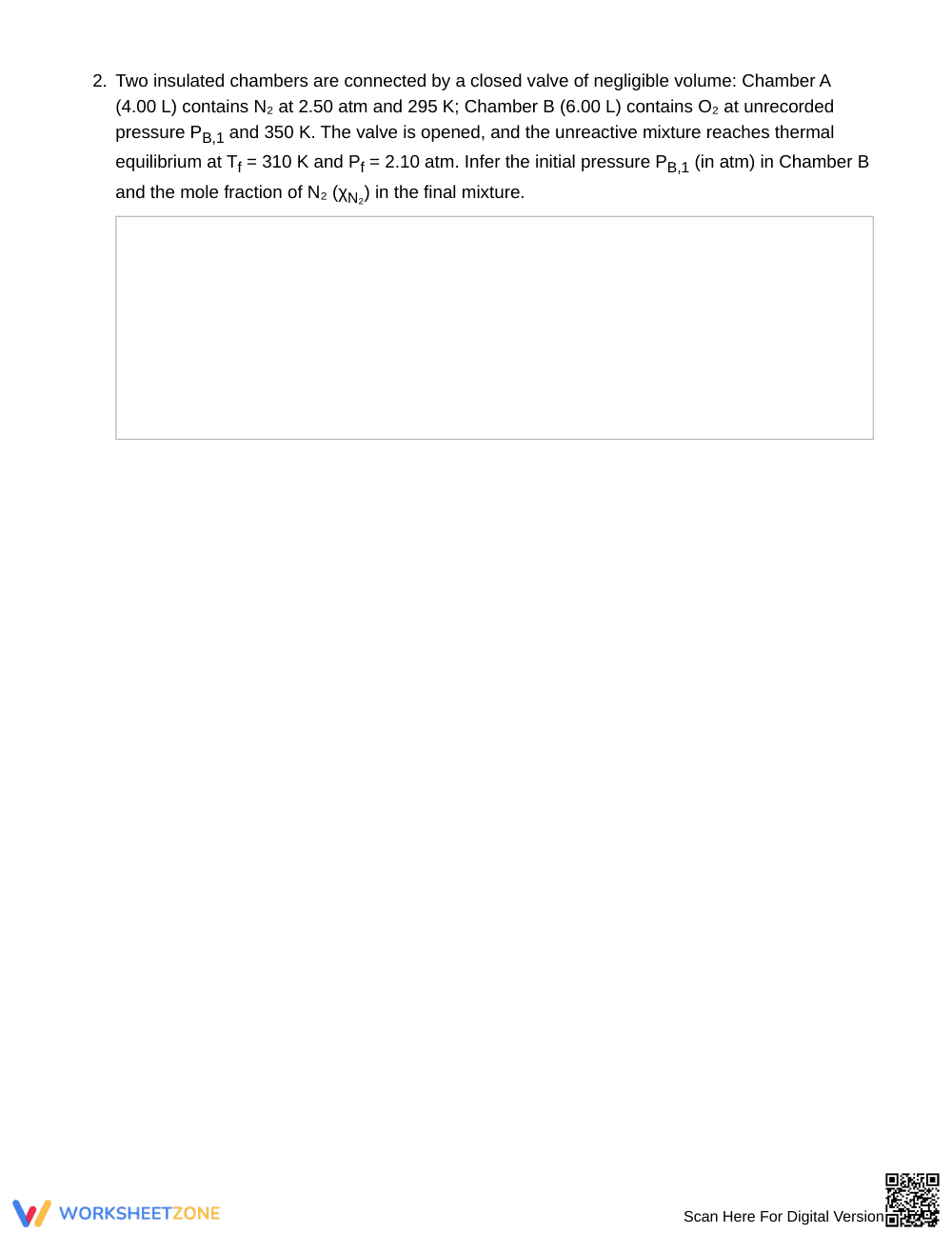
- Guided practice (Part A, Problems 1–2): Students analyze constrained multi-stage applications, identifying invariant quantities across isobaric, isochoric, and equilibrium mixing processes.
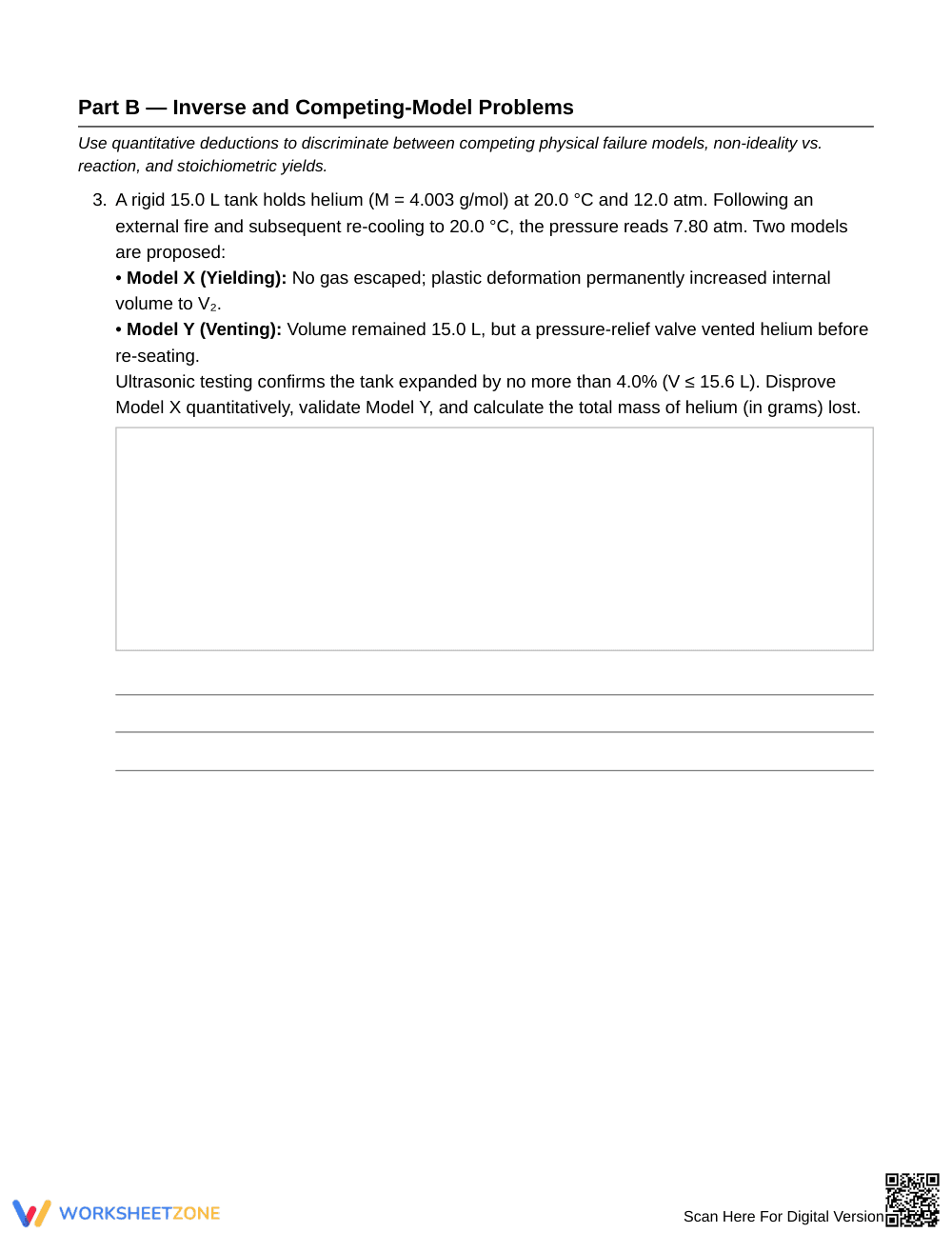
- Supported practice (Part B, Problems 3–5): Learners evaluate competing physical models, differentiating yielding from venting, testing Van der Waals non-ideality against dissociation, and solving combustion stoichiometry.
- Independent practice (Part C, Problem 6): Students complete a three-stage thermodynamic cycle table, verify vessel operating limits, and defend which state poses the greatest failure risk.
This sequence follows a gradual-release model (I Do, We Do, You Do), moving from structured tracking to independent defense.
Standards Alignment
This worksheet aligns with high school chemistry standards requiring quantitative modeling of gas systems, state variables, and thermodynamic relationships governed by ideal gas laws and kinetic molecular theory. Supporting standards integrate chemical stoichiometry and partial pressures. Both standard codes can be copied directly into lesson plans, IEP goals, or district curriculum mapping tools.
How to Use It
Use this worksheet after direct instruction on gas laws for collaborative problem-solving or summative assessment. For formative assessment, verify whether students identify invariant quantities before calculating unknown state variables. Expected completion time is 45 to 60 minutes.
Who It's For
This activity is designed for Grade 11 chemistry or AP Chemistry students requiring advanced multi-step practice beyond basic formulas. It offers extension via non-ideal gas comparisons and pairs effectively with thermodynamic cycle anchor charts.
According to research on scaffolded problem architecture by Fisher & Frey (2014), structuring multi-step quantitative tasks through explicit invariant identification and competing-model validation significantly enhances secondary chemistry students' conceptual retention and mathematical transfer. This Grade 11 chemistry worksheet targets high school physical science standards on gas behavior by requiring learners to calculate unknown thermodynamic state variables across complex, sequential multi-stage processes. Rather than relying on isolated formula substitution, students systematically evaluate real-world physical constraints across 6 rigorous analytical tasks, ranging from isobaric heating and isothermal expansion to Van der Waals non-ideality corrections and stoichiometric combustion condensation. By progressing methodically from constrained state tracking to independent thermodynamic cycle calculations and mechanical vessel safety defense, the instructional design reinforces deep procedural fluency and evidence-based scientific argumentation, making it an exceptionally rigorous assessment tool for advanced secondary chemistry educators.


