


























Views
Downloads

Essential Gas Laws Worksheet | Grade 11 Chemistry
Paste this activity's link or code into your existing LMS (Google Classroom, Canvas, Teams, Schoology, Moodle, etc.).
Students can open and work on the activity right away, with no student login required.
You'll still be able to track student progress and results from your teacher account.
Mastering two-state gas systems requires high school chemistry students to systematically isolate variables, convert units, and apply kinetic molecular theory. This five-page worksheet delivers ten targeted chemistry problems that build rigorous computational fluency with Boyle's, Charles's, Gay-Lussac's, and Avogadro's laws, helping students connect quantitative problem-solving directly to particle-level physical behaviors.
At a Glance
- Grade: 11 · Subject: Chemistry
- Standard: State Physical Science Standards — Calculate changes in gas pressure, volume, temperature, and moles.
- Skill Focus: Apply a Single-Variable Gas Law
- Format: 5 pages · 10 problems · Answer key included · PDF
- Best For: Independent practice and unit review
- Time: 45–60 minutes
What's Inside
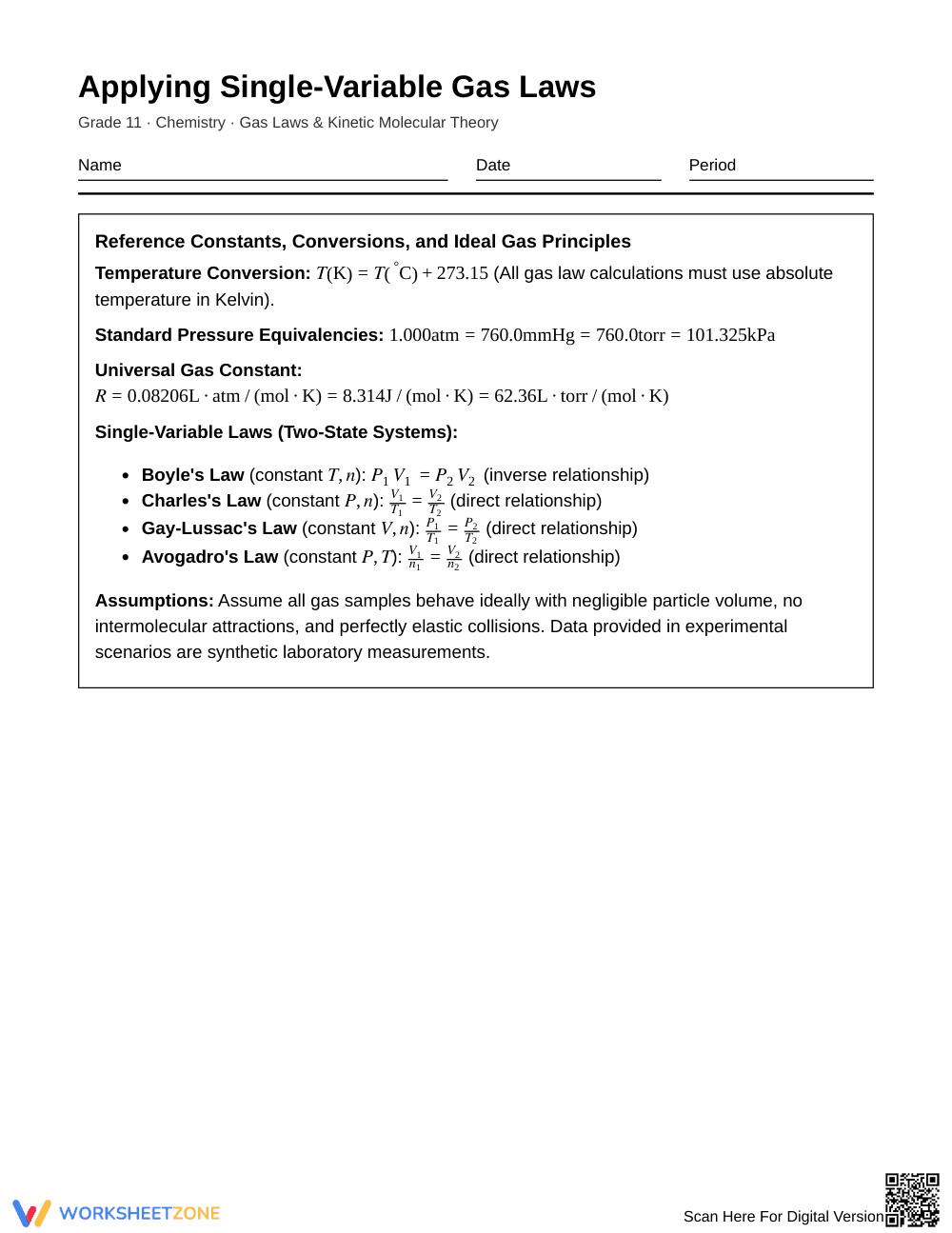
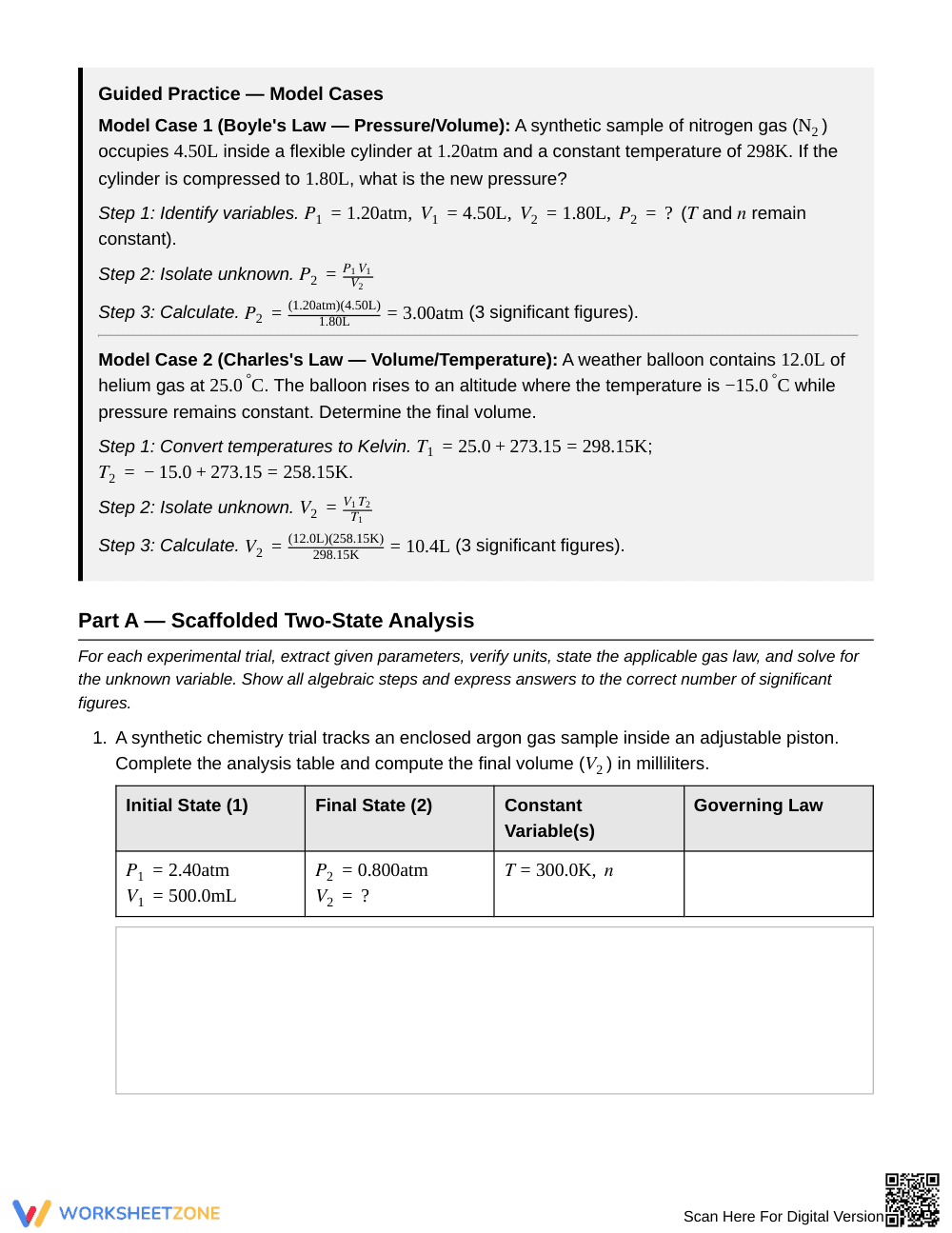
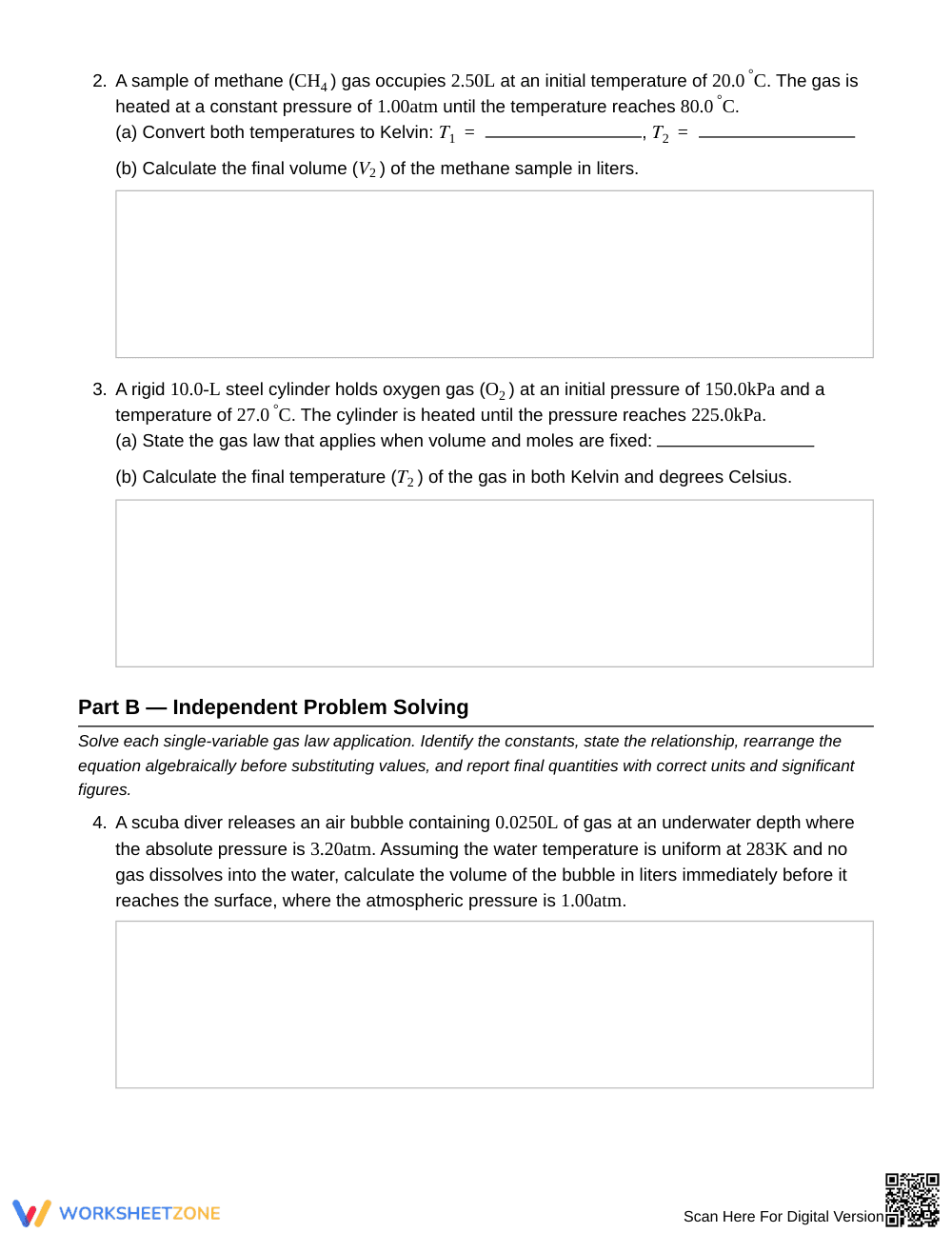
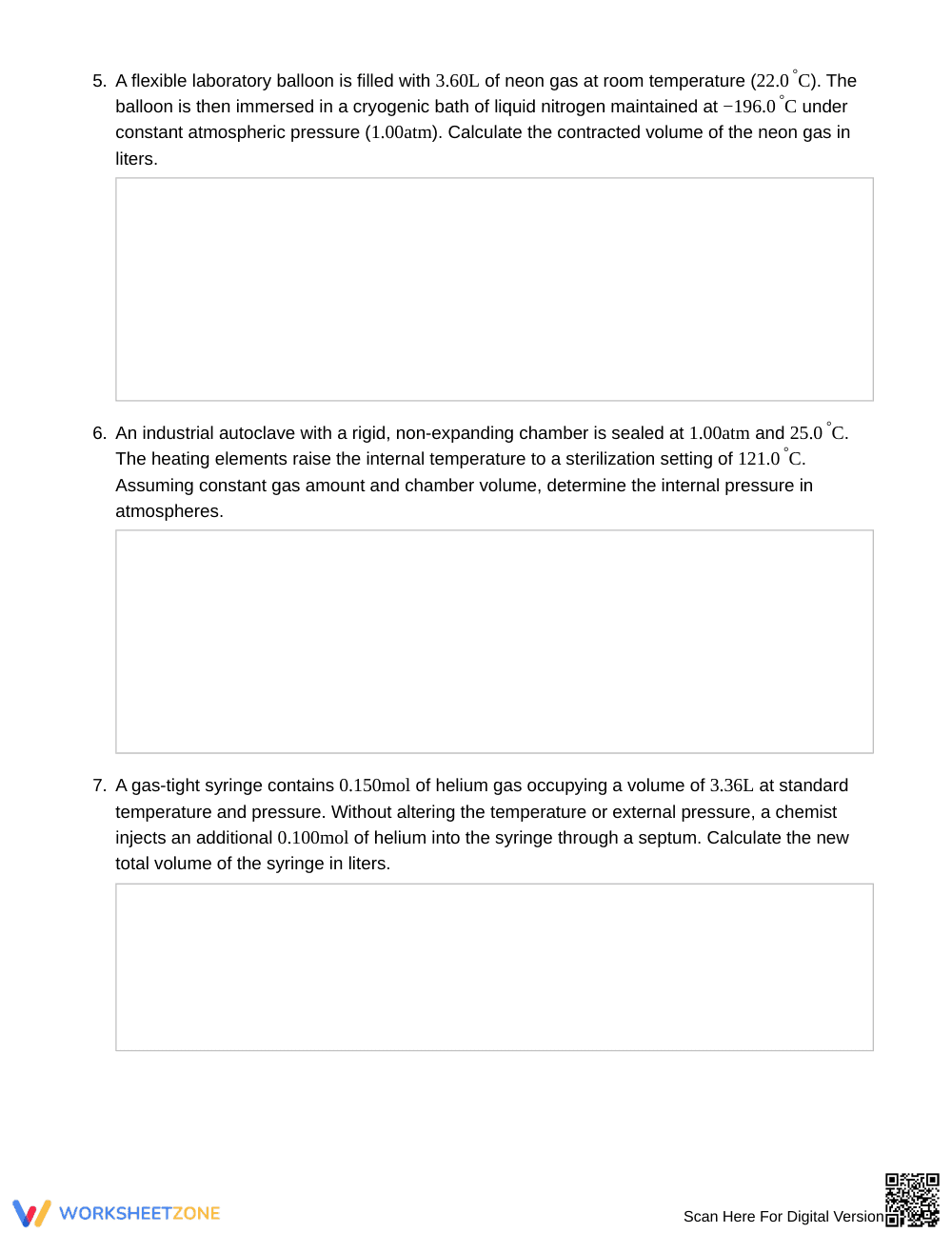
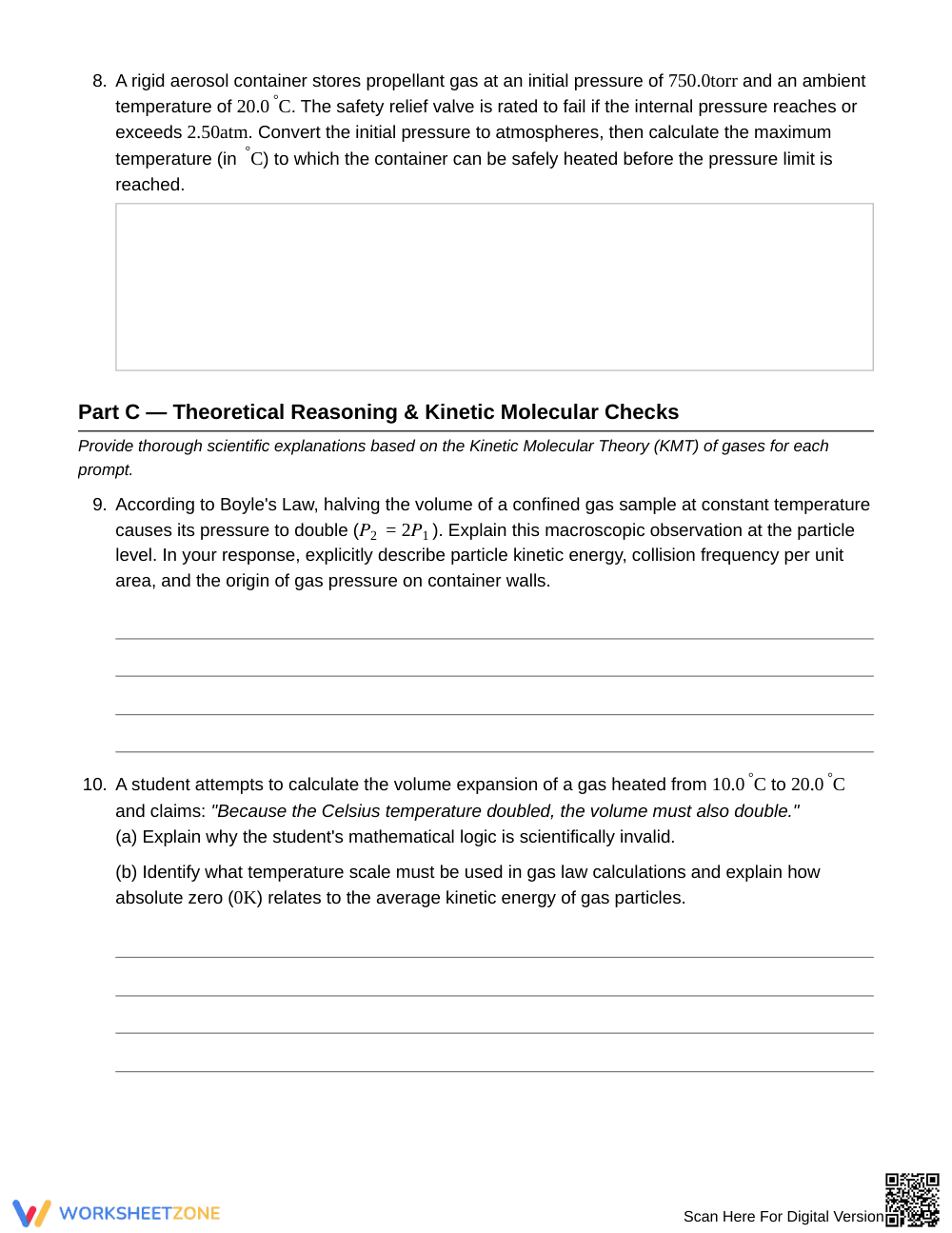
This comprehensive five-page chemistry packet opens with an essential reference table featuring conversion formulas, absolute temperature guidelines, and standard pressure values. Students study two worked model cases before tackling three scaffolded table-based problems, five multi-step word problems, and two qualitative kinetic molecular theory prompts. A complete four-page teacher answer key provides full algebraic derivations and significant figure checks.
Skill Progression
- Guided practice: Two complete model cases demonstrate step-by-step algebraic isolation and mandatory Celsius-to-Kelvin temperature conversions for pressure-volume and volume-temperature systems.
- Supported practice: Part A includes three scaffolded trials utilizing structured data tables where students extract initial and final states, identify constant variables, and state the governing equation.
- Independent practice: Parts B and C present five authentic industrial and laboratory scenarios alongside two conceptual kinetic molecular theory analyses requiring zero teacher prompting.
This sequence mirrors the gradual-release I Do, We Do, You Do instructional framework to build independent computational stamina.
Standards Alignment
Aligned with high school chemistry expectations, this resource requires students to plan and conduct investigations or utilize mathematical representations to explain relationships among volume, pressure, temperature, and gas quantity. Supporting chemistry standards focus on describing how microscopic collisions produce macroscopic observable pressure. Both standard codes can be copied directly into lesson plans, IEP goals, or district curriculum mapping tools.
How to Use It
Deploy this packet directly after initial direct instruction on gas laws. During individual seatwork, conduct formative spot-checks at Part A, verifying that students convert Celsius temperatures into Kelvin before performing calculations. Alternatively, assign Part B as a post-lab activity following a syringe or balloon expansion experiment. Most high school learners complete the full problem set within 45 to 60 minutes.
Who It's For
This worksheet serves general and honors Grade 11 Chemistry students preparing for unit assessments. Built-in constants and model cases assist students who need calculation scaffolds, while the open-ended conceptual explanations in Part C challenge advanced thinkers. Pair this resource with a visual Kinetic Molecular Theory simulation or an anchor chart tracking state variables.
Explicit mathematical modeling in secondary chemistry instruction directly enhances students' quantitative literacy and conceptual retention. According to Fisher & Frey (2014), the gradual-release framework equips secondary learners with the metacognitive structures required to move successfully from teacher-facilitated tasks to unassisted problem solving. By combining worked demonstrations with structured variable extraction tables, this gas laws instructional resource bridges the gap between mechanical formula substitution and deep kinetic understanding. Students must not only calculate numerical values for pressure, volume, temperature, and molar amounts, but they must also articulate how particle collision frequencies generate macroscopic pressure changes. Grounding physical science coursework in structured problem solving ensures that eleventh-grade learners build transferable analytical competencies. Teachers can rely on this systematic progression to reinforce consistent algebraic manipulations across diverse two-state gas law scenarios while supporting long-term science achievement.


