


























Views
Downloads

Essential Gas Laws PVT Data Worksheet | Grade 11 Chemistry
Paste this activity's link or code into your existing LMS (Google Classroom, Canvas, Teams, Schoology, Moodle, etc.).
Students can open and work on the activity right away, with no student login required.
You'll still be able to track student progress and results from your teacher account.
This rigorous Grade 11 chemistry worksheet equips students to interpret empirical pressure, volume, and temperature data through structured scientific inquiry. Learners analyze real-world laboratory trials to derive Boyle's and Charles's gas laws, calculate thermodynamic state changes using the ideal gas equation, and evaluate physical boundary conditions where real gas behaviors diverge from ideal mathematical models.
At a Glance
- Grade: 11 · Subject: Chemistry
- Standard: Analyze and interpret empirical thermodynamic data to quantify relationships among pressure, volume, and temperature
- Skill Focus: Interpret Pressure-Volume-Temperature Data
- Format: 5 pages · 10 problems · Answer key included · PDF
- Best For: Thermodynamics laboratory data analysis, gas laws practice, and model evaluation
- Time: 45–60 minutes of active inquiry
What's Inside
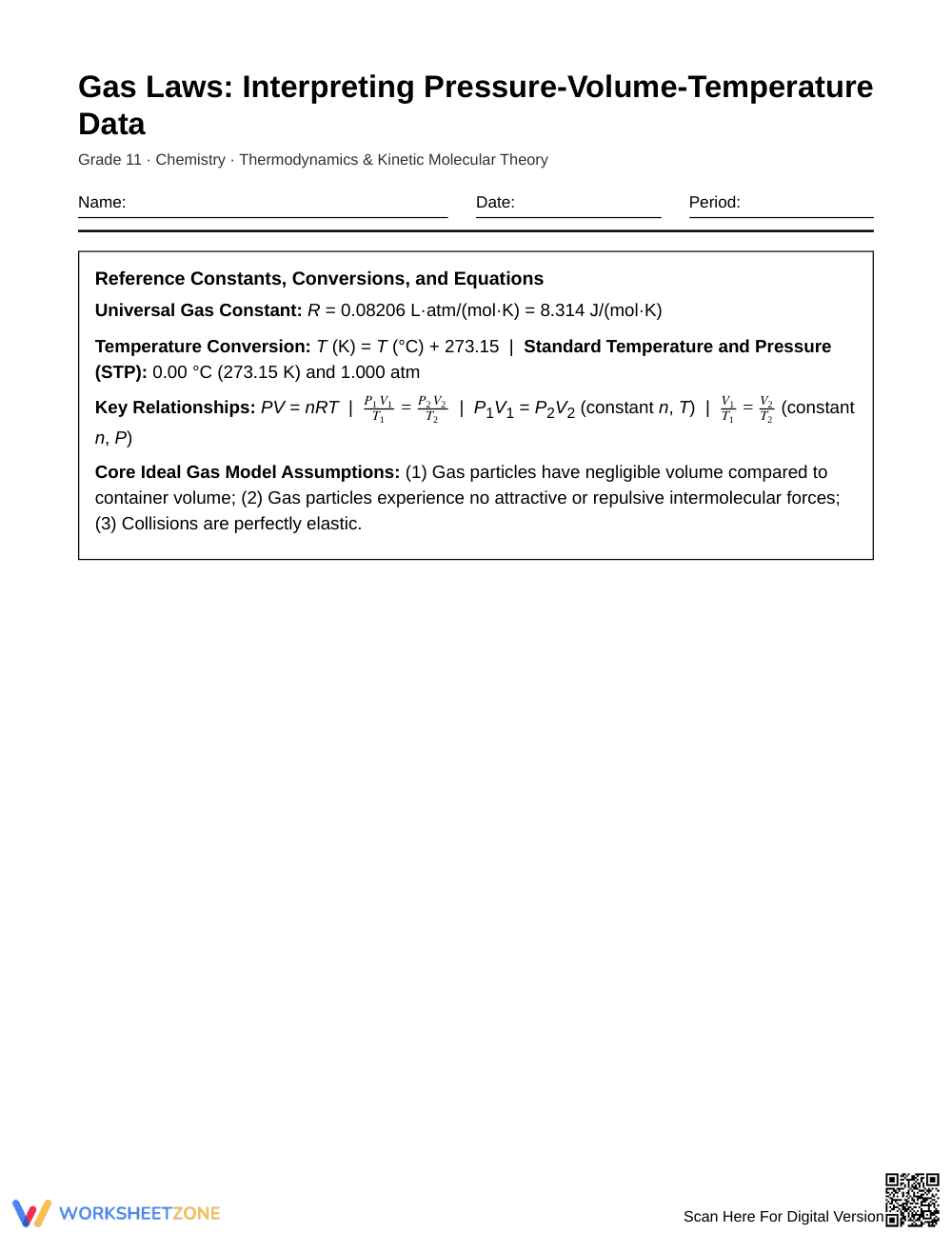
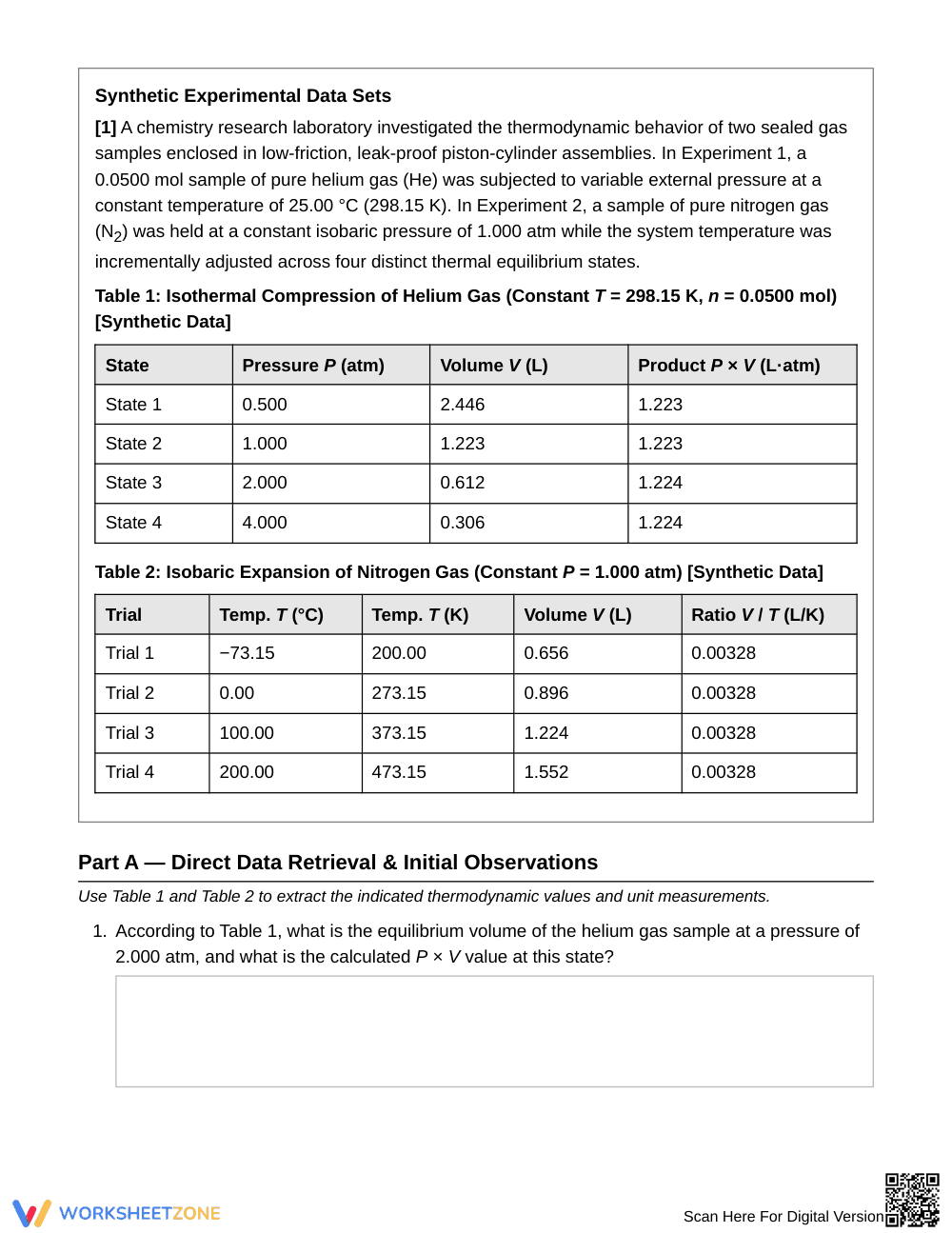
Spanning 5 total pages, this resource provides 10 structured problems grounded in two comprehensive synthetic laboratory data sets: isothermal helium compression and isobaric nitrogen expansion. It includes a complete reference table of fundamental gas constants, conversion factors, and kinetic molecular theory assumptions. A detailed 3-page answer key provides step-by-step mathematical setups, significant-figure solutions, and complete conceptual explanations for advanced real gas analysis.
Skill Progression
- Guided practice (Part A, Problems 1–2): Students retrieve discrete pressure, volume, and absolute temperature values directly from controlled experimental tables with minimal cognitive friction.
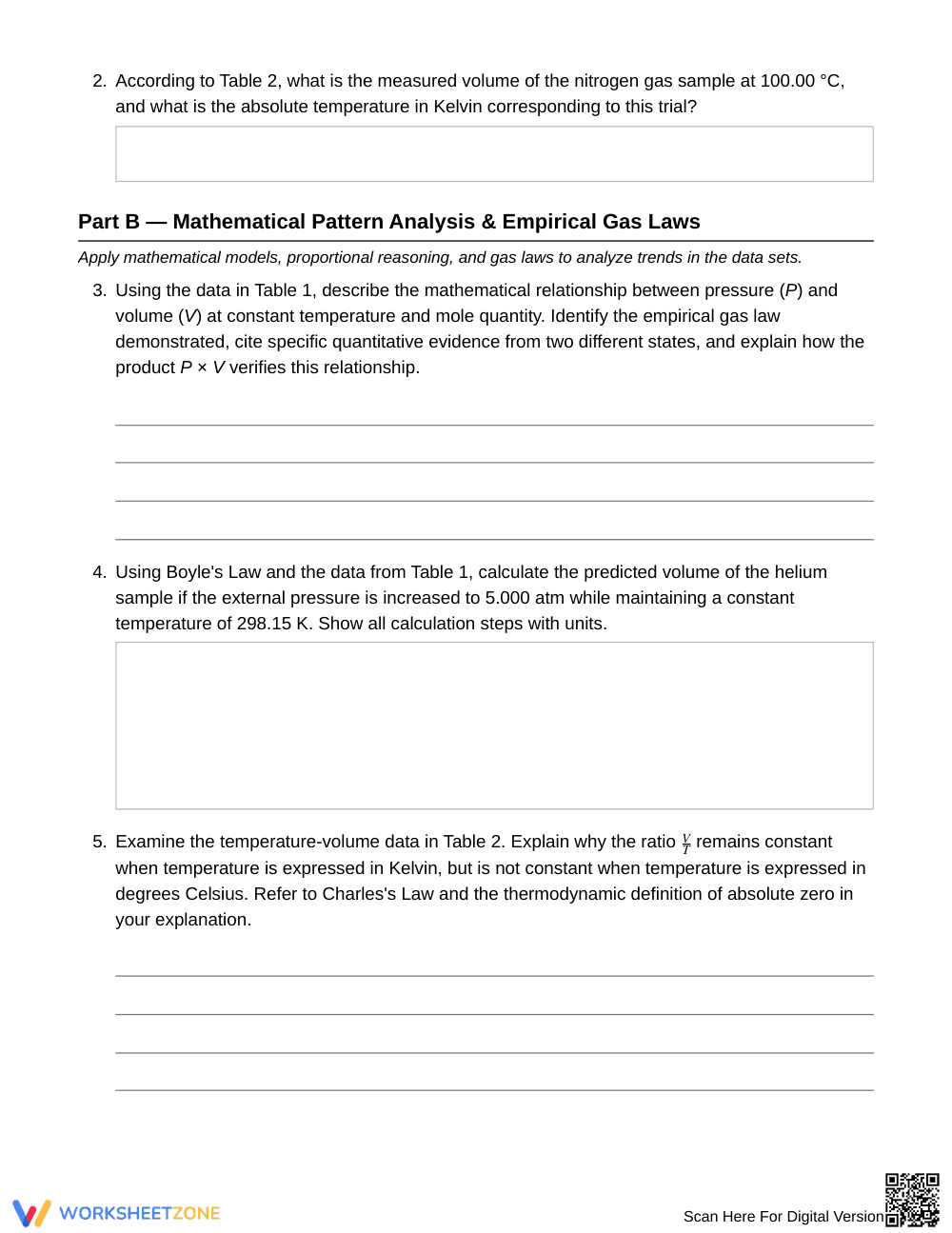
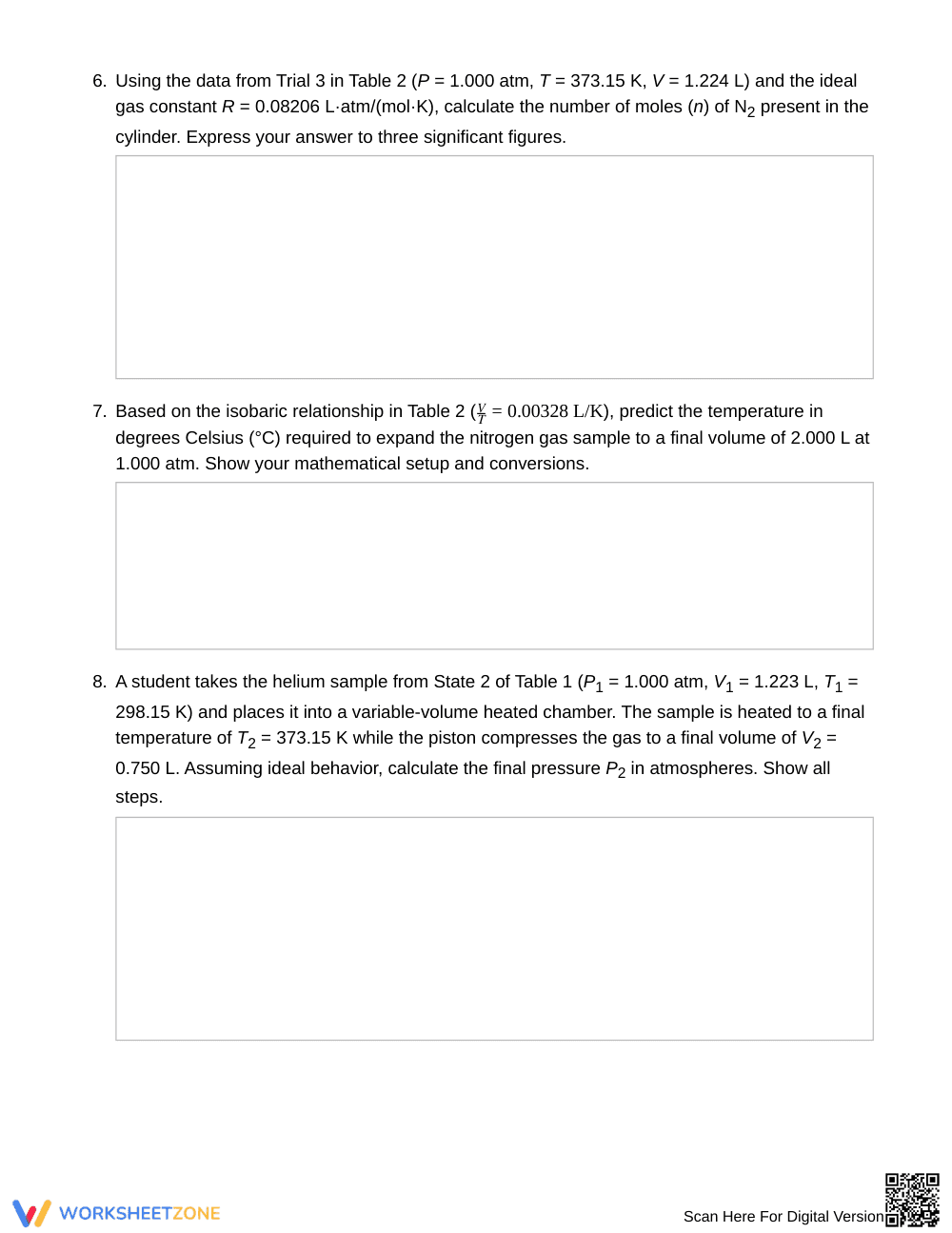
- Supported practice (Part B, Problems 3–8): Students apply mathematical models, verify inverse and direct proportionality, compute molar quantities using PV=nRT, and calculate combined gas law shifts with provided reference formulas.
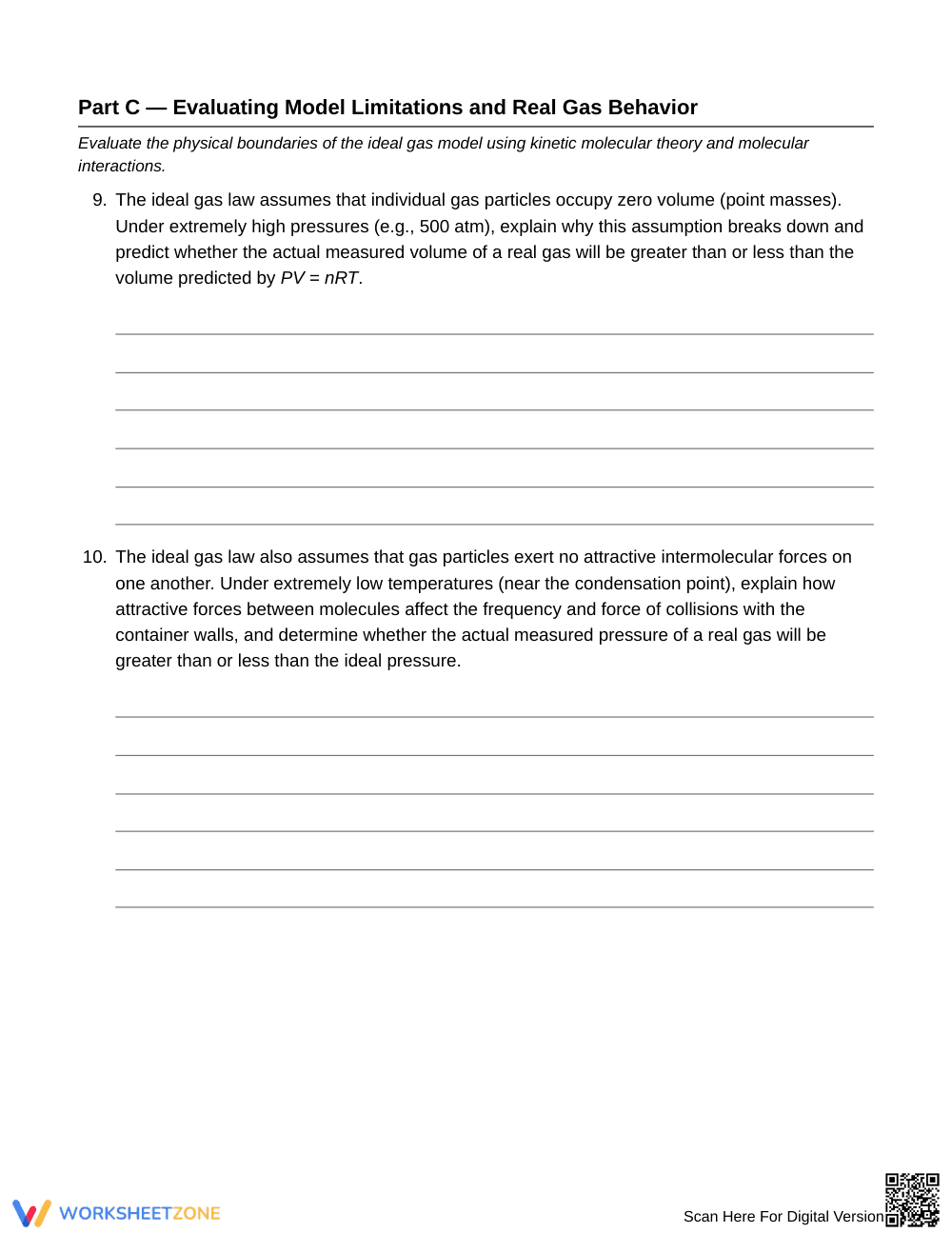
- Independent practice (Part C, Problems 9–10): Students evaluate the theoretical limitations of the ideal gas model, applying kinetic molecular theory to predict deviations under extreme conditions.
This systematic design reflects the gradual-release framework, shifting students smoothly from scaffolded data extraction to autonomous thermodynamic reasoning.
Standards Alignment
This instructional resource aligns with high school physical science core ideas regarding matter, energy, and thermodynamics. Students analyze quantitative evidence to demonstrate Boyle's and Charles's empirical laws and predict macroscopic gas behavior using kinetic molecular models. Both standard codes can be copied directly into lesson plans, IEP goals, or district curriculum mapping tools.
How to Use It
Deploy this worksheet after direct instruction on the kinetic molecular theory or as a guided inquiry transition following gas law demonstrations. For formative assessment, examine students' Kelvin conversions in Part B to catch additive versus multiplicative scaling errors before moving to stoichiometry. The 10 problems require approximately 45 to 60 minutes, functioning effectively as collaborative partner work or an independent post-lab application.
Who It's For
This problem set serves Grade 11 chemistry, honors physical science, and introductory AP Chemistry students seeking mastery over gas behavior. The data tables support developing math learners, while the boundary-evaluation prompts challenge advanced thinkers. Pair this resource directly with a gas properties simulation or laboratory pressure-sensor demonstration.
According to Fisher & Frey (2014), structured data analysis tasks that bridge concrete observational evidence with formal mathematical modeling significantly accelerate scientific literacy and domain-specific problem-solving. This 10-problem Grade 11 chemistry resource targets the core physical science standard on gas behavior by having students interpret pressure-volume-temperature data across multiple experimental representations. By engaging directly with synthetic laboratory data sets, students unpack the inverse pressure-volume relationship of Boyle's Law and the direct temperature-volume proportionality of Charles's Law. Furthermore, learners calculate state variables using the ideal gas constant and critically examine model breakdown under high-pressure and low-temperature conditions. Fisher & Frey (2014) emphasize that pairing explicit proportional reasoning with conceptual molecular explanations builds durable conceptual understanding, ensuring students move beyond rote algorithmic substitution into authentic thermodynamic analysis suitable for advanced secondary science coursework and laboratory inquiry.


